R&D / Analytical Teams
Define chemical identity, assay basis, impurity profile, reference standard and intended application.
AIHerba® — the specialty botanical ingredient brand of Shaanxi Zhonghong Investment Technology Co., Ltd. — supplies standardized extracts, selected high-purity compounds and specialty materials for industrial formulation and life-science R&D.
Match identity, assay, impurities and intended use to the required grade before requesting a bulk quote. Pharmaceutical-use materials require separate product- and site-specific qualification.
Define chemical identity, assay basis, impurity profile, reference standard and intended application.
Review the offered lot, manufacturer and site scope, documentation, pilot volume and delivery destination.
From molecular identity verification to commercial-scale supply, AIHerba® delivers GMP-controlled pharmaceutical ingredients with analytical transparency and global documentation support.

Material identity and manufacturing route are distinct from regulatory grade. Choose the appropriate family before setting acceptance criteria.
Botanical identity, plant part, extraction solvent, DER, carrier and marker assay.
Chemical form, CAS identity, assay basis, related substances and stereochemistry where relevant.
Production route, purification, microbial control and process-related impurity review.
Confirm exact chemical form, intended process role and impurity carryover. An intermediate is not automatically an API.
Define analytical identity and experimental purpose. Research-use materials are not qualified for human or veterinary administration.
For an actual drug substance or excipient, confirm applicable monograph, site scope and dossier requirements before an offer.
A high assay, an HPLC chromatogram or a general GMP statement alone does not establish pharmaceutical eligibility.
Explore the existing product catalog. Listed specifications are starting points for technical review, not a guarantee of lot availability or regulatory status.
Compare plant part, ginsenoside profile, extract ratio and marker method.
Catalog lists multiple HPLC-standardized grades up to 98%; confirm actual assay basis and source.
Catalog lists ≥97% HPLC and a JP18 reference. Confirm salt form, water content and full applicable monograph tests.
Confirm offered purity, stereochemical identity, manufacturing route and process impurity profile.
Catalog lists 99% HPLC; request chiral identity and purity evidence where required.
Catalog lists ≥98% HPLC; confirm exact grade, assay basis, isomer profile and storage.
For pharmaceutical-use inquiries, define molecular weight, intended route, site qualification and relevant impurity requirements.
Review root identity, withanolide method, carrier and extract composition.
For research peptides or regulated drug substances, use a separate qualification inquiry. Do not substitute catalog research grades for a pharmaceutical or human-use material.
Life science and pharmaceutical ingredients include high-purity compounds, intermediates, fermentation products, and research-grade actives used in biopharmaceutical development, laboratory research, and regulated formulation environments. AiHerba provides consistent quality supported by validated analytical methods (HPLC/GC/ICP-MS), ensuring batch-to-batch reproducibility required by R&D teams and industrial formulators.
These ingredients support metabolic research, drug delivery development, molecular biology, and advanced health solutions. AiHerba ensures regulatory compliance documentation including COA, MSDS, TDS, and, when requested, process flowcharts for industrial clients. This category is ideal for global manufacturers and research institutions requiring specialty compounds with controlled purity levels and strong technical support.
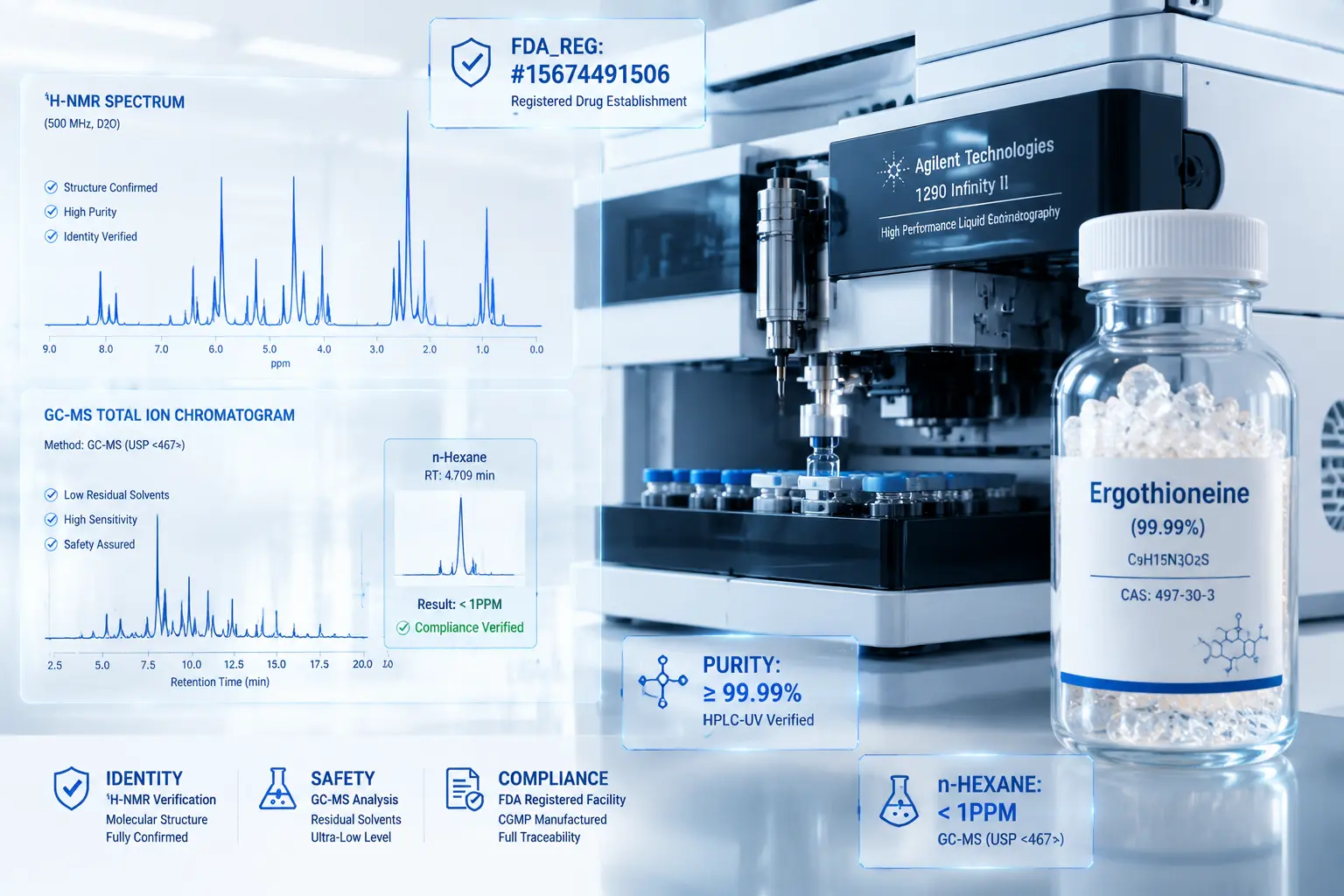
Documentation, testing, samples and DDP options depend on the selected grade and destination.
Ask for a specification with defined test methods, acceptance limits and reporting basis. Chromatographic area percentage and mass assay are not interchangeable without a justified method.
| Material class | Key identity / assay | Additional qualification |
|---|---|---|
| Botanical extract | HPTLC or fingerprint; marker-specific HPLC as appropriate | Species, part, DER, carrier, pesticides and contaminants |
| Purified small molecule | HPLC assay; MS, NMR or other orthogonal identity where appropriate | Related substances, salt form, water, isomers |
| Fermentation-derived compound | Identity and assay; chiral method when relevant | Process impurities, microbial controls, production route |
| Polymer / excipient candidate | Identity, molecular weight distribution or viscosity | Grade-specific microbial and process impurities; endotoxin only where required |
| Research material | Defined identity, purity method, reference or lot information | Intended research use; no clinical or human-use qualification inferred |
| Drug substance candidate | Applicable monograph or justified specification | Manufacturer/site scope, GMP evidence, relevant dossier and impurity controls |
Request the actual lot COA and method details. Results reported on an as-is, dried or anhydrous basis must be compared on the same basis.
For regulated procurement, use the exact product name, destination, intended route and applicable regulatory framework. Requirements differ by market and product.
| Term | What to verify | What it does not establish |
|---|---|---|
| USP–NF / Ph. Eur. / JP | Applicable current monograph, all required tests, acceptance criteria and lot evidence | One assay result does not demonstrate full compendial compliance. |
| API / drug substance | Intended role in drug manufacture, material and site qualification | High purity alone does not make a material an authorized drug substance. |
| ICH Q7 GMP | Applicable manufacturing activities, site identity and current quality evidence | Food or supplement GMP is not automatically API GMP. |
| DMF | Jurisdiction, type, holder, product, status and authorization where required | A filing is not itself product approval. |
| CEP | Current certificate, holder, scope and any conditions | Not a GMP certificate or batch COA. |
| FDA establishment registration | Correct registration category, site, activity and current record | Registration does not establish product approval. |
No DMF, CEP, drug-establishment registration or API GMP qualification is asserted for the whole portfolio. Availability must be confirmed for the exact product and manufacturer.
Match each test to the chemical structure, manufacturing process and intended use. The following is a qualification framework, not a statement that every test is performed on every lot.
HPLC fingerprints, LC-MS, NMR or chiral methods as justified. An identity test does not rule out every possible isomer or impurity.
Select solvents from the actual process and apply relevant limits; review headspace GC or other suitable methods and LOQ. ICH Q3C / USP <467> where applicable.
ICP-MS or justified methods; evaluate source, intended use and applicable limits. ICH Q3D is a drug-product risk framework, not a universal raw-material ppm limit.
For applicable drug substances, assess process and degradation impurities; consider ICH Q3A and M7 where relevant.
Select microbial limits, bioburden or endotoxin criteria based on material, processing and intended route. Sterility is not inferred from purity.
Request evidence for storage, retest or expiry, packaging and stability-indicating methods. ICH Q1A(R2) is relevant where applicable to drug substances/products.
Method validation principles: ICH Q2(R2) and Q14 where applicable. “Not detected” requires a meaningful detection or quantitation limit; it does not mean absolute zero.
Use a staged qualification process to align technical evidence and commercial terms before placing a production order.
Exact identity, grade, intended use, destination, required monograph and acceptance limits.
Request lot COA, specification, TDS/SDS where relevant, origin and process summary; agree on any additional documentation.
Agree the test plan, sample quantity, reference method and whether sample and production lots must match.
Confirm manufacturing entity, applicable certificates, scope, traceability and audit or dossier access subject to agreement.
Confirm actual MOQ, packaging, lead time, Incoterms and logistics feasibility. DDP is destination- and product-dependent.
Agree notification needs for source, process, site or specification changes; retain records as appropriate.
Contact technical sales to initiate document review and quotation.
No. Standardized botanical, high-purity, research-use and pharmaceutical-use materials have different qualification requirements. Confirm the specific grade and intended use.
Provide the required current monograph and product identity. Full applicable tests and lot documentation must be reviewed before confirming conformity.
Availability depends on the exact material, holder, manufacturer, jurisdiction and authorization. Request a product-specific review; no portfolio-wide availability is implied.
Area normalization and quantitative mass assay may use different calculations and reference standards. Request the method and reporting basis.
Research-use materials are not offered as qualified human-use ingredients. A separate lawful use and material qualification review is necessary.
Specify the tests, methods and documents required. Availability depends on the offered grade, lot and confidentiality arrangements.
Send the exact product, grade, intended use, destination, quantity, required documents and testing limits. Sample arrangements and lead time are confirmed with the offer.
Send material name / CAS, target specification, intended use and market, required monograph or dossier, sample or bulk quantity and delivery location. We can then review the applicable documentation and commercial options.
These external resources explain qualification principles. They are not evidence of AIHerba certification or regulatory authorization.