AIHERBA® / STANDARDIZED BOTANICAL SUPPLY

Bulk Herbal Extracts Manufacturer & Supplier in China

AIHerba®, operated by Shaanxi Zhonghong Investment Technology Co., Ltd. , is a China-based B2B manufacturer and supplier of standardized herbal extracts and natural plant extract powders for nutraceutical, functional food, beverage and personal care ingredient buyers.

We support bulk ingredient sourcing with botanical identity and plant-part review, defined active-marker specifications, suitable analytical methods including HPLC, UV or GC where applicable, and product-specific batch documentation.Custom extraction, carrier preferences, sample evaluation and commercial supply terms are reviewed according to each ingredient and project.

Botanical Identity Marker & Assay Method DER & Carrier Review Batch COA
Need help matching a specification? WhatsApp Technical Sales Online Inquiry
BOTANICAL SOURCING / ENGINEERING AIHERBA / 01
Illustrative botanical ingredient extraction and laboratory analysis workflow SOURCE IDENTITY ASSAY REVIEW
What Buyers Can Review
Source Identity Defined Marker Batch Documents

Illustrative botanical engineering graphic. Not a production photograph or analytical test result.

Bulk Herbal Extract Procurement Snapshot

Confirm requirements before commercial approval

Botanical Identity

Latin name, plant part, source material and identification approach.

Marker & Assay

Active marker, target content, analytical method and reporting basis.

Extraction & DER

Extraction route, native ratio, carriers and powder properties.

Bulk Supply Terms

Sample options, batch COA, MOQ, packaging and delivery quotation.

AIHERBA® / TWO SOURCING PATHWAYS

Choose Your Herbal Extract Sourcing Pathway

Whether you need an established standardized herbal extract grade or a tailored botanical ingredient specification, AIHerba® helps your procurement and technical teams define the relevant quality, analytical and commercial requirements before ordering.

PATHWAY 01
STANDARD GRADE

Standardized Grade Procurement

SPECIFICATION MATCHING / BULK PURCHASING

Source an established herbal extract specification by botanical identity, standardized marker, assay method and required quantity.AIHerba® can review available grades, relevant batch documentation and commercial supply options for the requested material.

Ideal for: Procurement managers and ingredient distributors who already know their required material, specification or active-marker content.

Share Your Procurement Requirements

  • Ingredient / Botanical Name
  • Plant Part, if applicable
  • Target Marker & Assay
  • Required Specification
  • Purchase Quantity
  • Destination Country
EXPECTED TECHNICAL & COMMERCIAL REVIEW

Suitable grade availability, applicable specification, batch COA or technical files where available, sample options, MOQ, quotation and estimated dispatch arrangements.

Request Grades, COA & Pricing

Grade and batch availability are subject to confirmation.

PATHWAY 02
CUSTOM SPECIFICATION

Custom Extraction & Specification Engineering

FORMULATION TARGETS / FEASIBILITY REVIEW

Submit a targeted botanical extract specification when standard grades do not fully match your formulation or analytical requirements.We can assess proposed extraction routes, active-marker targets, native DER, carriers, particle size and relevant process constraints before discussing sample or pilot feasibility.

Ideal for: R&D teams, formulators and technical buyers who require a defined target outside established commercial specifications.

Define Your Technical Target

  • Botanical Species & Part
  • Target Marker / Purity
  • Preferred Assay Method
  • Native DER / Solvent
  • Carrier / Particle Size
  • Project Quantity & Market
EXPECTED ENGINEERING REVIEW

Target specification analysis, process suitability, analytical method alignment, manufacturing feasibility, potential pilot requirements and indicative commercial considerations.

Submit Custom Specification

Custom targets require technical feasibility review before acceptance.

How We Review Your Requirement

Initial technical and sourcing assessment
STEP 01 / DEFINE

Identify the Required Grade

Confirm the botanical source, intended application, marker definition, analytical method and target specification.

STEP 02 / MATCH

Evaluate Technical Fit

Compare available grades or assess proposed custom manufacturing requirements, document scope and sample feasibility.

STEP 03 / QUOTE

Confirm the Next Supply Stage

Review sample options, pilot considerations, commercial quantity, MOQ, delivery terms and quotation.

Unsure which sourcing pathway fits? WhatsApp Technical SalesOnline Inquiry Form
AIHERBA® / STANDARDIZED HERBAL PLATFORMS

Standardized Herbal Extracts by Botanical Source & Active Marker

Explore representative natural plant extracts supplied for professional B2B ingredient sourcing.Each botanical platform is organized around plant identity, source part, relevant marker compounds and suitable analytical approaches, helping buyers compare specifications before requesting a batch COA or commercial quotation.

Botanical Identity Plant Part Defined Marker Assay Method Batch Documentation
PLATFORM
01 / 06

Adaptogenic Root Extracts

ROOT-SOURCED STANDARDIZATION Ashwagandha Root Extract Withania somnifera (L.) Dunal · Root

Root-derived botanical extracts require clear control of plant part, marker definition and the assay method used to assess withanolide content.

TARGET MARKER Withanolides
METHOD REVIEW HPLC / Marker Profile
BUYER QUALIFICATION FOCUS

Verify root-only sourcing, individual versus total withanolide definitions, and the analytical basis stated on the offered COA.

PLATFORM
02 / 06

Polyphenol-Rich Leaf Extracts

DEFINED LEAF PHENOLIC MARKERS Olive Leaf Extract Olea europaea L. · Leaves

Leaf extracts may be standardized to individual phenolic compounds, rather than an undefined total antioxidant or polyphenol value.

TARGET MARKER Oleuropein
METHOD REVIEW HPLC Assay
BUYER QUALIFICATION FOCUS

Distinguish the oleuropein assay from total phenolics or hydroxytyrosol content. Confirm the offered analytical method and relevant batch data.

PLATFORM
03 / 06

Fruit Peel & Phenolic Extracts

STANDARDIZED FRUIT-DERIVED MARKERS Pomegranate Peel Extract Punica granatum L. · Fruit Peel

Pomegranate peel contains multiple phenolic constituents. Extract standardization should define the actual analyte rather than equating all polyphenol measurements.

TARGET MARKER Ellagic Acid
METHOD REVIEW HPLC / Method Basis
BUYER QUALIFICATION FOCUS

Confirm whether the method reports free ellagic acid, a hydrolysis-derived total, or another defined assay. These results are not automatically interchangeable.

PLATFORM
04 / 06

Saponin & Glycoside Extracts

MULTI-COMPONENT MARKER CONTROL Ginseng Root Extract Panax ginseng C.A. Mey. · Root

Ginseng contains a complex ginsenoside profile. Its standardized specification depends on which compounds are included in the reported assay.

TARGET MARKERS Ginsenosides
METHOD REVIEW HPLC / Defined Sum
BUYER QUALIFICATION FOCUS

Review the specified ginsenosides, individual markers and total-content calculation. The same percentage may not represent an identical analytical definition.

PLATFORM
05 / 06

Traditional Herbal Ratio Extracts

DER / PLANT-PART DEFINITION Dandelion Root Extract Taraxacum officinale · Root

Traditional ratio extracts require clear definitions of the botanical raw material, plant part, extraction ratio and finished-powder composition.

GRADE DEFINITION DER / Plant Part
METHOD REVIEW Product-Specific
BUYER QUALIFICATION FOCUS

Distinguish a nominal extraction ratio from quantified active content. Confirm carrier inclusion and whether the DER refers to the native or finished extract.

PLATFORM
06 / 06

Formulation-Ready Seed Botanicals

FRACTION & POWDER PROPERTY REVIEW Fenugreek Seed Extract Trigonella foenum-graecum L. · Seed

Seed-derived ingredients may contain distinct saponin, carbohydrate and fiber fractions requiring different analytical approaches and formulation assessments.

FRACTION OPTIONS Saponins / Galactomannans
METHOD REVIEW Fraction-Specific
BUYER QUALIFICATION FOCUS

Specify the exact quantified fraction. Confirm suitable assay methods, carrier composition, particle properties and water dispersion requirements.

Need Another Botanical Species or a Different Marker Specification?

Share the botanical name, plant part, target marker, preferred test method and purchase quantity. AIHerba® can review suitable ingredient grades and available technical documentation for your project.

Technical Scope: Featured products represent botanical ingredient platforms, not guaranteed current commercial batch specifications. Marker definitions, assay methods, carrier content, sample availability, MOQ and destination-market suitability must be confirmed for the selected ingredient and grade.

AIHERBA® / BOTANICAL SPECIFICATION ENGINEERING

Botanical Identity, Native DER & Marker Standardization

Two herbal extract powders with similar product names may differ significantly in botanical source, extraction ratio, marker definition, assay method, carrier content and physical properties.AIHerba® helps B2B buyers evaluate these technical parameters when comparing standardized herbal extract specifications, custom manufacturing targets and relevant batch documentation.

01 / IDENTITY

Botanical Identity & Plant Part

SOURCE AUTHENTICATION / SPECIES CONTROL

Accurate identification starts with the botanical taxon and the plant part used for extraction.A root-derived extract should not be treated as equivalent to a leaf, seed or whole-herb extract without supporting evidence.

  • Scientific name and taxonomic identity
  • Plant part and raw-material source
  • Appropriate HPTLC, HPLC or other identity methods
BUYER CHECKPOINT Confirm species, plant part, source traceability and identification evidence for the offered material.
02 / EXTRACTION RATIO

Genuine (Native) DER

HERBAL INPUT / NATIVE EXTRACT OUTPUT

Genuine DER expresses the quantity of herbal starting material relative to the native extract obtained, excluding excipients added after extraction.It does not establish active-marker concentration.

  • Raw material quantity and fresh/dry starting basis
  • Native extract yield and genuine DER range
  • Extraction solvent identity and concentration
BUYER CHECKPOINT Ask whether the declared ratio refers to the genuine extract or the finished powder containing added excipients.
03 / ASSAY TARGET

Active & Analytical Markers

PRECISE ANALYTE DEFINITION

Marker specifications should clearly identify which compounds are measured.An individual constituent, a defined sum of compounds and a broad total-content assay are different analytical claims.

  • Individual versus total marker content
  • Reference standards and assay calculation
  • Reporting basis and target acceptance limits
BUYER CHECKPOINT Define the exact analyte and method before comparing two suppliers' reported percentages.
04 / METHOD

Analytical Method & Reporting Basis

HPLC / UV / GC / METHOD SUITABILITY

HPLC, UV and GC may be appropriate for different ingredient classes and analytical purposes.Their reported percentages are not automatically equivalent or interchangeable.

  • Method and analyte specificity
  • Reference material, calibration and result units
  • Dry-basis versus as-supplied reporting
BUYER CHECKPOINT Compare specifications using compatible methods and the same reporting basis wherever possible.
05 / COMPOSITION

Carrier & Excipient Disclosure

NATIVE SOLIDS / FINISHED POWDER

Maltodextrin, dextrin or other permitted excipients may be used for drying, powder handling or specification adjustment.The finished ingredient composition should be distinguished from the native extract.

  • Carrier identity and origin
  • Percentage and calculation basis
  • Allergen and formulation documentation where applicable
BUYER CHECKPOINT Specify whether carrier content is expressed as a percentage of finished powder or relative to native extract solids.
06 / PHYSICAL GRADE

Particle Size & Powder Properties

PSD / MOISTURE / DISPERSION

Two powders with the same marker specification may behave differently during blending, filling or liquid formulation.Physical properties should be evaluated separately from the assay result.

  • D10 / D50 / D90 and sieve information
  • Moisture and bulk-density targets
  • True solubility versus water dispersibility
BUYER CHECKPOINT Define test conditions and functional requirements; mesh size alone does not establish the full particle-size distribution.

Why a 10:1 Extract Is Not the Same as a 10% Marker Assay

Extraction ratio and marker concentration describe different aspects of herbal preparations. They cannot be substituted for one another when comparing commercial specifications.

EXTRACTION MASS RATIO 10:1

Genuine / Native DER

As a simplified example, a 10:1 genuine DER describes 10 mass units of herbal starting material relative to 1 mass unit of resulting genuine extract, on a clearly defined measurement basis.Post-extraction excipients are excluded from the genuine extract quantity.

QUANTIFIED MARKER CONTENT 10%

Defined Marker Assay

A 10% marker specification refers to the concentration of a defined constituent or constituent group measured by an appropriate analytical method.The result depends on the analyte definition, reporting basis and method used.

Critical Procurement Distinction

A 10:1 DER does not mean 10% active compounds, a tenfold biological potency or guaranteed equivalence between two manufacturers.For a meaningful comparison, request the botanical source, extraction solvent, genuine DER, declared carrier composition, specific marker assay and relevant batch results.

Educational illustration only. The displayed numbers are not specifications or batch results for any particular AIHerba® ingredient.

How to Prepare a Technically Complete RFQ

Provide the following information to help AIHerba® evaluate a standard herbal extract grade or a customized specification request.

STEP 01 / SOURCE

Identify the Botanical

Scientific name, plant part, starting material form, intended extraction route and destination market.

STEP 02 / SPECIFY

Define the Analytical Target

Marker compound, target assay, preferred analytical method, reporting basis, DER and permitted carriers.

STEP 03 / QUALIFY

Confirm Commercial Requirements

Intended application, required documents, sample or bulk quantity, destination and delivery preferences.

Need a Defined Herbal Extract Specification?

Share your botanical source, target marker, assay method, genuine DER, carrier limits and required quantity.AIHerba® can review suitable existing grades or evaluate custom specification feasibility before discussing samples and commercial supply.

Technical Scope: Genuine DER terminology is informed by internationally recognized herbal-preparation quality guidance. Applicability of pharmacopoeial or medicinal-product requirements depends on the material and market.Product specifications, carrier disclosure, analytical methods and batch results must be verified for the selected grade.For additional terminology, see theEMA Herbal Quality Guidance.

AIHERBA® / NATURAL PLANT EXTRACTION ENGINEERING

Natural Plant Extraction & Manufacturing Engineering

Manufacturing standardized herbal extracts requires more than concentrating botanical raw materials.AIHerba® supports ingredient-specific process assessment across botanical preparation, solvent selection, extraction, concentration, drying and quality verification.Process conditions are evaluated against the target marker, natural plant matrix, finished-powder specification and intended commercial application.

STAGE 01

Botanical Raw Material Identification

Establish the correct botanical species, plant part and starting-material characteristics before selecting the extraction process.

INCOMING QUALITY GATE Botanical identity, origin records, moisture, foreign matter and relevant raw-material risks.
STAGE 02

Cutting, Milling & Pretreatment

Adjust the plant matrix for extraction by considering particle size, surface area, moisture and the sensitivity of relevant constituents.

PREPARATION CONTROL Milling or cutting conditions, particle range, handling and suitability for the chosen extraction route.
STAGE 03

Controlled Botanical Extraction

Evaluate a suitable extraction route according to compound polarity, plant-matrix properties and the required marker profile.

PROCESS PARAMETERS Solvent composition, material-to-solvent ratio, temperature, time, extraction cycles and pH where applicable.
STAGE 04

Clarification, Concentration & Purification

Depending on the target grade, process streams may undergo filtration, separation, concentration or additional purification.

SEPARATION CONTROL Solids removal, marker recovery, concentration conditions and relevant thermal or oxidation exposure.
STAGE 05

Drying & Finished-Powder Engineering

Review an appropriate drying method and finished-powder composition with attention to thermal sensitivity, moisture, carriers and handling performance.

FINISHED-GRADE CONTROL Drying conditions, carrier disclosure, moisture targets, particle properties and packaging suitability.
STAGE 06

Batch Testing, Documentation & Release

Compare the finished extract with its agreed identity, assay, physical and relevant contaminant requirements before commercial release.

QUALITY REVIEW GATE Appropriate analytical methods, batch results, specification alignment and applicable release documentation.
AIHERBA® PROCESS LOGIC
SourcePrepareExtractConcentrateFinishVerify

Extraction Technology Selection by Botanical Matrix & Target Marker

No single extraction method is optimal for every botanical.Solvent polarity, ingredient chemistry, thermal stability and downstream powder requirements help determine the appropriate processing route.

EXTRACTION ROUTE 01

Water Extraction

Water-based extraction may be appropriate for selected hydrophilic botanical constituents and matrices, depending on solubility, processing conditions and the target composition.

PROCESS CONSIDERATION Solid-to-liquid ratio, temperature, duration and extraction efficiency.
QUALITY CONSIDERATION Marker profile, microbiological control, drying and moisture management.
EXTRACTION ROUTE 02

Water–Ethanol Extraction

Hydroethanolic solvent systems can be evaluated for botanicals containing constituents with different polarity profiles.The solvent composition should match the required analyte and extraction goal.

PROCESS CONSIDERATION Ethanol concentration, extraction conditions, concentration and solvent recovery.
QUALITY CONSIDERATION Marker assay, residual ethanol and relevant finished-grade limits.
EXTRACTION ROUTE 03

Supercritical CO₂ Extraction

Supercritical carbon dioxide may be considered for suitable lipophilic botanical fractions, oils and selected volatile or nonpolar constituents.Suitability depends on the target molecule and available process design.

PROCESS CONSIDERATION Pressure, temperature, target selectivity and optional process modifiers.
QUALITY CONSIDERATION Fraction composition, marker recovery, stability and material-specific purity.
EXTRACTION SUPPORT ROUTE 04

Enzyme-Assisted Processing

Enzyme-assisted pretreatment may improve access to selected botanical constituents or modify plant-matrix characteristics.Enzyme selection and process compatibility require ingredient-specific evaluation.

PROCESS CONSIDERATION Enzyme type, pH, treatment conditions and downstream process compatibility.
QUALITY CONSIDERATION Marker integrity, treatment-related changes and relevant composition documentation.
Important Manufacturing Distinction: These routes describe possible ingredient-processing options, not a single mandatory manufacturing sequence.Enzyme-assisted processing may serve as a pretreatment within another extraction route.Availability, actual equipment, processing parameters, production site and feasibility must be confirmed for the requested botanical ingredient.

Critical Process Parameters & Batch Quality Gates

Technical buyers should distinguish the parameters used to manufacture an herbal extract from the analytical evidence used to qualify the resulting batch.

Process Engineering Parameters

  • Botanical Input: species, part, origin, moisture and raw-material condition.
  • Extraction Conditions: solvent type and composition, material-to-solvent ratio, pH and thermal exposure where relevant.
  • Process Sequence: extraction cycles, clarification, concentration and any additional purification.
  • Drying & Powder: method suitability, excipients, particle properties and moisture.
Process parameters are selected for the ingredient and cannot be inferred from the final extract ratio alone.

Finished-Batch Verification

  • Identity: botanical authentication, chromatographic identity or other suitable methods.
  • Active Marker: defined analyte and appropriate HPLC, UV, GC or other assay method.
  • Contaminants: relevant elemental impurities, microbiological limits, pesticides and residual solvents where applicable.
  • Documentation: selected-batch COA, technical specification, composition and relevant analytical records.
Testing scope, acceptance limits and available reports vary by ingredient, grade and manufacturing batch.

From Botanical Process Design to Manufacturing Feasibility

Custom extraction requirements should progress through defined technical review before a pilot or commercial production arrangement is accepted.

REVIEW 01 / TARGET DEFINITION

Source & Marker Assessment

Confirm botanical identity, intended active-marker specification, preferred analytical method and application constraints.

REVIEW 02 / PROCESS SELECTION

Extraction & Drying Route

Evaluate appropriate processing options, carrier requirements, thermal sensitivity, target yield considerations and testing needs.

REVIEW 03 / QUALIFICATION

Sample, Pilot & Batch Review

Determine whether available material, technical samples or pilot evaluation can support the requested specification and proposed supply stage.

Need a Custom Botanical Extraction Process?

Share your botanical species, plant part, target marker, preferred analytical method, extraction solvent, genuine DER, carrier requirements and estimated order quantity.AIHerba® can review available manufacturing approaches, technical feasibility and the next suitable sourcing stage.

Manufacturing & Quality Scope: Extraction technologies described on this page represent potential technical approaches and do not imply that every process is used for every AIHerba® product.Manufacturing site, production route, equipment, drying conditions, specification, batch testing and commercial availability are subject to confirmation.Reference to quality-control methods does not constitute a universal pharmacopoeial or market-authorization claim.

AIHERBA® / BATCH QUALITY & ANALYTICAL REVIEW

Batch Quality, Analytical Evidence & Supplier Qualification

AIHerba® supports the qualification of standardized herbal extracts through botanical identity review, defined assay requirements, relevant contaminant controls and product-specific documentation.Technical buyers can evaluate the relationship between a declared specification, its analytical method and the results available for the offered production batch.

QC 01

Botanical Identity

SPECIES / PLANT PART / AUTHENTICATION

Identity assessment should distinguish the intended botanical material from substitutes, related species and unsuitable plant parts.

  • Latin binomial and source part
  • Raw-material identity records
  • Appropriate chromatographic profile
METHOD REVIEW HPTLC, HPLC, microscopy or other appropriate identity procedures.
QC 02

Marker Assay

CONTENT / METHOD / REPORTING BASIS

The reported assay should correspond to a defined analyte, constituent group or documented calculation method.

  • Named active or analytical marker
  • Reference standard and method
  • Dry-basis or as-supplied result
METHOD REVIEW HPLC, UHPLC, UV, GC or other justified analytical methods.
QC 03

Elemental Impurities

LEAD / ARSENIC / CADMIUM / MERCURY

Elemental impurity limits should be evaluated against the ingredient, intended use and applicable quality requirements.

  • Pb, As, Cd and Hg as applicable
  • Suitable reporting limits and units
  • Batch-linked analytical records
METHOD REVIEW ICP-MS or another suitable validated elemental analysis method.
QC 04

Residual Solvents

EXTRACTION SOLVENT / RESIDUE LIMITS

Residual solvent control should reflect the manufacturing process, solvent history and relevant destination requirements.

  • Extraction solvent identification
  • Relevant solvent residue limits
  • Method sensitivity and reporting
METHOD REVIEW GC or HS-GC methods appropriate to the solvents of concern.
QC 05

Pesticides & Targeted Contaminants

SOURCE RISK / RESIDUE SCREENING

Botanical raw materials may require risk-based screening for pesticide residues and other relevant contaminants.

  • Applicable pesticide residue scope
  • Mycotoxins or PAHs where relevant
  • Method and reporting limit review
METHOD REVIEW LC-MS/MS, GC-MS/MS or other appropriate targeted methods.
QC 06

Microbiology & Batch Release

MICRO LIMITS / COA / QA REVIEW

Finished herbal extract specifications may include microbiological limits, physical parameters and batch release requirements.

  • Total aerobic count and yeast/mold
  • Specified organisms where relevant
  • Moisture, appearance and batch COA
METHOD REVIEW Appropriate microbiological procedures and documented acceptance criteria.

Analytical Records & Batch Evidence Review

Traceable analytical information helps buyers understand the methods behind an ingredient specification.Reference-standard data, representative examples and actual commercial batch results must be clearly distinguished.
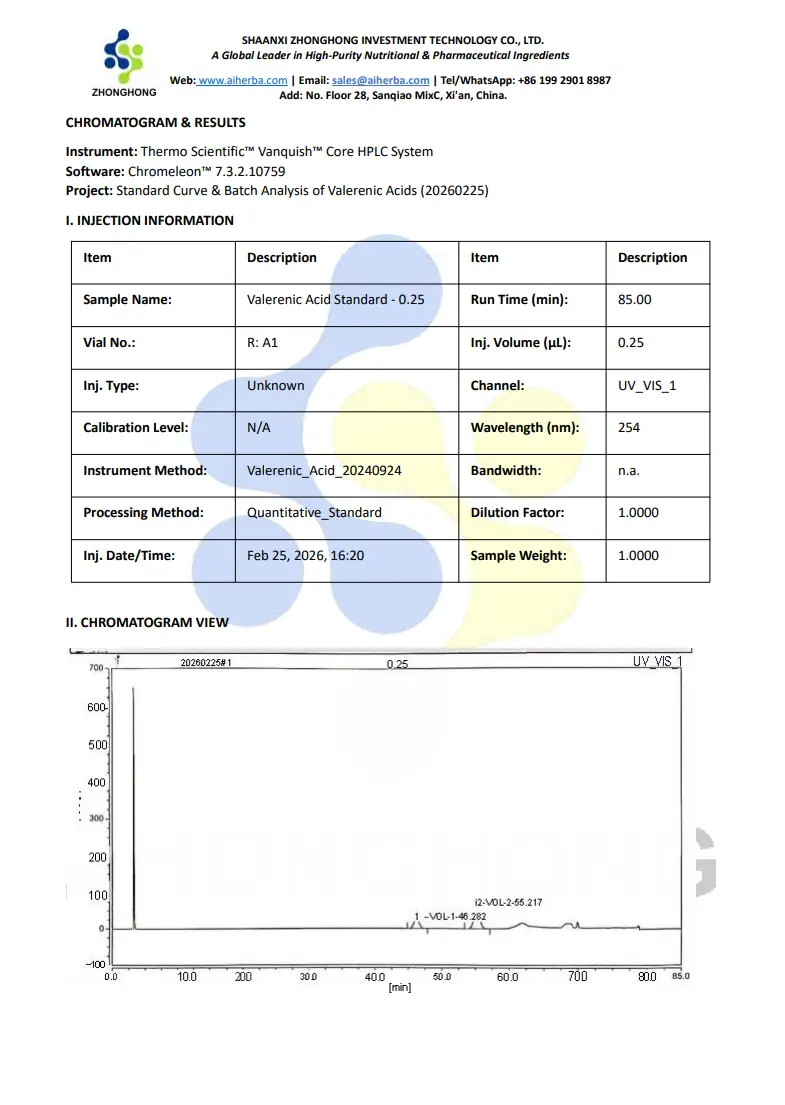
ZHONGHONG HPLC record showing a valerenic acid reference standard injection on a Thermo Scientific Vanquish Core system with UV detection at 254 nm. REFERENCE STANDARD RECORD
LAB_REF 01 / HPLC METHOD REFERENCE

Valerenic Acid Standard — HPLC Analytical Record

This ZHONGHONG analytical record shows a valerenic acid reference-standard injection obtained using a Thermo Scientific Vanquish Core HPLC system with UV detection at 254 nm.It illustrates method documentation that may support analytical review.

  • Reference-standard sample identification
  • Instrument and acquisition information
  • UV detection wavelength: 254 nm
  • Chromatographic output and relevant method information
Evidence Classification: Reference-standard analytical record. This image does not independently establish the assay, purity or release status of an offered commercial production lot.
View Original Analytical Record
Elemental Impurity Review Matrix
Pb Lead — method, limit and actual batch result
As Arsenic — reporting basis and applicable requirements
Cd Cadmium — LOQ and batch-specific result
Hg Mercury — analytical scope and documented limits

Quality review diagram only. No batch results, test certificates or PASS conclusions are represented.

LAB_REF 02 / CONTAMINANT REVIEW

Elemental Impurity & Contaminant Documentation

Ingredient qualification may involve assessing lead, arsenic, cadmium, mercury and other relevant contaminants.Suitable analytical reports should identify the sample, test method, analytes, reporting units, detection limits and acceptance criteria.

  • Actual sample and batch identity
  • Test method and analytical laboratory
  • LOD / LOQ and measurement units
  • Defined limits and genuine test results
Evidence Classification: Technical review framework. Real batch-linked test records or third-party reports can be evaluated according to the selected ingredient and available documentation.

Analytical Evidence Integrity: A reference-standard chromatogram is not equivalent to a finished batch COA. Similarly, report illustrations and generic laboratory photographs cannot substitute for actual batch-linked analytical data.

Supplier Qualification & Technical Documentation Matrix

Procurement, QA and R&D teams can use the following document framework to establish what is required before approving a selected herbal extract grade.

Document / Record Qualification Purpose Important Review Checkpoint
Batch Certificate of Analysis (COA) Review actual release results against the agreed specification. Batch number, method, limits, reported results, test date and authorized review.
Product Specification & TDS Define material identity, composition, assay and physical parameters. Botanical source, plant part, marker definition, DER, carrier and testing basis.
Safety Data Sheet (SDS) Communicate relevant handling, hazard and safety information. Product identity, revision status and applicability to the offered material.
Analytical Support Reports Provide additional identity, assay or contaminant information where required. Laboratory source, tested lot, method, units, reporting limits and analytical scope.
Origin, Composition & Manufacturing Information Support source and ingredient traceability. Country of origin, raw material, extraction solvent, carrier and manufacturing source.
Certification & Supplier Audit Files Support the buyer's supplier approval and quality-system review. Validity, issuing body, manufacturing-site coverage and product relevance.
Document Availability: COA, TDS, SDS, testing reports, certification files and manufacturing declarations vary by ingredient, grade and production source.Additional or independent laboratory testing may require separate technical arrangements, fees and lead-time confirmation.

From Specification Review to Batch Qualification

Establish a traceable relationship between the requested ingredient, analytical methods, actual supplied material and the final purchasing decision.

STEP 01 / DEFINE

Establish Requirements

Confirm botanical source, target marker, grade, quality limits and intended application.

STEP 02 / DOCUMENT

Review Available Files

Check product specification, COA, methods, manufacturing source and supporting documents.

STEP 03 / VERIFY

Evaluate Sample or Lot

Compare representative or batch-specific analytical information with agreed criteria.

STEP 04 / QUALIFY

Confirm Commercial Supply

Approve the suitable grade and confirm actual batch documents, packaging and ordering terms.

Need a Herbal Extract COA or Supplier Qualification Package?

Share your botanical ingredient, target specification, assay method, required contaminant limits, estimated quantity and destination market.AIHerba® can review available batch documentation, analytical evidence, sample options and additional quality requirements for your project.

Analytical & Quality Scope: The appropriate tests, analytical methods, acceptance limits and supplier qualification documents vary by ingredient, intended use, manufacturing source and production batch.The inclusion of a method or quality parameter on this page does not mean every AIHerba® extract has been tested by that method or independently certified to all international standards.

AIHERBA® / APPLICATION & GLOBAL SUPPLY

Application Sourcing, Samples & Global Bulk Herbal Extract Supply

AIHerba® supports bulk herbal extract purchasing for nutraceutical, functional food, beverage and cosmetic ingredient programs.Following technical qualification, buyers can discuss representative samples, custom-grade feasibility, commercial packing, order quantities and international delivery arrangements.Supply terms are confirmed according to the selected botanical ingredient, specification and destination.

APPLICATION 01

Dietary Supplement Ingredients

Source standardized botanical extracts for ingredient evaluation in capsule, tablet and nutritional powder formulations.Grade suitability depends on the intended finished product and destination market.

SOURCING FOCUS Botanical identity, active-marker assay, excipient disclosure, powder properties, relevant contaminant limits and batch documentation.
Explore Supplement Solutions
APPLICATION 02

Functional Food & Beverage

Explore suitable botanical ingredients for food, beverage and nutritional powder development.Formulation requirements may include dispersibility, sensory performance, pH compatibility and processing stability.

SOURCING FOCUS Food-use suitability, carrier composition, water behavior, sensory profile, processing conditions and ingredient-specific stability assessment.
Explore Food Ingredient Solutions
APPLICATION 03

Cosmetic & Personal Care

Consider selected botanical extracts for skin care and personal care ingredient development, subject to the intended formulation and cosmetic-use assessment.

SOURCING FOCUS Botanical INCI identity, extraction solvent, active-marker profile, product compatibility, relevant impurities and formulation testing.
Explore Cosmetic Ingredient Solutions

From Laboratory Samples to Repeat Commercial Orders

Ingredient qualification and bulk procurement follow different commercial stages.Each stage has its own technical requirements, cost structure and acceptance criteria.

STAGE 01 / SAMPLE

Laboratory Sample

Evaluate an available grade for analytical identity, preliminary formulation or internal R&D comparison.

CONFIRM BEFORE DISPATCH Sample size, material cost, courier charges, available documents and delivery address.
STAGE 02 / PILOT

Pilot Evaluation

Review the feasibility of custom marker content, extraction route, carrier requirements or modified powder properties.

CONFIRM BEFORE PILOT Technical target, minimum pilot quantity, testing plan, development charges and process feasibility.
STAGE 03 / BULK

Commercial Bulk

Confirm the approved ingredient specification, quantity, packaging, batch documentation and agreed purchase terms.

CONFIRM BEFORE ORDER Unit price, MOQ, production schedule, payment, packaging, Incoterm and shipment plan.
STAGE 04 / REPEAT

Repeat Supply

Discuss recurring orders through specification control, demand forecasts, production planning and batch-to-batch review.

CONFIRM FOR REORDER Updated forecast, quantity, availability, current batch records and delivery schedule.

Herbal Extract MOQ, Packaging & Ordering Terms

The following procurement framework helps buyers prepare a realistic commercial inquiry.Actual terms depend on the botanical material, target specification, production quantity and delivery destination.

Parameter Supply Approach Buyer Confirmation
Samples Representative material may be available for selected ingredients and grades. Quantity, sample charge, courier cost and available documentation.
Minimum Order Quantity MOQ is ingredient- and grade-specific, particularly for custom manufacturing. Standard grade versus custom grade and required purchase quantity.
Bulk Packaging 25 kg fiber drums are a common reference for suitable bulk extract powders. Other sizes may be reviewed. Net weight, inner liner, outer packaging, labeling and material suitability.
Production & Dispatch Manufacturing and shipment scheduling depend on material availability, batch review and order requirements. Lead time, payment status, export documents and intended dispatch date.
Technical Documentation Product specification, batch COA, TDS, SDS and additional records may be reviewed as relevant. Exact document list, tested lot and buyer acceptance criteria.
International Freight Courier, air freight, sea freight and named delivery terms may be assessed by shipment. Destination, gross weight, dimensions, insurance, customs and final costs.

Procurement Note: A laboratory sample purchase does not establish the MOQ, pricing, production readiness or specifications of a future commercial manufacturing order.

International Logistics & Incoterms® 2020

AIHerba® can review international shipping options based on the delivery location, transport mode, customs arrangements and the responsibilities agreed by buyer and seller.

FCA Free Carrier

Delivery to the nominated carrier at an agreed named place, with seller-side export clearance obligations.

Suitable for multimodal or air freight arrangements.
FOB Free On Board

Delivery takes place when goods are loaded on board the nominated vessel at the agreed port of shipment.

Sea or inland waterway shipments only.
DAP Delivered at Place

Seller-arranged carriage to the named destination, ready for unloading. The buyer is responsible for import clearance and applicable duties and import taxes.

Buyer handles import customs formalities.
DDP Delivered Duty Paid

The seller assumes import clearance and applicable duty and tax responsibilities under the agreed term.Availability requires destination-specific feasibility confirmation.

Only where customs arrangements are feasible.
Import Clearance, Insurance & DDP Feasibility

Before issuing a final delivered quotation, the parties should confirm the ingredient's import eligibility, customs classification, importer-of-record arrangements, applicable duties and taxes, brokerage, bonds where relevant, freight, final delivery charges and insurance coverage.Shipment insurance is not automatically included under FCA, FOB, DAP or DDP solely because of the selected Incoterm.The agreed quotation must state the named delivery location and the applicable Incoterms® 2020 rule.

Export Documents & Import Readiness

Match the commercial shipment documents to the actual ingredient, batch, consignee and destination-country import requirements.

Supplier & Shipment Files

  • Commercial invoice and packing list
  • Product identity, agreed specification and applicable batch COA
  • TDS / SDS and other available technical documents
  • Origin declarations or certificates where required and available
  • Export and transport records according to the shipping method
  • Additional product-specific declarations where relevant

Buyer & Destination Review

  • Full importer and consignee information
  • Exact ingredient name, botanical identity and customs classification
  • Applicable import permits, declarations or notifications
  • Destination-market ingredient eligibility and intended use
  • Named delivery place, insurance instructions and agreed customs responsibility
  • Shipment quantity, packaging and final delivery arrangements

Need Bulk Herbal Extract Pricing & Delivery Options?

Send your ingredient name, botanical source, target specification, required quantity, destination country and preferred delivery term.AIHerba® can review suitable grades, sample options, bulk packaging, technical documentation and an applicable commercial quotation.

Commercial Supply Notice: Ingredient availability, sample quantities, manufacturing options, MOQ, packaging, payment, lead times, document availability and international delivery terms must be confirmed for each product and order.No published transport option guarantees import permission or destination clearance. Regulatory suitability must be reviewed for the actual ingredient, intended use and market.

AIHERBA® / TECHNICAL FAQ & FINAL RFQ

Herbal Extract Technical FAQ & Supplier Qualification

Compare herbal extract specifications with confidence.These frequently asked questions address botanical identity, genuine DER, assay methods, batch documentation, customization, sample sourcing and international purchasing considerations for professional B2B buyers.

Frequently Asked Technical Questions

10 QUESTIONS
01 How can I verify the botanical identity of a herbal extract?

Confirm the scientific botanical name, applicable plant part, raw-material source and identity procedures. Depending on the ingredient, supporting methods may include microscopy, HPTLC, HPLC or other appropriate techniques.

Buyer checkpoint: The identity and plant part documented for the offered material should match the agreed product specification.

02 Is a 10:1 herbal extract equivalent to 10% active content?

No. An extraction ratio describes a relationship between the botanical starting material and the resulting extract, according to its defined basis. It does not directly indicate the percentage of any active or analytical marker.

For comparison: Request both the clearly defined DER and a separate marker assay when active-marker content matters.

03 What is genuine (native) DER, and how are carriers disclosed?

Genuine DER relates the botanical input to the genuine extract produced, excluding excipients added after extraction. The ratio should be distinguished from a finished powder containing maltodextrin, dextrin or other carriers.

Buyer checkpoint: Confirm carrier identity, composition and calculation basis, especially when comparing nominal extraction ratios between suppliers.

04 Are HPLC and UV assay results directly interchangeable?

Not automatically. HPLC methods can separate and quantify specified constituents. UV-based methods may measure a broader response depending on the analytical procedure and calibration standard.

Buyer checkpoint: Compare the exact analyte, reference standard, calculation method and reporting basis, rather than relying on percentages alone.

05 Can AIHerba provide a COA for the actual supplied batch?

Batch-specific COA availability can be reviewed for the selected ingredient and proposed supply lot. A buyer should confirm the batch identifier, specification, analytical methods, acceptance limits and reported results.

A reference-standard chromatogram or historical representative COA is not automatically evidence of the exact lot that will ship. Request actual batch alignment before final approval.

06 Which contaminant tests should be included?

The testing scope depends on the botanical material, manufacturing process, intended use and applicable buyer or market requirements. Relevant parameters may include heavy metals, microbiology, pesticide residues, mycotoxins and residual solvents.

Buyer checkpoint: Specify test methods, target limits, units and reporting limits. Additional third-party testing may require separate arrangements.

07 Can you develop a custom herbal extract specification?

AIHerba can review custom requirements involving botanical source, target markers, extraction solvent, genuine DER, carriers, particle size or powder properties.

Acceptance depends on technical feasibility, analytical capability, material availability, pilot considerations and commercial requirements. A requested specification is not guaranteed until feasibility is established.

08 What are the sample and bulk minimum order quantities?

Sample sizes and commercial MOQ vary by product, grade, manufacturing route and order requirements. Many suitable bulk powders use 25 kg fiber drums, but this does not establish a universal minimum order.

For quotation: State the required quantity, destination and whether the request is for laboratory evaluation, pilot work or commercial supply.

09 Are herbal extracts automatically suitable for the US or EU market?

No. Market suitability depends on the exact ingredient, botanical identity, manufacturing process, intended use and destination-country rules.

FDA facility registration, general manufacturing certifications or an existing COA do not by themselves establish authorization for every ingredient or intended application.

Customers should confirm applicable food, dietary supplement, novel food or cosmetic requirements as relevant to their project.

10 Can AIHerba quote FCA, FOB, DAP or DDP delivery terms?

AIHerba can review suitable international delivery arrangements for the proposed shipment, including FCA, FOB, DAP or DDP where feasible.

FOB applies to sea or inland waterway transport. Under DAP, the buyer generally handles import clearance and duties. DDP requires the seller to handle applicable import obligations and must be confirmed for the destination.

Before confirmation: Review customs arrangements, taxes, brokerage, insurance, final delivery costs and the named destination under Incoterms® 2020.

AIHERBA® / FINAL TECHNICAL & BULK RFQ

Source Standardized Herbal Extracts with Defined Specifications

AIHerba®, operated by Shaanxi Zhonghong Investment Technology Co., Ltd., supports B2B sourcing of standardized herbal extracts and natural plant extract powders for professional formulation and procurement teams.

Send your botanical identity, active-marker target, assay method, extraction requirements, quantity and destination.We can review relevant ingredient grades, batch-specific documentation, sample availability and commercial supply options.

Botanical IdentityActive MarkerAssay MethodGenuine DERQuantityDestination
Request Technical RFQ WhatsApp Technical Sales Use the Online Inquiry Form

Specification, MOQ, documents and delivery are confirmed for each ingredient and order.

Technical & Regulatory Notice:Herbal extract specifications, analytical methods, batch documentation, sample availability, manufacturing feasibility, MOQ and commercial terms depend on the selected ingredient and project.Market suitability, labeling and import eligibility require ingredient-specific assessment.The information on this page is intended for professional B2B sourcing and does not establish product-specific regulatory authorization.

Bulk Supply & Technical Advisory
Batch-Specific COA
Analytical Verification
Global Supply & DDP
Evaluation Samples

Documentation, testing, samples and DDP options depend on the selected grade and destination.

Scroll to Top

Request Factory-Direct Quote & Lab Samples

Request Bulk Pricing & Batch COA