AIHERBA® / NUTRACEUTICAL INGREDIENT SOLUTIONS

Bulk Dietary Supplement Ingredients Supplier & Custom Solutions

AIHerba® supports global supplement brands, contract manufacturers and ingredient distributors with standardized botanical extracts, selected nutraceutical actives and ingredient-level specification engineering.

From technical evaluation and sample qualification to recurring bulk sourcing, we help purchasing and R&D teams review ingredient identity, assay methods, quality documentation and commercial feasibility.

Botanical Identity
HPLC / Assay Review
Custom Specifications
Bulk Supply
Standardized dietary supplement raw materials, herbal extract powders and functional active ingredients for nutraceutical formulations - AIHerba
STANDARDIZED NUTRACEUTICAL ACTIVES
MANUFACTURING AUDIT USP / EP Verified
Clean-Label Nutraceutical Ingredients
High bio-absorption botanical extracts and pure active powders for premium capsule, tablet, and ready-mix formulations.
PROCUREMENT / TECHNICAL REVIEW

Ingredient Qualification Snapshot

Confirm the requirements that matter before supplier approval and commercial ordering.

Identity & Assay

Source, active marker, analytical method and assay basis.

Quality Documentation

Batch COA, specification and supporting technical records.

Custom Grade Feasibility

Particle size, dispersibility, carriers and processing fit.

MOQ & Global Supply

Sample availability, commercial packing and delivery terms.

Evidence-first sourcing: Specifications, laboratory methods and document availability are confirmed for the requested ingredient and grade.

AIHERBA® INGREDIENT PROJECT GATEWAY

Two Clear Pathways for Dietary Supplement Ingredient Development & Bulk Sourcing

AIHerba® supports formulation R&D teams and commercial buyers with different technical and procurement priorities. Select the pathway that best matches your current ingredient project.

TRACK 01 / R&D ENGINEERING
For Formulators & Technical Teams

Custom Ingredient Specifications & Formulation Engineering

Review ingredient identity, target active content, process requirements and formulation compatibility before laboratory evaluation or pilot development.

Technical Evaluation Priorities

01
Ingredient Identity & Assay

Botanical source, active markers, assay basis and suitable analytical methods.

02
Formulation Compatibility

Capsules, tablets, powders, gummies and liquid supplement applications.

03
Powder & Processing Properties

Particle size, moisture, dispersibility, carrier selection and powder flow.

04
Testing & Sample Planning

Relevant quality specifications, sample requirements and feasibility of requested testing.

What to Include in Your Technical Brief:

Ingredient name, target specification, dosage form, anticipated use level, required analytical method and development quantity.

TRACK 02 / PROCUREMENT
For Sourcing & QA Managers

Supplier Qualification & Commercial Bulk Purchasing

Compare available ingredient grades, assess relevant quality documentation and confirm commercial supply conditions before approving a bulk purchasing program.

Commercial Qualification Priorities

01
Available Grades & MOQ

Confirm the offered specification, order quantity, sample availability and commercial pack size.

02
COA & Technical Files

Product-specific COA, TDS, SDS, analytical records and relevant supplier documentation.

03
Market & Documentation Review

Discuss destination-market documentation and ingredient-specific regulatory considerations.

04
Pricing & International Supply

Quotation, packaging, estimated lead time, Incoterms and delivery destination.

What to Include in Your Purchasing RFQ:

Product name, target grade, quantity per order, expected annual demand, destination and required documents.

Not Sure Which Pathway Fits Your Project?

Share your ingredient name, intended supplement application and sourcing needs. Our team can help route your request for initial review.

Technical feasibility, sample availability, analytical documents and commercial terms are confirmed for each ingredient and requested grade. Destination-market regulatory suitability requires product-specific evaluation.
AIHERBA® / INGREDIENT PLATFORM DIRECTORY

Six Dietary Supplement Ingredient Platforms for B2B Formulation & Sourcing

Explore AIHerba® botanical extracts, functional actives, mushroom-derived ingredients and specialty materials for professional nutrition development. Each platform connects ingredient selection with specification review, analytical documentation and bulk purchasing.

01 / BOTANICAL PLATFORM MARKER ASSAY

Standardized Botanical Extracts

Plant-derived ingredient grades standardized against selected botanical markers or defined extract specifications for professional nutraceutical formulations.

TECHNICAL PROCUREMENT FOCUS

Botanical identity · Plant part · Marker assay · Extract ratio · Residual solvents

Verify the offered assay method and botanical identity for each grade.

02 / ACTIVE COMPOUNDS PURITY REVIEW

Functional Nutraceutical Actives

Defined functional compounds for ingredient development programs requiring clear chemical identity, purity specifications and application-specific quality review.

TECHNICAL PROCUREMENT FOCUS

Identity · Purity basis · HPLC or suitable assay · Residuals · Formulation fit

Ingredient grades and destination-market suitability must be confirmed separately.

03 / MUSHROOM PLATFORM SOURCE CONTROL

Mushroom Extracts & Polysaccharides

Mushroom-derived raw materials evaluated by species, source material and analytical markers. Fruiting-body and mycelium preparations must be clearly distinguished.

TECHNICAL PROCUREMENT FOCUS

Species identity · Fruiting body vs mycelium · β-Glucans · Polysaccharides · Marker methods

Total polysaccharides, β-glucans and cordycepin are not interchangeable assays.

04 / COGNITIVE PLATFORM FORMULATION

Cognitive & Brain Health Ingredients

Selected cholinergic and botanical ingredients for formulation development, with attention to compound identity, hygroscopicity, analytical methods and powder processing.

TECHNICAL PROCUREMENT FOCUS

Identity · Hygroscopicity · Carrier content · Moisture · Powder flow · Stability review

Finished-product positioning requires separate scientific and regulatory review.

05 / SPECIALTY ACTIVES MARKET REVIEW

Healthy Aging & Specialty Actives

High-value compounds for advanced nutrition, R&D and specialty ingredient programs. Regulatory screening is particularly important before planning finished-product use.

TECHNICAL PROCUREMENT FOCUS

Chemical form · Identity evidence · Purity method · Stability · Destination-market eligibility

Listing a specialty active does not establish its approval for supplement use in any particular market.

06 / PHYSICAL ENGINEERING GRADE MATCHING

Formulation-Ready Ingredient Grades

Ingredient options evaluated for capsules, tablets, sachets, powders and liquid development. Physical properties and performance depend on the exact grade and formulation system.

TECHNICAL PROCUREMENT FOCUS

Particle size · Powder flow · Dispersibility vs solubility · Carrier system · Moisture

Standard powders are not automatically water-soluble or validated for every processing condition.

Need a Different Ingredient or Custom Specification?

Send the ingredient name, botanical source or chemical identity, target assay, expected order quantity, application and destination country. AIHerba® can review suitable grades, available documentation and commercial sourcing options.

Ingredient Qualification Notice: Product links represent available ingredient information or technical dossiers, not blanket regulatory approval. Suitability for dietary supplement manufacturing must be assessed for the exact ingredient form, destination market, intended application and supporting evidence. Specifications and test data are product- and batch-specific.

AIHERBA® / FORMULATION ENGINEERING

Dietary Supplement Application Engineering Challenges

Ingredient purity alone does not guarantee successful formulation performance. Capsules, tablets, powder sachets, gummies, liquid supplements and softgels impose different physical and processing demands. AIHerba® supports ingredient-level technical evaluation to help R&D teams identify suitable grades and qualification priorities.

Powder Flow & Physical PropertiesProcessing & Stability ReviewIngredient–Matrix Compatibility
01 / SOLID DOSAGE CAPSULES

Hard Capsules

FILL UNIFORMITY & POWDER FLOW

Encapsulation performance depends on powder flow, packing behavior, hygroscopicity and the compatibility of the ingredient with the selected capsule shell and excipient system.

PRIMARY FORMULATION RISKS

Poor flow, bridging, fill-weight variation, moisture uptake and powder segregation.

ENGINEERING REVIEW
  • Particle-size distribution and bulk density
  • Hygroscopicity and moisture requirements
  • Carrier and excipient compatibility
VALIDATION FOCUS

Evaluate flow behavior, moisture, powder blend uniformity and capsule-filling trials as applicable.

02 / SOLID DOSAGE TABLETS

Compressed Tablets

COMPRESSIBILITY & PROCESS STRESS

Botanical powders and specialty actives can differ in compactibility, particle cohesion and sensitivity to manufacturing stress. Tablet performance requires evaluation within the complete formulation.

PRIMARY FORMULATION RISKS

Capping, lamination, inconsistent hardness, friability and possible active-content changes during processing.

ENGINEERING REVIEW
  • Particle engineering and compaction behavior
  • Binder, lubricant and excipient interactions
  • Moisture and processing sensitivity
VALIDATION FOCUS

Assess compression trials, disintegration and finished-tablet quality with the responsible formulator.

03 / POWDER SYSTEM SACHETS

Powders & Sachets

BLEND UNIFORMITY & DISPERSION

Powder blends and portioned sachets require suitable particle properties, accurate distribution of active compounds, controlled moisture and application-specific dispersion characteristics.

PRIMARY FORMULATION RISKS

Segregation, caking, dust generation, poor wettability, sedimentation and undesirable sensory properties.

ENGINEERING REVIEW
  • Particle-size matching and powder density
  • Moisture, caking and carrier systems
  • Wettability, dispersibility and flavor impact
VALIDATION FOCUS

Review blend uniformity, flow, storage behavior and dispersion in the intended preparation medium.

04 / CHEWABLE MATRIX GUMMIES

Gummies & Chewables

HEAT, ACIDITY & MATRIX COMPATIBILITY

Nutraceutical actives incorporated into gummy or chewable systems may encounter heating, acidic conditions, moisture and interactions with gelling or sweetening components.

PRIMARY FORMULATION RISKS

Active degradation, color changes, off-flavors, precipitation and uneven distribution in the matrix.

ENGINEERING REVIEW
  • Ingredient-specific temperature sensitivity
  • Acidic pH and water-activity considerations
  • Color, taste and carrier compatibility
VALIDATION FOCUS

Assess assay retention, dispersion and sensory properties through representative processing trials.

05 / AQUEOUS SYSTEM LIQUIDS

Liquid Supplements

SOLUBILITY, CLARITY & STABILITY

Liquid supplement systems require careful distinction between genuine solubility and physical dispersibility. pH, ionic strength, oxidation and storage conditions may influence ingredient behavior.

PRIMARY FORMULATION RISKS

Precipitation, sedimentation, turbidity, color drift, oxidation and changes in active content.

ENGINEERING REVIEW
  • Solubility versus dispersion performance
  • pH, temperature and ionic-strength effects
  • Oxidation and packaging interactions
VALIDATION FOCUS

Check physical stability, precipitation and assay changes under representative storage and processing conditions.

06 / LIPID SYSTEM SOFTGELS

Softgels & Lipid Systems

OIL COMPATIBILITY & FILL STABILITY

Lipophilic actives and suspended powders intended for softgel fills require evaluation of carrier oils, dispersion behavior, oxidative stability and compatibility with the fill system.

PRIMARY FORMULATION RISKS

Sedimentation, particle agglomeration, oxidative degradation, unstable fill viscosity and shell–fill interactions.

ENGINEERING REVIEW
  • Oil solubility versus particle suspension
  • Fill viscosity and particle-size selection
  • Oxidation and shell compatibility
VALIDATION FOCUS

Evaluate the selected active within the proposed lipid fill and review finished-softgel performance separately.

Application Feasibility: From Formulation Brief to Ingredient Review

Successful ingredient selection depends on the intended dosage form and the conditions under which the ingredient will be processed and stored.

STAGE 01

Application Requirement

Define ingredient identity, target concentration, dosage form, pH range, process temperature and expected storage conditions.

STAGE 02

Ingredient Feasibility

Review chemical and physical properties, available grades, potential processing limitations and relevant quality requirements.

STAGE 03

Sample & Fit-for-Use Review

Agree on suitable sampling, testing and pilot evaluation. Use actual analytical results and formulation trials before commercial qualification.

Facing a Supplement Formulation Challenge?

Share your ingredient name, dosage form, target specification, processing conditions and observed formulation issue. AIHerba® can review available ingredient options and discuss potential next steps for technical evaluation.

Technical Scope: The parameters above describe formulation evaluation considerations, not guaranteed performance of a specific ingredient. Test methods, data availability and technical feasibility depend on the selected grade and application. Finished-product validation, shelf-life determination and destination-market compliance remain subject to separate review.

AIHERBA® / CUSTOM SPECIFICATION ENGINEERING

Custom Dietary Supplement Ingredient Specifications & Analytical Engineering

Move from a target ingredient concept to a technically reviewable purchasing specification. AIHerba® supports ingredient-level evaluation of identity, assay, extraction route, particle properties, carrier systems and batch quality requirements before sample and commercial qualification.

Target Specification Method-Based Verification Process Feasibility Batch-Linked Evidence
01 / IDENTITY ENGINEERING SOURCE CONTROL

Identity & Botanical Source

START WITH THE RIGHT MATERIAL

Define the exact botanical or chemical identity before comparing specifications. Different plant parts, species and ingredient forms may require different analytical and regulatory reviews.

CUSTOM SPECIFICATION INPUT

Latin binomial, plant part, source type, extraction ratio or precise chemical form, where applicable.

KEY ENGINEERING PARAMETERS
  • Species and botanical identity
  • Plant part or fermentation source
  • Native extract versus formulated grade
VERIFICATION APPROACH

Review source documentation and use appropriate identification methods, such as HPTLC, HPLC or other methods suitable for the specific ingredient.

02 / ANALYTICAL CHEMISTRY ASSAY DESIGN

Active Content & Assay Method

PURITY IS METHOD-DEPENDENT

Define the target active content and how it will be measured. The method, analyte definition, reference standard and reporting basis must be clear before comparing supplier results.

CUSTOM SPECIFICATION INPUT

Target assay or purity, named active marker, HPLC/UHPLC or another appropriate method, and dry-basis versus as-supplied reporting.

KEY ENGINEERING PARAMETERS
  • Target assay and acceptance range
  • Method, analyte and reference standard
  • Dry basis versus as-supplied result
VERIFICATION APPROACH

Review the suitable assay procedure, chromatographic evidence when available, and the actual batch COA. UV total-content results must not be treated as automatically equivalent to HPLC marker quantification.

03 / PROCESS ENGINEERING EXTRACTION

Extraction Route & Residual Solvents

PROCESS FEASIBILITY & CONTROL

Extraction technology influences selectivity, product composition and manufacturing feasibility. The process route must be evaluated against target markers and final quality limits.

CUSTOM SPECIFICATION INPUT

Preferred extraction route, permitted solvents, process restrictions and applicable residual-solvent limits.

KEY ENGINEERING PARAMETERS
  • Water/ethanol or other feasible processes
  • Supercritical CO₂ or enzyme-assisted options
  • Residual solvent limits and test methods
VERIFICATION APPROACH

Confirm process availability for the requested material and review suitable GC/HS-GC results where relevant. Pharmacopoeial or ICH solvent limits apply only where justified by the intended material and market.

04 / PHYSICAL ENGINEERING PSD / D90

Particle Size & Powder Properties

D10 / D50 / D90 & PROCESSING FIT

Particle-size distribution affects powder flow, blend homogeneity, wetting and process performance. A target mesh designation alone may not fully describe the required particle distribution.

CUSTOM SPECIFICATION INPUT

Target D10, D50 or D90 values, measurement method, moisture limit, bulk density and preferred powder-handling characteristics.

KEY ENGINEERING PARAMETERS
  • Particle-size distribution and test basis
  • Sieving versus laser diffraction
  • Flowability, bulk density and moisture
VERIFICATION APPROACH

Compare actual PSD data with the specified method and process needs. D90 and mesh size are not directly interchangeable without a defined measurement basis.

05 / CARRIER ENGINEERING COMPOSITION

Carrier, Excipient & Dispersion System

COMPOSITION TRANSPARENCY

Carriers and processing aids may change the composition, assay on total-powder basis, powder flow and dispersion behavior. Their identity and quantity must be reviewed before grade selection.

CUSTOM SPECIFICATION INPUT

Carrier-free preference or permitted carriers, maximum carrier percentage, target active content and required dispersibility characteristics.

KEY ENGINEERING PARAMETERS
  • Maltodextrin or other permitted carriers
  • Declared carrier percentage and origin
  • Water solubility versus dispersibility
VERIFICATION APPROACH

Review formulation composition, assay on the supplied-powder basis and representative application tests. A dispersible powder must not automatically be described as fully water-soluble.

06 / QUALITY ENGINEERING BATCH RELEASE

Quality Limits & Acceptance Criteria

QUALITY CONTROL MUST BE EVIDENCE-BASED

Define suitable identity, assay, contaminant and physical-property requirements before purchase. Supplier specifications and batch-specific test results must be clearly differentiated.

CUSTOM SPECIFICATION INPUT

Applicable limits for assay, microbiology, elemental impurities, pesticides, residual solvents and physical quality attributes.

KEY ENGINEERING PARAMETERS
  • Identity and assay acceptance limits
  • Heavy metals, microbiology and pesticides
  • Relevant test methods and batch traceability
VERIFICATION APPROACH

Review batch COA, test methods and available supporting reports. HPLC, GC, ICP-MS, LC-MS/MS or other methods are selected according to the material and relevant test requirements.

Three-Stage Specification Qualification Pipeline

A custom specification is a proposed target until manufacturing feasibility and representative analytical evidence have been reviewed.

STAGE 01 / DEFINE

Target Specification

Record the required ingredient identity, target active content, assay method, particle size, carriers, quality limits and intended dosage form.

OUTPUT: TECHNICAL REQUIREMENT BRIEF
STAGE 02 / EVALUATE

Manufacturing Feasibility

Review the proposed manufacturing route, available grade, raw material characteristics, test capabilities, commercial quantity and practical technical constraints.

OUTPUT: FEASIBILITY RESPONSE
STAGE 03 / VERIFY

Sample & Batch Verification

Evaluate representative samples and appropriate analytical results. Confirm the agreed specification against actual batch evidence before commercial acceptance.

OUTPUT: AGREED SPECIFICATION & BATCH COA
Target Specifications Are Not Batch-Tested Results

Requested purity, particle size, extraction ratio and quality limits represent project requirements, not guaranteed or measured results. Final specifications, analytical methods, sample availability and production feasibility are confirmed individually. Historical batch data cannot automatically be applied to a new production lot.

Have a Custom Supplement Ingredient Specification?

Send the ingredient name, target assay and test method, particle-size requirements, permitted carrier system, quality limits and estimated purchasing quantity. AIHerba® can review suitable grade options and the technical feasibility of your project.

Technical Scope: Custom ingredient development, testing and manufacturing options are subject to feasibility review. No specification, laboratory result, production process or regulatory suitability is guaranteed solely by its inclusion in this engineering matrix. Destination-market requirements and finished-product compliance must be evaluated separately.

AIHERBA® / QUALITY & REGULATORY INTELLIGENCE

Batch Quality Evidence & Dietary Ingredient Regulatory Review

Supplier qualification requires more than a declared assay or a generic certificate. AIHerba® supports ingredient-specific review of batch documentation, analytical methods, contaminant controls and regulatory considerations for professional dietary supplement sourcing.

01 / DOCUMENT INTEGRITY

Batch COA & Specification

Review the actual batch identifier, specification limits, test results, method references and release status.

Batch number · Test date · Acceptance limits · Actual results
02 / ANALYTICAL IDENTITY

Identity & Assay Evidence

Compare the selected analytical method, analyte definition, reference standards and reporting basis against the specification.

HPLC / UHPLC · HPTLC · GC · Other suitable methods
03 / SAFETY PARAMETERS

Contaminant Control

Establish relevant acceptance limits for elemental impurities, microbiology, pesticides and process-related contaminants.

ICP-MS · Microbiology · LC-MS/MS · GC/HS-GC as applicable
04 / SUPPLIER DOCUMENTS

Technical Dossier Review

Request product specification, TDS, SDS, origin information and supporting manufacturing or quality documentation.

COA · TDS · SDS · Origin · Method information

Analytical Documentation & Quality Review Examples

Review an HPLC reference-standard record and an illustrative heavy-metals report layout. Neither image is a commercial production-lot COA; actual batch qualification requires traceable analytical results from the relevant material.
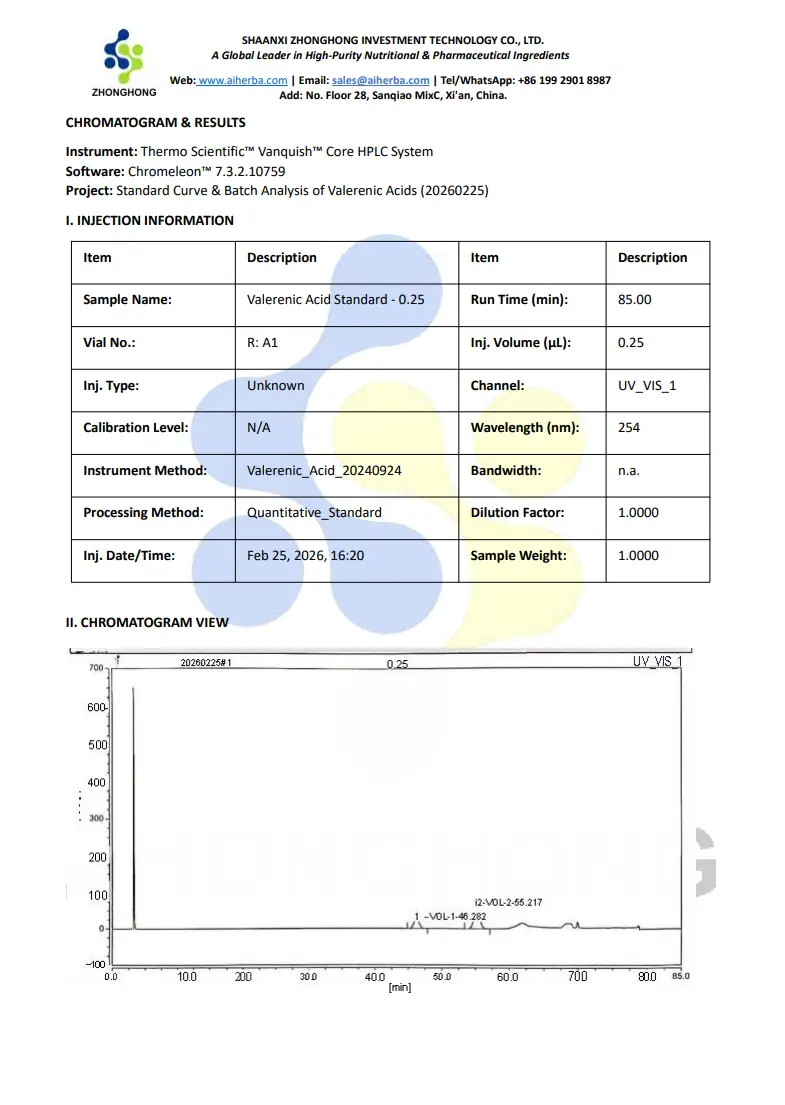
ZHONGHONG valerenic acid reference-standard HPLC chromatogram recorded with UV detection at 254 nm, dated February 25, 2026; not a batch release COA. REFERENCE STANDARD · NOT BATCH COA
LAB_REF 01 / HPLC REFERENCE-STANDARD RECORD

HPLC Method & Reference Standard Review

This ZHONGHONG analytical record displays an injection of a valerenic acid reference standard on a Thermo Scientific Vanquish Core HPLC system with UV detection at 254 nm. It illustrates analytical documentation and is not an assay result for a commercial ingredient batch.

  • Reference-standard identity and instrument details
  • Detection wavelength, injection information and chromatogram
  • Analytical method and traceability review
  • Commercial-lot assay requires separate batch-linked evidence
Computer-generated ZHONGHONG illustrative ICP-MS heavy-metals report with Pb, As, Cd and Hg rows; simulated results and PASS indicators, not an actual laboratory report. ILLUSTRATIVE SAMPLE · NOT A VALID COA
LAB_REF 02 / ILLUSTRATIVE CONTAMINANTS REPORT

ICP-MS Heavy Metals Screening — Report Layout

This computer-generated report illustrates the presentation of Pb, As, Cd and Hg measurements, laboratory methods, reporting limits and acceptance criteria. Actual qualification requires a genuine report linked to the ingredient and production lot.

  • Elemental impurity analytes and ICP-MS methodology
  • Result units, LOD/LOQ and analyte-specific limits
  • Actual lot number, laboratory identity and report traceability
  • Verify applicable limits for the ingredient and intended use

Illustrative sample — not a valid COA. All reported values, PASS labels, signatures, laboratory seals and batch identifiers shown in this picture are simulated. The illustrated limits do not establish universal USP/EP acceptance criteria.

Evidence integrity: LAB_REF 01 is a reference-standard chromatogram, not production-lot evidence. LAB_REF 02 is a computer-generated report illustration, not a third-party test result. Actual supplier qualification must use genuine, batch-linked reports and applicable acceptance criteria.

01 / SOURCEIngredient Identity

Botanical or chemical identity and material description.

02 / LOTBatch Identification

Connect the provided material with a specific batch number.

03 / METHODSAnalytical Verification

Confirm methods, reporting basis and available results.

04 / RELEASEDocument Review

Check the COA, specification and relevant release records.

Destination-Market Regulatory Screening

Regulatory suitability is evaluated against the ingredient's exact identity, manufacturing process, chemical form, intended supplement use and destination market.

United States

Review whether the material qualifies as a dietary ingredient and whether New Dietary Ingredient notification requirements apply to the proposed conditions of use.

  • Dietary ingredient identity
  • NDI / NDIN applicability
  • Intended use and safety evidence
  • Applicable manufacturing requirements
FDA NDI Guidance — Official Reference

European Union

Evaluate Novel Food status, applicable Union-list conditions, supplement ingredient restrictions and destination Member State requirements before market entry.

  • Regulation (EU) 2015/2283
  • Authorised Novel Food Union List
  • Directive 2002/46/EC where relevant
  • National ingredient restrictions
EU Novel Food Union List — Official

Other Markets

Requirements differ across the United Kingdom, Canada, Australia and other destinations. The importer and finished-product manufacturer should verify the applicable ingredient pathway.

  • Local ingredient classification
  • Product or ingredient authorization
  • Relevant safety documentation
  • Import and labeling requirements
Request Destination-Market Review
Regulatory status is not a blanket approval. A supplier's COA, facility registration, analytical test report, GRAS-related document or historical use record does not by itself establish that every ingredient is lawfully marketable for every dietary supplement use. Additional importer, manufacturer or qualified regulatory review may be necessary.

Four-Stage Supplier Qualification Workflow

Align documentation, technical findings and purchasing requirements before commercial order confirmation.

STAGE 01 / REQUIREMENT

Define the Target

Ingredient, intended application, quality limits, assay method and destination market.

STAGE 02 / DOCUMENTS

Review Technical Files

Check available COA, TDS, SDS, identity and contaminant documentation.

STAGE 03 / VERIFICATION

Evaluate Samples

Compare representative material and relevant results with agreed acceptance criteria.

STAGE 04 / APPROVAL

Qualify the Supply

Confirm the offered grade, batch documents, packaging and commercial terms.

Need a Batch COA or Supplier Qualification Package?

Share your ingredient name, target specification, assay method, required quality documentation, estimated quantity and destination. AIHerba® can review available technical files, batch evidence and additional testing options for your project.

AIHERBA® / MANUFACTURING & GLOBAL SUPPLY

From Ingredient Samples to Commercial Bulk Supply

AIHerba® supports dietary supplement manufacturers, R&D teams and ingredient distributors through technical qualification, selected ingredient manufacturing, pilot evaluation and international bulk sourcing.Sample availability, custom specifications, production scheduling and shipping terms are confirmed for each material and order.

01 / LABORATORY SAMPLE

Laboratory Samples

INITIAL INGREDIENT QUALIFICATION

Review product identity, available specifications and representative samples for analytical assessment or preliminary formulation trials.

COMMERCIAL CHECKPOINT Sample quantity, sample material cost, international courier charges, documentation and dispatch timing are confirmed before shipment.
02 / DEVELOPMENT PILOT

Pilot & Custom Grade Review

MANUFACTURING FEASIBILITY

Assess process options, custom active content, particle size, carrier requirements and representative testing before considering a larger production quantity.

COMMERCIAL CHECKPOINT Pilot MOQ, development cost, target parameters, test plan and feasibility are agreed by project.
03 / PRODUCTION BULK

Commercial Bulk Orders

AGREED GRADE & BATCH REVIEW

Confirm the order specification, quantity, manufacturing arrangement, packaging, relevant batch documentation and agreed delivery terms.

COMMERCIAL CHECKPOINT Quotation, agreed MOQ, production schedule, payment terms, packing and shipment instructions.
04 / SUPPLY CHAIN REPEAT

Repeat Supply Programs

REORDER PLANNING & LOGISTICS

Support recurring procurement through specification control, forecast discussions, batch documentation review and shipment planning.

COMMERCIAL CHECKPOINT Rolling demand forecast, repeat-order quantities, available scheduling and logistics confirmation.

Ingredient-Level Manufacturing & Process Support

Manufacturing options are reviewed according to ingredient chemistry, target specifications, suitable production routes and available technical capabilities.

Water & Ethanol Extraction

Evaluate extraction solvent suitability, active-marker recovery and relevant residual solvent requirements.

Enzyme-Assisted Processing

Review ingredient-specific enzyme processes where technically relevant and manufacturing-feasible.

Supercritical CO₂ Options

Consider selective processing of suitable botanical matrices, subject to equipment and process feasibility.

Fermentation-Derived Ingredients

Discuss fermentation-based supply where the specific ingredient and production process are applicable.

Particle & Carrier Engineering

Review feasible milling, sieving, powder properties and permitted carrier or dispersion systems.

Batch Quality Documentation

Confirm identity, assay, batch-related quality records and testing scope according to the agreed specification.

Manufacturing Scope: AIHerba® focuses on ingredient-level production, customization and technical sourcing support. The specific manufacturing site, process availability, batch size and supporting certifications must be confirmed for each project. Ingredient OEM/ODM does not automatically include finished dietary supplement contract manufacturing.

Samples, MOQ, Packaging & Commercial Ordering

Procurement conditions depend on the selected ingredient, specification, production route, destination and order quantity. The following is a qualification framework, not a fixed price list.

Samples

Available sizes, sample charges and courier costs are confirmed individually.

MOQ

Minimum order quantity varies by material and custom processing requirements.

Packaging

25 kg/drum is a common reference for suitable bulk powder products, not universal.

Lead Time

Dispatch and production schedules are quoted after grade, quantity and documentation review.

Order StageTypical PurposeItems to Confirm
Laboratory Sample Identity, assay or initial application evaluation. Sample size, price, courier cost, available documentation and dispatch arrangement.
Pilot / Development Custom grade feasibility and preliminary process trials. Pilot quantity, target parameters, testing, tooling if applicable, and development charges.
Commercial Bulk Approved specification and commercial procurement. MOQ, unit price, packaging, batch documentation, payment, production schedule and Incoterm.
Repeat Supply Ongoing supply for qualified ingredient programs. Reorder quantity, forecast, specification changes, available capacity and shipment planning.

Commercial transparency: Sampling, pilot production and commercial manufacturing are distinct stages. A small sample purchase does not automatically establish the commercial production MOQ or guarantee identical performance in a future batch.

Global Ingredient Logistics & Incoterms® 2020

Choose the agreed delivery term based on transport mode, named delivery place, customs responsibilities and actual shipping feasibility.

FCA Free Carrier

The seller delivers to the buyer-nominated carrier at the agreed named place. Export clearance is generally the seller's responsibility.

Any transport mode. Specify the exact handover point.
FOB Free On Board

Applicable to sea or inland waterway transport. Delivery and risk transfer occur when goods are placed on board the nominated vessel.

Sea/inland waterway only. Not an air-courier term.
DAP Delivered at Place

The seller arranges carriage to the agreed destination. Import clearance, duties and applicable import taxes remain the buyer's responsibility.

Destination delivery. Importer clearance required.
DDP Delivered Duty Paid

The seller assumes import clearance and applicable duty/tax responsibilities. Offered only when the destination and customs arrangements are feasible.

Subject to written quotation and import feasibility.
Important: DDP Availability & Import Cost Verification

DDP is not automatically available for all ingredients, order sizes or destinations. Before confirmation, the responsible parties must review importer-of-record arrangements, product eligibility, customs classification, duties, applicable taxes, brokerage, bonds, destination charges and final delivery costs.Any DAP or DDP quote must identify the named destination and agreed Incoterms® 2020 rule.

Export Documentation & Shipment Readiness

Align the commercial shipment with the actual product identity, export paperwork and destination-country import requirements.

Shipment & Technical Documents

  • Commercial invoice and packing list
  • Batch COA and agreed product specification
  • TDS/SDS and origin documentation, as available and applicable
  • Export documents and transport records under the agreed shipping method
  • Additional declarations or certificates where applicable and available

Buyer & Logistics Confirmation

  • Exact consignee and delivery address
  • Ingredient description and customs classification review
  • Import eligibility, permits or notifications where required
  • Packaging, transport mode and insurance arrangements
  • Named Incoterm, customs responsibility and final costs
Ingredient & Grade Target Specification Order Quantity Destination Requested Incoterm Required Documents

Ready to Qualify a Bulk Supplement Ingredient Supply?

Share your ingredient, target specification, order quantity, shipping destination, preferred Incoterm and required documents.AIHerba® can review sample options, commercial pricing, manufacturing feasibility and international delivery arrangements for your project.

Commercial & Supply Scope: Product availability, manufacturing methods, sample quantities, MOQ, pricing, lead times, packaging and logistics are subject to project-specific confirmation. Delivery terms follow the agreed named location and Incoterms® 2020 rule. Product import eligibility and finished-product regulatory compliance require destination-market review.

AIHERBA® / TECHNICAL BUYER SUPPORT

Dietary Supplement Ingredient FAQ & Supplier Qualification

Answers to common technical, quality and procurement questions from supplement formulation teams, contract manufacturers, QA professionals and bulk ingredient buyers.

01 Can AIHerba customize ingredient purity or active content?

AIHerba® can review custom assay targets, standardized extract grades and ingredient-specific purity requirements. Feasibility depends on raw material characteristics, manufacturing processes, required quantity and test capability.

Important: A requested assay is a target specification, not a guaranteed production result.

02 Are HPLC, UV and other assay methods equivalent?

No. Different methods may measure different analytes or chemical groups and may use different calibration approaches.

An HPLC result for a defined active marker must not be automatically treated as equivalent to a UV total-content result.

For purchasing qualification, specify the target analyte, test method, reference standard and reporting basis.

03 Can you provide batch COA and supporting laboratory reports?

Product-specific COA, specification, TDS, SDS and supporting analytical documents can be reviewed according to the selected material and available records.

Additional laboratory analysis or third-party testing may be discussed when required for qualification.

Batch integrity: Historical analytical data must be distinguished from results for the actual offered lot.

04 How is botanical or mushroom ingredient identity verified?

Qualification begins with botanical species, plant part, mushroom species or fermentation source, as applicable.

Suitable identification may include source records, morphology, HPTLC, HPLC or other ingredient-specific methods.

Mushroom fruiting body and mycelium materials should be differentiated. Total polysaccharides, β-glucans and individual markers are not interchangeable measurements.

05 Can particle size, carriers or powder properties be customized?

AIHerba® can assess specified particle-size targets, carrier preferences, moisture limits and processing requirements.

Relevant parameters may include D10/D50/D90, bulk density, permitted carrier percentage and dispersibility.

Technical distinction: Water dispersibility is not the same as true solubility. Proposed performance should be evaluated in the intended formulation.

06 Can ingredients be qualified for capsules, tablets, gummies or liquids?

Ingredient-level technical review can address powder flow, hygroscopicity, processing temperature, pH, dispersion and other application-specific properties.

Final suitability must be confirmed through appropriate formulation and manufacturing trials by the responsible finished-product developer.

07 What are the sample policy, MOQ and pilot order requirements?

Sample availability, sample charges, courier fees, pilot quantities and commercial MOQ are confirmed for each ingredient and grade.

Some bulk powders may use 25 kg drum packaging, but this is not a universal minimum order quantity.

Sample and pilot purchases do not automatically establish the terms of a future commercial manufacturing order.

08 Are all AIHerba ingredients approved for U.S. or EU supplements?

No blanket approval should be assumed.

U.S. dietary ingredient status and potential NDI notification requirements depend on the exact substance and intended conditions of use.

EU suitability may require assessment of Novel Food status, applicable authorization conditions and Member State rules.

An ingredient's presence in the AIHerba catalog does not establish lawful use in every destination market.

09 Can AIHerba arrange international delivery or DDP?

Quotations may be evaluated under FCA, FOB, DAP or DDP, subject to the transport mode, named location and destination feasibility.

Under DAP, the buyer generally handles import clearance, duties and import taxes. DDP requires the seller to assume the relevant import responsibilities and is offered only when feasible.

Customs classification, import eligibility, shipment costs and insurance coverage require order-specific confirmation.

10 Does ingredient OEM/ODM include finished supplement manufacturing?

This Custom Solutions page focuses on ingredient-level specification engineering, technical sourcing and manufacturing feasibility.

Finished capsules, tablets, gummies, beverages or retail-packaged supplements are separate manufacturing projects and are not automatically included.

For ingredient customization, see our OEM/ODM Ingredient Solutions .

Six-Point Supplier Qualification Checklist

Use this framework when evaluating AIHerba® ingredients for a new formulation, supplier onboarding or repeat commercial purchasing.

01. Identity & Source

Verify botanical or chemical identity, source material, plant part, extraction process and precise ingredient form.

REVIEW: IDENTITY & SOURCE RECORDS

02. Assay & Method

Confirm active marker, assay method, reference standard, reporting basis and agreed limits.

REVIEW: METHOD & SPECIFICATION

03. Contaminant Limits

Review relevant elemental impurities, microbiology, pesticides, residual solvents and risk-based testing.

REVIEW: ACCEPTANCE LIMITS & RESULTS

04. Batch Documents

Check the offered batch COA, lot number, available test records, TDS, SDS and relevant supplier documents.

REVIEW: BATCH-LINKED TECHNICAL FILES

05. Market Screening

Assess ingredient status, intended application, available safety evidence and destination-market rules.

REVIEW: MARKET-SPECIFIC ELIGIBILITY

06. Commercial Supply

Confirm sample cost, MOQ, packaging, price, delivery schedule, agreed Incoterm and import responsibilities.

REVIEW: QUOTATION & LOGISTICS
Supplier Qualification Principle: A published product specification, certification logo or historical analytical result should not be used as a substitute for the actual technical documents required to qualify a specific ingredient, manufacturing source or production batch.Certificates and audit information should be checked for validity, manufacturing-site scope and relevance to the requested material.
AIHERBA® / FINAL PROCUREMENT GATEWAY

Ready to Qualify Your Next Supplement Ingredient?

Share your ingredient requirement with AIHerba® for an initial technical and commercial review.Our team can discuss suitable grades, batch documentation, sample options, manufacturing feasibility and bulk delivery conditions.

Ingredient Name Target Grade / Assay Dosage Form Order Quantity Destination Country Required Documents

Quality & Regulatory Notice: AIHerba® provides ingredient-level sourcing, technical review and customization support. Analytical documentation, manufacturing options, quality certifications and availability differ by material and production source. Ingredient regulatory status, permissible use and finished-product compliance must be evaluated for each destination market.

Bulk Supply & Technical Advisory
Batch-Specific COA
Analytical Verification
Global Supply & DDP
Evaluation Samples

Documentation, testing, samples and DDP options depend on the selected grade and destination.

Scroll to Top

Request Factory-Direct Quote & Lab Samples

Request Bulk Pricing & Batch COA