
Chlorogenic acid (CGA) is a naturally occurring polyphenol found in coffee and many plant foods. It’s commonly discussed for its antioxidant activity and its potential role in supporting metabolic markers. This guide explains what CGA is, where it comes from, what research suggests, and how to source CGA responsibly—whether you’re a consumer or a manufacturer.
Compliance note: This article is educational and does not provide medical advice. Dietary supplements should not claim to diagnose, treat, cure, or prevent disease.
1) What Is Chlorogenic Acid?
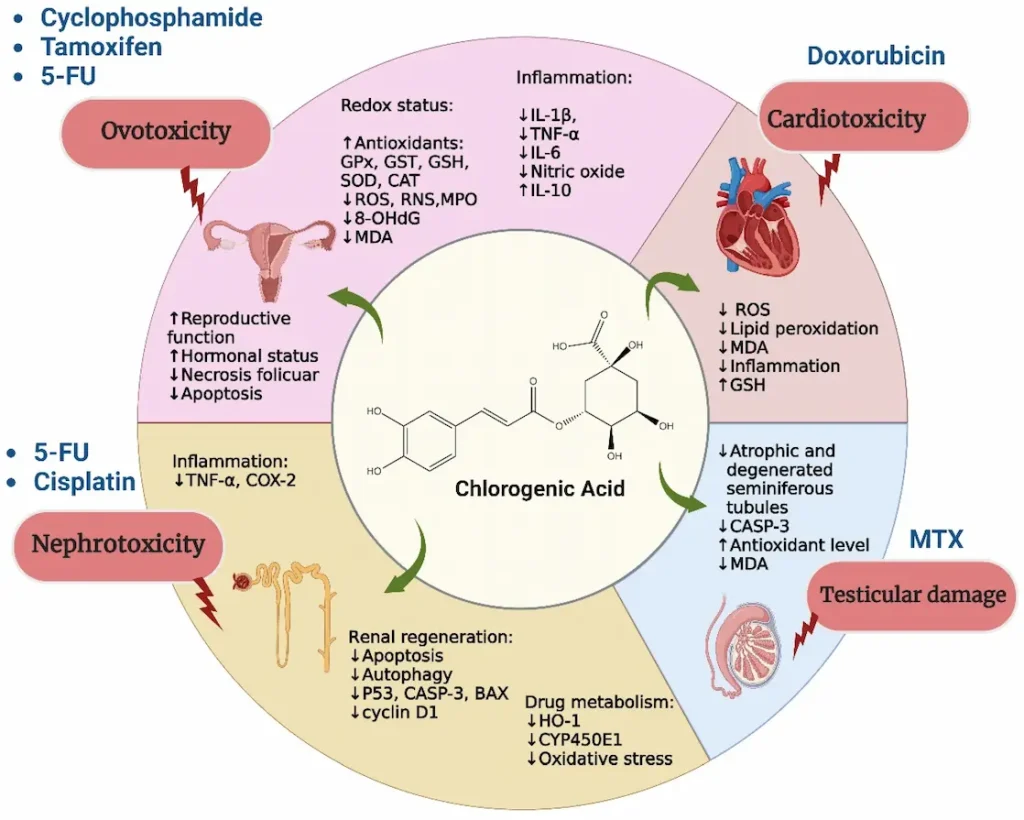
Chlorogenic acid refers to a group of compounds often called caffeoylquinic acids (CQAs)—esters formed from caffeic acid and quinic acid. In coffee, one commonly referenced isomer is 5-O-caffeoylquinic acid (5-CQA). PubChem provides standardized chemical identity data for chlorogenic acid.
2) Where Is Chlorogenic Acid Found?
Coffee is one of the most recognized dietary sources, but CGA can also appear in a variety of fruits and vegetables. Natural levels can vary by plant variety, harvest conditions, and processing.
Common food & beverage sources
- Coffee (varies by bean type and roast level)
- Apples and pears
- Eggplant and tomatoes
- Potatoes and artichokes
- Some berries (varies by species and processing)
3) Potential Benefits of Chlorogenic Acid (What Research Suggests)
CGA has been studied in different formats (food, coffee, extracts). Findings vary depending on dose, population, and product composition.
Antioxidant activity
CGA is widely studied as a dietary polyphenol with antioxidant properties. (See systematic reviews in references.)
Metabolic support (glucose & lipid markers)
Some research explores CGA’s role in glucose and lipid metabolism pathways; outcomes depend on study design and the form of CGA used.
Weight management context (often via green coffee extracts)
Green coffee extracts (which contain CGAs) are frequently marketed for weight management; reviews discuss potential effects but also limitations and heterogeneity in clinical evidence.
Important: If you sell supplements in the US/EU/UK, marketing claims should align with applicable claims rules (see Regulatory Sources below).
4) Safety, Side Effects & Precautions
Chlorogenic acid is widely consumed in food and beverages. Concentrated extracts may not be suitable for everyone.
Possible side effects (reported with concentrated extracts in some users)
- Mild digestive upset
- Sensitivity symptoms such as jitteriness, often related to caffeine if the product is coffee-derived
Who should be cautious
- Individuals using blood sugar or blood pressure medications
- People sensitive to caffeine (choose low-caffeine or decaffeinated options)
- Pregnant or breastfeeding individuals should consult a healthcare professional
Practical note: CGA and “green coffee products” are not identical—green coffee extracts may contain caffeine unless specifically reduced/removed.
For Manufacturers & Bulk Buyers: 98% CGA Sourcing Guide (Low-Caffeine Option)
If you are sourcing chlorogenic acid as an ingredient, your key procurement risks are usually assay method clarity, batch consistency, and documentation completeness. Below is a buyer-focused checklist.
5) Mainstream Market Spec: 98% Chlorogenic Acid (HPLC)
Our core supply focus
- Chlorogenic Acid ≥98% (HPLC)
- Suitable for supplement manufacturing and functional ingredient applications that require precise dosing and higher purity
- Low-caffeine requirement supported (request caffeine test and target limit in your RFQ)
Customization options (common requests)
- Low-caffeine / caffeine-controlled lots (with supporting test results)
- Particle size / flowability optimization for encapsulation/tableting
- Packaging customization (1 kg / 25 kg and export-ready options)
6) COA Checklist: What Buyers Should Verify
A professional COA should include:
Identity & traceability
- Product name, batch/lot number, manufacturing date
- Reference to the analytical method used for assay (e.g., HPLC)
Assay
- Chlorogenic acid content result (e.g., ≥98%)
- Method details available upon request (chromatogram availability is a plus)
Safety and contaminants (as required by your market)
- Heavy metals (Pb/As/Cd/Hg)
- Microbiology (TPC, yeast & mold; pathogens if applicable)
- Pesticide residues (risk- and market-dependent)
- Residual solvents (if solvent extraction is used)
- Caffeine test (for low-caffeine claims/specs)
7) Typical Documentation Pack (Standard for B2B Qualification)
Commonly provided documents for procurement and regulatory review:
- COA (Certificate of Analysis)
- Specification Sheet / TDS
- SDS/MSDS
- Allergen Statement
- Non-GMO Statement
- TSE/BSE Statement
- Residual Solvents Statement
- Country of Origin (COO)
- Additional test reports upon request (heavy metals, micro, pesticides, caffeine)
8) Typical MOQ, Lead Time & Packaging (Industry-Typical)
Because buyers’ requirements vary (destination market, testing panels, customization), these are typical ranges:
MOQ
- Samples: 100 g – 1 kg
- Bulk: commonly 1–25 kg for standard lots; larger volumes for long-term supply programs
Lead time
- Standard lots: commonly 7–15 business days
- Customized requirements (e.g., low-caffeine target): commonly 2–4 weeks depending on testing/production scheduling
Packaging
- 1 kg foil bag (inner) + carton
- 25 kg fiber drum (double PE inner liners), export-ready
9) How to Request a Quote (RFQ Template)
To receive an accurate quote quickly, send:
- Spec: Chlorogenic Acid ≥98% (HPLC)
- Low-caffeine target (yes/no; provide target limit if you have one)
- Application: capsules/tablets/powder blend/functional ingredient
- Destination market: US/EU/UK/Other
- Required documents: COA + SDS + Allergen + Non-GMO + (others)
- Order quantity + annual forecast
- Preferred incoterms and destination port
Bulk inquiry: liaodaohai@gmail.com
FAQ
Is ORAC a good way to judge CGA effectiveness?
ORAC is an in-vitro antioxidant test and has been widely criticized as being misused for marketing; USDA removed its ORAC database due to concerns about biological relevance and misuse.
Can you supply low-caffeine CGA?
Yes—request caffeine testing and a defined limit in the RFQ so it can be controlled and verified on documentation.
What’s the difference between CGA and green coffee extract?
Green coffee extract is a botanical extract that may contain CGAs and other compounds (including caffeine unless reduced). 98% CGA is a higher purity ingredient used when precise dosing and tighter specs are required.
References & Regulatory Sources
CHEMICAL IDENTITY
1) PubChem – Chlorogenic acid (Compound ID 1794427)
https://pubchem.ncbi.nlm.nih.gov/rest/pug_view/data/compound/1794427/XML/?response_type=display
Use: authoritative chemical identity, synonyms, formula, structure.
RESEARCH REVIEWS (EVIDENCE CONTEXT)
2) MDPI Nutrients – Chlorogenic Acid: A Systematic Review (review)
https://www.mdpi.com/2072-6643/16/7/924
Use: overview of mechanisms and evidence landscape.
3) ScienceDirect – Chlorogenic acids: pharmacological systematic review
https://www.sciencedirect.com/science/article/pii/S0944711323003227
Use: evidence summary (note: paywalled; still credible for referencing existence of reviews).
US CLAIMS COMPLIANCE (DIETARY SUPPLEMENTS)
4) FDA – Structure/Function Claims
https://www.fda.gov/food/nutrition-food-labeling-and-critical-foods/structurefunction-claims
Use: defines structure/function claims and how FDA views them.
5) eCFR – 21 CFR 101.93 (Structure/Function claim requirements + disease claim criteria)
https://www.ecfr.gov/current/title-21/chapter-I/subchapter-B/part-101/subpart-F/section-101.93
Use: primary legal text for compliant claim framing and disclaimer requirements.
EU/UK CLAIMS COMPLIANCE
6) EUR-Lex – Regulation (EC) No 1924/2006 (Nutrition & health claims)
https://eur-lex.europa.eu/eli/reg/2006/1924/oj/eng
Use: legal framework for health/nutrition claims in EU.
7) European Commission – EU Register of Nutrition & Health Claims
https://food.ec.europa.eu/food-safety/labelling-and-nutrition/nutrition-and-health-claims/eu-register-health-claims_en
Use: check whether a claim is authorised, non-authorised, or conditions of use.
ORAC CONTEXT (AVOID MISUSE)
8) Nutraceuticals World – USDA ORAC database withdrawn (2012) and why
https://www.nutraceuticalsworld.com/exclusives/orac-database-withdrawn/
Use: supports removing ORAC-number marketing and keeping claims conservative.
Bulk Supply & Technical Support
Get direct factory quotes, COA, and MSDS within 12 hours. We support bulk supply and custom specifications.
Fast Response via Email/WhatsApp
Get direct factory quotes, COA, and MSDS within 12 hours. We support bulk supply and custom specifications.