Urolithin A 99% Bulk Powder — Manufacturer & R&D Supply
CAS 1143-70-0 · Batch qualification for supplement brands, CMOs, importers and formulation R&D teams.
1. Buyer & R&D Dual-Track Supply
Commercial qualification
Request current MOQ, qualified lot, origin, pack size, export documents, FOB/DAP terms and prices for 1 kg, 10 kg, 25 kg or 50 kg. Stock, current pricing and shipment dates must be confirmed in writing.
Evidence-based ingredient approval
Request the actual lot COA, HPLC identity/purity method, residual-solvent profile, analytical identity documents and particle-size distribution for the exact grade under evaluation.
2. What Is Urolithin A?
Urolithin A (UA) is a defined small molecule that can be generated by certain gut microorganisms from ellagic acid–related dietary precursors. Commercial Urolithin A powder is the isolated chemical entity; it is not equivalent to pomegranate fruit extract or ellagic-acid powder.
AIHerba positions this page for purchasing teams seeking a specified raw ingredient, rather than retail supplementation advice. The intended finished-product use must be reviewed separately for each destination market.
3. Chemical Identity & Registry
| Field | Value |
|---|---|
| Chemical name | Urolithin A |
| CAS registry number | 1143-70-0 |
| Molecular formula | C13H8O4 |
| Molecular weight | 228.20 g/mol |
| Reference identity | 3,8-Dihydroxybenzo[c]chromen-6-one |
| Botanical species / plant part | Not applicable to the isolated Urolithin A molecule |
| Product standard | In-house specification; no USP/EP/BP product monograph claimed |
Molecular identity source: PubChem CID 5488186. The actual manufacturing route and material origin must be documented for the offered lot.
4. 12-Point Technical Qualification Dashboard
5. HPLC Purity, Identity & Assay Interpretation
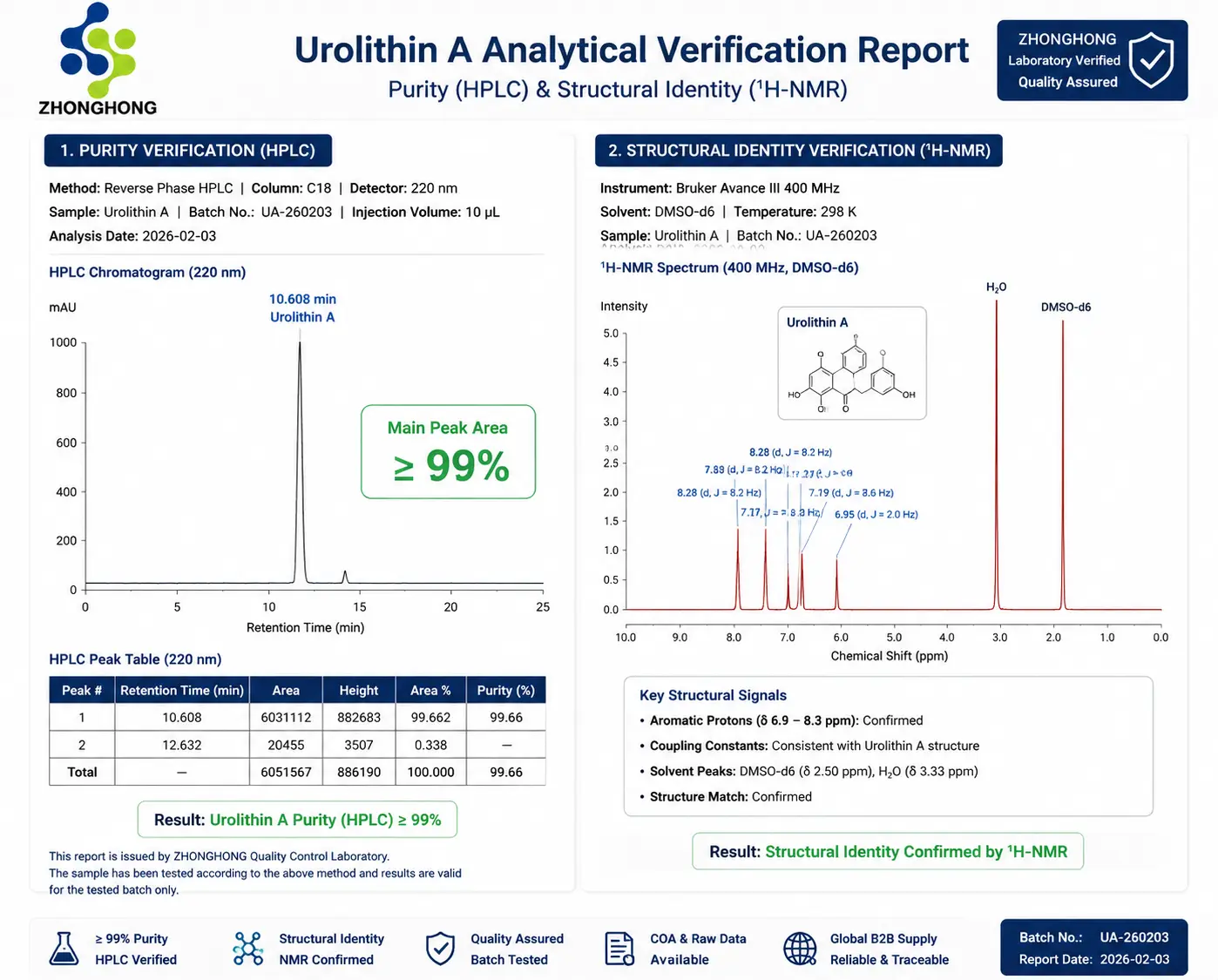
For a ≥99% Urolithin A grade, AIHerba recommends reviewing the test method together with the batch COA, not merely a headline purity percentage. Buyers should clarify whether the reported percentage is assay by external standard, chromatographic area normalization or another calculation basis.
| Qualification question | What to request |
|---|---|
| How is 99% calculated? | Calibration and quantitation approach, standard purity, calculation basis |
| Which batch was tested? | Lot number, test date, linked chromatogram and signed COA |
| Are related compounds visible? | Impurity profile, peak integration and acceptance criteria |
| Can the method be replicated? | Method summary, extraction solvent, column/detector settings and reference standard information |
No synthetic chromatograms or fictional peak retention times should be posted. Add actual batch HPLC data only after QC authorization.
AIHerba historical benchmark: Our ingredient directory cites a representative 99.66% HPLC Urolithin A result. This is an earlier reported example, not a guarantee for the lot currently offered; ask for the matched batch COA and chromatogram before placing a purchase order.
6. NMR / LC-MS Molecular Identity Verification
A purity number does not independently establish molecular identity. Spectroscopic and mass-spectrometric documents may support structural confirmation, while HPLC provides a separate quantitative result. For regulated or high-value projects, align the identity report to the lot listed on the COA.
¹H NMR / LC-MS
Provide the available report with solvent, instrument conditions and interpretation tied to the sample or batch. An NMR spectrum alone is not a substitute for quantitative HPLC purity.
Request a matched dossier
Ask for batch number, method version and any reference-standard comparison before approving raw material for a commercial formula.
7. COA & Quality-Control Review Matrix
| Control category | What the buyer should verify | Release basis |
|---|---|---|
| Assay / related substances | Urolithin A HPLC assay and known/unknown impurities | Actual batch COA |
| Identity | Validated identity method and reference comparison | Available batch dossier |
| Heavy metals | Pb, As, Cd, Hg limits and results where tested | Market/product-specific agreed specification |
| Residual solvents | Used solvents, applicable limits and headspace-GC results | Actual process and released COA |
| Microbiology | Applicable total count and specified pathogens | Agreed application specification |
| Particle size | Mesh screen or PSD/D10-D50-D90 by grade | Actual sieve/laser-diffraction report |
| Stability | Study condition, packaging, time point and acceptance limits | Written protocol and study report |
This matrix is a buyer qualification checklist—not a claim that every test and document is available for every AIHerba lot. Request a signed, batch-matched dossier before approval.
8. Standard, Micronized & Formulation-Specific Grades
| Grade | Meaning | Buyer decision |
|---|---|---|
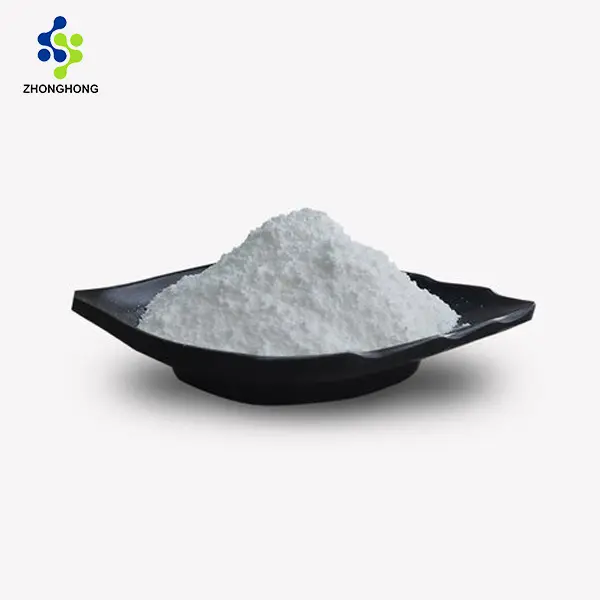
| Standard Urolithin A ≥99% | Default isolated powder; particle-size specification is batch-dependent | Request conventional powder sample and COA |
| Micronized Urolithin A | Smaller particle-size distribution only when supported by a PSD report | Specify required D90 and test method; request matching sample |
| Specialized delivery grade | Engineered dispersion or delivery format, not interchangeable with pure 99% powder | Request composition, active-content basis and formulation-specific stability data |
A smaller particle size may change processing and dispersion behavior; it must not be presented as proof of superior clinical efficacy or bioavailability without comparative evidence.
9. Solubility, Dispersibility & Formulation Constraints
Conventional Urolithin A has limited water solubility. For beverages or aqueous systems, do not equate fine particles with true dissolution. Formulators should distinguish dissolved concentration, suspended dispersion and long-term physical stability.
Capsules / tablets
Evaluate particle size, blending uniformity, flow, compression behavior, excipient compatibility and finished-unit content uniformity.
Powders for reconstitution / beverages
Confirm sedimentation, dispersibility, taste, color, viscosity, accelerated stability and the finished product’s regulatory position.
10. Source, Manufacturing Route & Traceability
Buyers should receive a factual declaration of the manufacturing pathway used for the offered grade. “Naturally occurring metabolite” describes the molecular biology; it does not establish that a commercial production batch was directly extracted from fruit.
Ask for the qualified manufacturing site, traceability of starting materials, process overview as disclosure permits, solvent controls, impurity rationale and batch numbering. AIHerba should publish site certificates only when the manufacturing scope covers the supplied material.
11. Storage, Handling, Shelf-Life & Packaging
Transport and warehouse storage should follow the released product specification and applicable SDS. Protect the powder from moisture, contamination and uncontrolled exposure. Confirm inner liners and pack size before shipment, including any requirements for nitrogen protection or custom secondary packaging.
Do not state a universal 36-month shelf life when the available supporting stability study covers only 24 months. Shelf life must be traceable to a specific grade, package and approved stability justification.
Current website statements about 1 kg foil bags, 25 kg drums and 36 months require confirmation against the real released commercial specification.
12. Documentation, Certifications & QA Support
COA / TDS / SDS
Request current lot-specific certificate, specification sheet, safety data sheet and methods relevant to the application.
GMP / ISO / process scope
Ask for current documents and confirm their issuing body, validity, facility address and which operation/product categories are covered.
Optional documents—including method chromatograms, residual-solvent reports, NMR, PSD or stability summaries—should be described as available only when validated and approved for disclosure.
13. United States Regulatory & Patent Qualification
A U.S. product-development review should distinguish ingredient identity, safety substantiation, dietary supplement/food pathway, labeling, patent exposure and manufacturing equivalence. A third-party regulatory record is not automatically transferable to a different manufacturer, manufacturing route or finished-product use.
FDA GRAS Notice 791 was submitted by Amazentis SA for specified food uses; FDA indicated no questions regarding that notifier’s conclusion. This is not an FDA approval of AIHerba Urolithin A, nor evidence that a particular AIHerba lot holds NDI, GRAS or patent clearance.
For U.S. projects, request a market-specific regulatory package and independent legal FTO review before making regulatory commitments or consumer claims.
Ready to Evaluate a Specific Urolithin A Grade?
Choose the document, sample or quotation needed to move your R&D and procurement review forward.
State 80 mesh or your actual D90 requirement; availability must be confirmed.
Sample size, particle-size specifications, document release and current prices are confirmed case by case.
14. EU & Other Target-Market Qualification
European Union, UK, South Korea, Australia and other destinations may apply different rules depending on whether the ingredient is used in conventional food, food supplements, cosmetics or another product category. Regulatory suitability cannot be inferred solely from a COA, PubMed paper or a U.S. GRAS notice.
Before quotation or shipment, the buyer and manufacturer should establish the legal product category, proposed daily intake, use level, ingredient status, required importer documentation and jurisdiction-specific labeling restrictions.
15. Human Research: What Published Trials Actually Show
Published clinical research has investigated Urolithin A under defined conditions. A 2019 human study examined safety, exposure and mitochondrial-related biomarkers. A 2022 randomized trial in older adults investigated endurance and mitochondrial outcomes, with differences across endpoints.
These publications are scientific context—not proof that an untested AIHerba ingredient lot will reproduce the same biological or clinical outcomes. Avoid disease treatment claims and avoid describing all reported findings as uniformly positive.
See the three linked primary regulatory/scientific sources in Section 20.
16. Industrial Applications & Formulation Decision Paths
Capsule / tablet concepts
Discuss active-content target, excipient choices, blend uniformity, PSD, ingredient identity and intended country of sale.
Dispersion and specialized formats
Evaluate true solubility versus dispersion, particle-size targets, stability and compositional disclosures before claiming delivery advantages.
Regulatory and supply review
Request site identity, lot release papers, Incoterms, packaging, traceability and regulatory route for the destination market.
17. MOQ, Samples, Quotations & Shipping
| Project stage | High-intent buyer request | AIHerba response |
|---|---|---|
| Technical screening | 10–50 g evaluation quantity and batch COA | Quote sample availability, fee and shipping |
| Pilot order | 1 kg / 5 kg / 10 kg | Confirm grade, MOQ and packaging |
| Commercial supply | 25 kg / 50 kg / 100 kg+ | Issue current offer with FOB/DAP/DDP where supported |
| Repeat orders | Annual volume and delivery calendar | Discuss batch reservation, QC requirements and forecast |
All offers should identify the grade, lot availability, shipment origin, currency, Incoterms, quoted validity, lead time and which tests/documents are included.
18. Buyer Qualification Checklist & Supplier Comparison
| Check | Minimum evidence for a qualified offer |
|---|---|
| Correct molecule | Urolithin A CAS 1143-70-0, not generic pomegranate extract |
| Purity | HPLC assay basis and report for offered batch |
| Identity | At least the applicable identity method and result |
| Physical grade | Mesh or D90 values tied to a sample |
| Regulatory | Use-specific, country-specific suitability and patent/FTO review |
| Commercial | Transparent MOQ, current stock check, packaging, lead time and price terms |
A cheaper price is not always comparable unless both offers cover the same purity basis, identity controls, particle-size grade, analytical dossier and delivery terms.
Related AIHerba resources
This product page focuses on the standard ≥99% HPLC procurement specification. Explore related AIHerba ingredients or request the current batch documentation before qualification.
AIHerba ingredient directory → Healthy Aging Ingredients → Contact for Batch Qualification →
19. Frequently Asked Questions — B2B Urolithin A
Is this Urolithin A the same as pomegranate extract?
No. Urolithin A is the identified molecule CAS 1143-70-0; pomegranate extract and ellagic acid are different materials.
What does ≥99% HPLC mean?
It refers to the specified assay grade. Please review the actual batch COA and the stated quantitation approach before purchasing.
Do you provide a batch COA and HPLC chromatogram?
Batch COA and available chromatographic materials can be requested; delivery depends on the actual released lot and document permissions.
Can I request 80 mesh or D90 ≤10 μm powder?
Specify the target mesh or particle-size distribution and the required test method. Only a matching grade supported by actual particle-size data should be offered.
Is Urolithin A powder water-soluble?
Conventional Urolithin A has poor water solubility. Micronization and formulation technology may change processing behavior, but not automatically confer true water solubility.
Does your ingredient have FDA GRAS or NDI approval?
Amazentis SA submitted FDA GRN 791 for specified food uses; that does not establish a GRAS or NDI regulatory basis for AIHerba material. Request a separate regulatory qualification review.
Can AIHerba quote 1 kg, 10 kg, 25 kg or 50 kg?
Yes, you may request these quantity tiers. The actual grade, batch availability, lead time and current quotation are confirmed individually.
Are clinical claims and patent freedom-to-operate included in the COA?
No. A COA addresses chemical and quality attributes of a batch. Finished-product claims and patent/FTO require separate scientific, regulatory and legal assessments.
20. References & Regulatory Context
The following original sources provide independent regulatory and human-research context. They do not substitute for a batch COA, a manufacturer-specific safety assessment or a product-specific legal opinion.
📑 1. FDA — GRAS Notice No. 791 (Urolithin A)
Notifier: Amazentis SA; FDA indicated no questions regarding that notifier’s GRAS conclusion for specified intended uses. Not a blanket clearance for unrelated manufacturers or dosage forms.
📑 2. Liu S, et al. JAMA Network Open (2022), PMID 35050355
Randomized trial in 66 older adults; muscle-endurance findings were endpoint-specific. Results cannot be directly attributed to an untested commercial ingredient batch.
📑 3. Andreux PA, et al. Nature Metabolism (2019), PMID 32694802
Early human trial examining safety, bioavailability and mitochondrial biomarkers. It is background literature, not clinical testing of AIHerba raw material.
⚠ Scientific & Regulatory Disclaimer
The cited FDA notice concerns a third-party notifier and specified conditions of use. Published clinical outcomes concern studied products, participants and protocols—not AIHerba batch-level efficacy. This page is intended for professional sourcing and ingredient qualification, not medical advice or a representation of FDA/EFSA approval, patent clearance, lawful market access or finished-product clinical performance. The buyer and qualified regulatory professionals must assess each final formulation and jurisdiction. Manufacturer claims and product specifications require current supporting documentation.
Qualifying Urolithin A 99% for Your Next Production Run?
Tell us the target grade, particle size, intended market and annual volume. We will review the available batch dossier, evaluation sample options and commercial terms.
Certification & Technical Assurance Card
AIHerba® supports professional procurement through batch-linked analytical documents and manufacturing-site qualification materials, subject to the scope and validity of the current records. The validity and product/process scope of site certifications must be confirmed for the material offered.
Documentation, testing, samples and DDP options depend on the selected grade and destination.