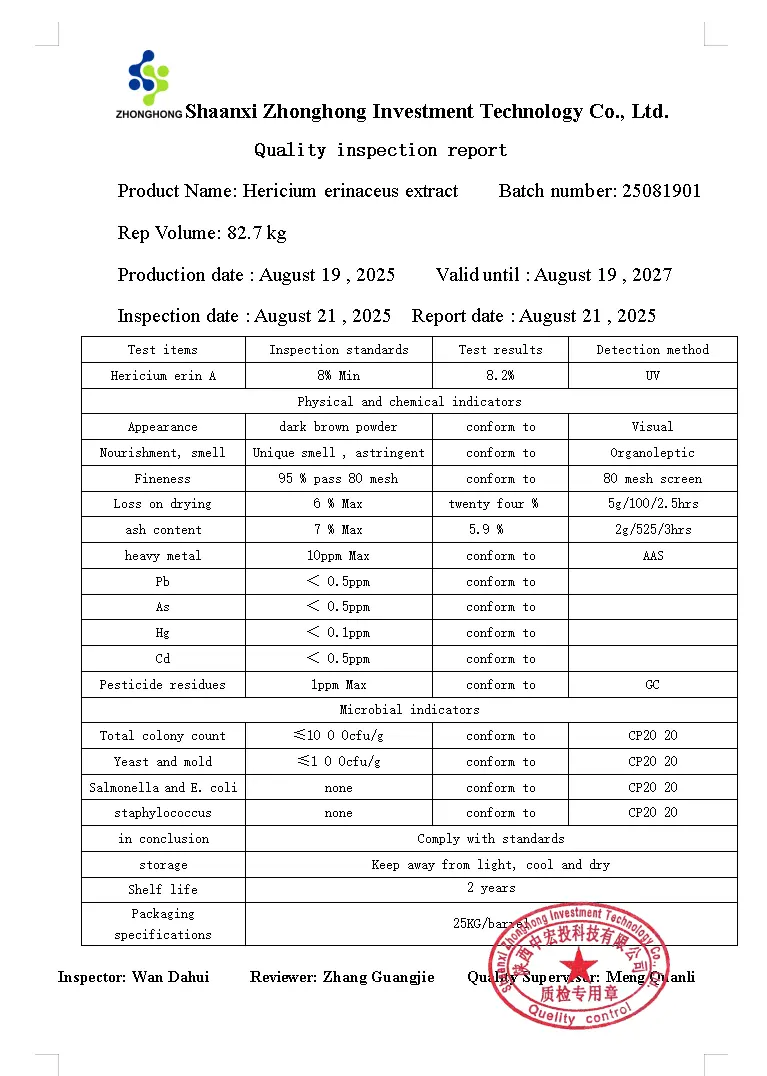
AIHerba® supplies Hericium erinaceus fruiting-body extracts for nutraceutical manufacturers, formulation laboratories and bulk ingredient buyers. The manufacturer technical response reports analyte-specific HPLC external-standard results for Hericenones C, D and E and separately for Hericenes A, C and D.
Example microencapsulated lot YFS261020-01 reported 3.92% Hericenones C+D+E and 1.32% Hericenes A+C+D. These are reported reference-lot results, not guaranteed levels for every shipment.
01Procurement & R&D Qualification
AIHerba® supplies Lion’s Mane (Hericium erinaceus) fruiting-body extracts for nutraceutical formulators and bulk ingredient buyers. The reported analytical program quantifies Hericenones C, D and E separately by HPLC using corresponding reference standards; Hericenes A, C and D form a separate analytical group.
R&D Qualification Path
Request analyte-specific assay conditions, standard details, reference-batch chromatograms, dispersion evaluation and stability evidence.
Wholesale Procurement Path
State target marker group, required annual kg, preferred drying route, destination, packaging and proposed delivery schedule.
B2B Decision Gate: Select the Testable Grade First
For a Lion’s Mane Hericenones bulk manufacturer or supplier inquiry, the first decision is the requested analyte group, not a generic “mushroom extract percentage.” Buyers should specify whether their target is Hericenones C+D+E, Hericenes A+C+D, beta-glucans, or a combination reported as separate release tests.
| R&D / Quality Reviewer | Procurement / Sourcing Reviewer |
|---|---|
| HPLC method, standards, sample-to-batch map, assay basis (as supplied or dry basis). | Requested kg per release, annual forecast, production route, packaging and shipping Incoterm. |
| Full quantitative composition, residual ethanol, microbial and elemental results. | Quoted lot number, lead time, representative sample and documentation release status. |
02Fruiting-Body Botanical Identity
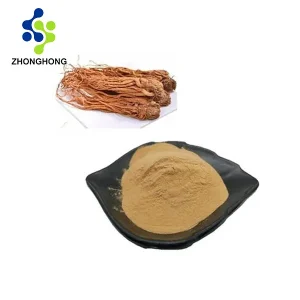
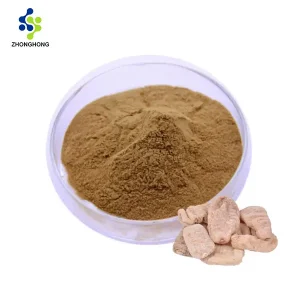
Hericium erinaceus (Bull.) Pers. is the species identified in the supplier’s technical response. The product described here uses the fruiting body, not an erinacine-standardized mycelium fermentation powder. Raw-material identification, geographic origin and plant-part declaration should accompany batch qualification.
Reported fruiting-body sourcing is cultivated material; actual regional origin and chain-of-custody records are confirmed for the chosen lot.
Fruiting Body ≠ Mycelium
- The source supplied for this offer is cultivated Hericium erinaceus fruiting body; the manufacturer reports no added mycelium or cultivation substrate in the selected raw-material route.
- The manufacturing response names cultivated supply from Gutian, Fujian and Changshan, Zhejiang. Confirm the exact region for the commercial lot rather than assigning every shipment one origin.
- Request raw mushroom botanical ID records, the species report, botanical-part declaration and traceable raw-material procurement documentation.
03Hericenones vs. Hericenes: Not One Assay
| Analyte group | Included markers | What it means |
|---|---|---|
| Hericenones | C, D, E | Report each HPLC value and separately show C+D+E subtotal |
| Hericenes | A, C, D | Different marker family; report separately from Hericenones |
| Erinacine A | Not part of this product claim | Commonly associated with mycelium products; do not mix with this fruiting-body grade |
A generic CAS number for Hericenone B does not identify the C+D+E mixture. Individual chemical identities should be assigned only to verified isolated analytes.
Buyer-Facing Assay Name and CAS Treatment
The appropriate commercial description is “Hericenones C+D+E by HPLC, with Hericenes A+C+D reported separately.” The individual Hericenone C, D and E results are summed only within their own analytical group. A number assigned to Hericenone B cannot represent the entire fruiting-body extract or a multi-analyte blend.
042026 Reference Batch: Quantified Markers
Manufacturer-reported example — microencapsulated batch YFS261020-01. These are historical technical-response values, not the specification of every shipment lot.
| Marker / Group | Reported value (w/w) | Method / status |
|---|---|---|
| Hericenone C | 2.43% | HPLC, external standard (reported) |
| Hericenone D | 1.09% | HPLC, external standard (reported) |
| Hericenone E | 0.40% | HPLC, external standard (reported) |
| Hericenones C+D+E | 3.92% | Sum of three distinct markers |
| Hericene A | 0.78% | HPLC, external standard (reported) |
| Hericene C | 0.34% | HPLC, external standard (reported) |
| Hericene D | 0.20% | HPLC, external standard (reported) |
| Hericenes A+C+D | 1.32% | Separate subtotal; not “total Hericenones” |
Additional Reported Carbohydrate Tests — Different Analytical Endpoints
| Reported item / same technical reference | Value | Qualification caveat |
|---|---|---|
| Beta-glucans | 23.44% | Enzymatic kit reading; carrier interference must be evaluated |
| Alpha-glucans | 9.33% | Separate from beta-glucans and Hericenones |
| Total polysaccharides | 57.71% | Method and matrix effect need formal review |
These carbohydrate results were supplied in the same factory technical response for the microencapsulated reference lot YFS261020-01. They are not substitutions for the six compound-specific HPLC values; gum arabic and beta-cyclodextrin may affect carbohydrate-based assays.
05HPLC Quantitation & Standards
The factory reports HPLC external-standard quantitation for Hericenones C, D and E and Hericenes A, C and D. For buyer qualification, the SOP should identify each standard, sample preparation, detector/wavelength, column, resolution, retention-time windows, linear calibration, LOD/LOQ and repeatability.
Direct UV absorbance is not interchangeable with HPLC-separated analyte quantitation. This product does not offer a validated “≥3% total Hericenones by direct UV” equivalence claim.
HPLC External-Standard Method: Minimum Review Package
| Technical item | What qualified buyers should receive |
|---|---|
| Reference standards | Chemical identity, supplier, lot number, assigned purity and preparation record for each of the six analytes |
| Chromatography | Column, mobile phase, flow, detection wavelength, run sequence, retention-time windows and peak resolution |
| Quantitation | Calibration range, external-standard calculation, sample dilution, reportable basis and individual integration results |
| Method suitability | Specificity, precision, repeatability, LOD/LOQ and suitability for the chosen carrier matrix |
The technical team reports use of corresponding reference standards and an external-standard HPLC method. A direct-UV spectrophotometric number is not an automatically equivalent specification; if a buyer’s purchase specification demands ≥3% by UV, that requirement must be renegotiated or separately validated.
06Chromatograms, Sample Mapping & Data Integrity
Match the reference standard injections, sample chromatogram and instrument sequence to the actual batch number. Retain original peak tables, chromatographic conditions, integration settings and signed reports. Actual chromatogram images should only be displayed when an approved sample-to-lot record is available.
Real HPLC Image Placement — Do Not Draw a Fake Chromatogram
After the Quality team releases the authentic chromatogram, place a readable image immediately after the method explanation. The caption should identify the specimen ID, lot YFS261020-01, wavelength and retention times as printed on the report; do not invent these parameters for visual design.
aiherba-hericenones-cde-hplc-batch-yfs261020-01.webp. Alt: “HPLC chromatogram of Hericenones C, D and E for verified reference batch YFS261020-01.” No claim of a third-party test unless the actual report supports it.07Six Precision Engineering Qualifications
Six technical checks define the purchase decision. All six engineering symbols are self-contained CSS/HTML graphics (no SVG, external icon host or JavaScript). Card colors represent workflow areas, not certification or assay approval.
08Two Different Processing Routes
| Review criterion | Freeze-dried extract route | Microencapsulated powder route |
|---|---|---|
| Reported batch-size capability | Approx. 100 kg per production batch | Approx. 300 kg per production batch |
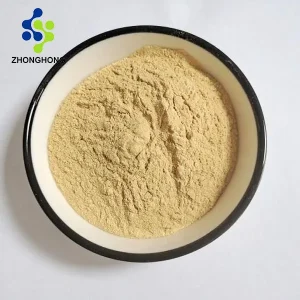
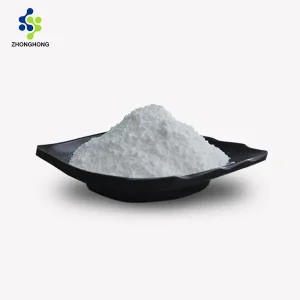
| Appearance | Light yellow powder | Off-white powder |
| Composition | Extract dried with added Lion’s Mane fruiting-body powder | Extract + gum arabic / β-cyclodextrin / sucrose-esters system |
| Water behavior | Not fully water-soluble | Designed for improved water dispersion; not proven molecular dissolution |
| Typical evaluation | Capsules, dry blends | Beverage/powder formulation trials |
Production-batch size is an engineering reference, not current inventory or guaranteed MOQ.
Manufacturing Technical Response — Details by Route
| Process evidence | Freeze-dried route | Microencapsulated route |
|---|---|---|
| Raw extract solvents | Water and food-grade ethanol | Water and food-grade ethanol |
| Reported powder form | Light-yellow, with added fruiting-body powder | Off-white, with gum arabic, beta-cyclodextrin and sucrose esters |
| Reported tapped density | More than 0.6 g/mL (manufacturer indication) | More than 0.5 g/mL (manufacturer indication) |
| Reported production batch scale | Approximately 100 kg | Approximately 300 kg |
| Ethanol / dispersion caveat | Residual ethanol requires lot GC; not fully water-soluble | Manufacturer describes improved dispersibility; lot GC and application evaluation still required |
For one reported freeze-dried example, native DER 7–8:1 differs from commercial DER 3–4:1 because added fruiting-body powder changes the finished product mass. Those ratios are process examples, not universal labels for every grade.
09Full Quantitative Carrier Declaration
The freeze-dried grade contains added botanical powder; “carrier-free” does not mean 100% isolated Hericenones. The microencapsulated grade may contain gum arabic, β-cyclodextrin and sucrose fatty-acid esters, and must be supplied with actual percentages that total 100%.
Request separate statements for added carriers, processing aids, food-grade solvents, extract solids, moisture and allergens. Do not infer the full composition from a chromatographic marker percentage.
Quantitative Composition Declaration — 100% Mass Balance
| Declare for the selected grade | Required reporting |
|---|---|
| Native extract solids | Weight percentage and reference test basis |
| Added fruiting-body powder | Botanical identity, quantity and percentage (freeze-dried route) |
| Gum arabic / beta-cyclodextrin / sucrose esters | Individual percentages and origin (microencapsulated route) |
| Residual water, carriers and process aids | State intentional additives; identify relevant residual testing and total formulation percentage |
The composition declaration must total 100% for the commercial powder. Do not interpret “3.92% Hericenones” as “96.08% uncharacterized carriers” or as a full composition statement.
10Dispersion, Solubility & Formulation Engineering
Powder wetting, suspension, true dissolution and physical stability are separate outcomes. Confirm intended matrix (water, beverage, dry mix or capsule), pH, shear conditions, treatment temperature, hold time, appearance and sedimentation. The microencapsulated route is the logical candidate for water-dispersible work, subject to real application tests.
Formulation Fit Matrix — Screening, Not a Performance Warranty
| Format | Likely development route | Qualification tests |
|---|---|---|
| Hard capsules / tablets | Freeze-dried or selected microencapsulated grade | Dose uniformity, flow, segregation, humidity and oxidation |
| Dry powder blend | Either grade following bench screening | Wet-out, flavor, mixing uniformity, oxidative exposure |
| Functional beverage / reconstitutable drink | Microencapsulated dispersion candidate | Wetting time, particle suspension, sedimentation, pH, thermal processing and 24-hour appearance |
| High-temperature process | No assumed suitability | Marker retention and accelerated hold tests against actual processing conditions |
The term water-dispersible refers to physical distribution of the powder and does not establish molecular solubility, optical clarity, chemical stability or oral bioavailability. Develop a verified formulation specification only after testing the actual offered lot.
11Particle Size, Powder Flow & Filling
Request measured sieve data, tapped/bulk density, loss on drying, water activity and fill-weight variability. The supplier reports that 95% passing an 80-mesh sieve can be evaluated, but an actual lot sieve result must substantiate any final claim.
What to Request for Capsule and Powder Filling
- Sieve/particle-size test such as ≥95% passing 80 mesh only if the actual lot is tested; the factory currently describes this target as feasible.
- Tapped density values are manufacturer indications, not confirmed current-lot COA entries. Request the bulk-density test method and the current batch result.
- Loss on drying: supplier describes a 7% general specification with approximately 3–5% typical readings. Confirm the specific commercial-grade limit instead of silently substituting a stricter buyer target.
- Request water activity, hygroscopicity, clumping, flowability and capsule fill-weight variation where important to the downstream line.
12Residual Solvents, Metals & Microbiology
Food-grade ethanol and water are reported extraction media. The freeze-dried route may retain ethanol; the microencapsulated route is reported as solvent-residue free, but this must be confirmed by the current-lot GC result and detection limit. Do not label a grade “zero solvents” from process description alone.
Heavy metals, microbiology, pesticides/ETO/2-CE, PAHs and mycotoxins should be reviewed against the buyer’s market and finished-product use. Use actual third-party reports, units, methods and reporting limits; legacy website acceptance numbers are not proof of current compliance.
Typical Buyer Limits Are Not Certificates of Batch Compliance
| Audit item | Buyer qualification target (example) | Current evidence status |
|---|---|---|
| Lead (Pb) | ≤2.0 mg/kg | Manufacturer reports compliance; obtain signed lot result / LOQ |
| Cadmium (Cd) | ≤1.0 mg/kg | Manufacturer reports compliance; obtain signed lot result / LOQ |
| Arsenic (As) | ≤1.0 mg/kg | Manufacturer reports compliance; obtain signed lot result / LOQ |
| Mercury (Hg) | ≤0.1 mg/kg | Manufacturer reports compliance; obtain signed lot result / LOQ |
| Total aerobic count | ≤10,000 CFU/g | Request relevant batch result and method |
| Yeast / mould | ≤100 CFU/g | Request relevant batch result and method |
| Residual ethanol | ≤50 mg/kg if specifically requested by buyer | Freeze-dried manufacturing target differs; need GC validation of capability |
The factory technical response describes a residual-ethanol internal threshold of less than 5,000 ppm for one freeze-dried route. That is not the same as a buyer’s requested limit of 50 ppm. The microencapsulated grade is described as having no solvent residue, but this must be backed by an appropriate GC result and LOQ, not by wording alone.
For EU-directed sourcing, also qualify pesticide residue, ethylene oxide/2-chloroethanol, PAH4, benzo[a]pyrene and mycotoxins when applicable. The factory reports PAH4 less than 50 ppb as a general response but this is not an approved current-lot report and does not by itself prove a market-specific limit.
13Oxidation & Shelf-Life Evidence
These marker groups can be oxidation- and heat-sensitive. Avoid excessive heat, light and oxygen exposure during formulation and transport. The supplier has discussed six-month accelerated work, but this does not itself substantiate a universal 24-month shelf life.
Packaging and Oxygen-Exposure Control Plan
- Review the selected lot’s oxygen-barrier bag, sealing process, humidity protection and carton/drum configuration.
- For microencapsulated grades, test encapsulation integrity and Hericenones retention after target process temperature and storage exposure.
- Use a real-time or validated stability program to justify the grade’s retest/expiry date; six months of accelerated information alone do not guarantee 24 months.
- Request lot-specific manufacture date, recommended storage conditions and guaranteed minimum remaining shelf life before release.
14Manufacturing Quality & Traceability
Qualify the actual manufacturing site, FSSC 22000/ISO 9001 status if applicable, production controls, botanical identity, batch documentation and release workflow. Certificates must match the site, legal entity, product scope and valid dates; do not infer a product-specific regulatory approval from a generic company certification.
Quality-System Documentation vs. Product Compliance
The manufacturing response mentions FSSC 22000, ISO 9001, organic, Kosher and Halal capability. These must be reviewed for certificate holder, factory address, scope, expiry date and the selected grade. A company-level certificate is not a replacement for product-level EU food-supplement eligibility or for a signed analytical COA.
15Production Feasibility & Available Lots
The technical team reports two processing routes with different batch-scale capabilities and changing inventory. For 25–200 kg inquiries, request the preferred marker group, target assay level, process type, annual volume, desired delivery schedule and available validated lot before quoting.
Sample and Commercial Lot Matching
The factory states that representative production-batch samples are available, with approximately 30 g free described in the customer-project response and larger samples chargeable. This was a project-specific indication, not a site-wide sample policy. The actual sample size, price, preparation time, packing and lot number must be confirmed in the quotation.
For buyers forecasting 150–200 kg per year and releases of 25–50 kg, the 100 kg freeze-dried and 300 kg microencapsulated production batch-scale indications help screen feasibility. They must not be mistaken for available sale inventory, firm MOQ, fixed lead time or a guarantee of identical markers across all manufacturing lots.
16Three-Stage Engineering Pipeline
From target monograph to feasible grade to traceable batch evidence, the technical review proceeds in a clear three-step sequence.
01 / TARGET →Target Monograph
Agree on marker set, acceptance limits, assay basis, intended application and contaminant specification.
02 / ENGINEER →Feasibility
Select freeze-dried or microencapsulated route; review composition, oxidative stability and achievable lot quantity.
03 / VERIFYVerification
Match COA, C/D/E chromatograms, standards, packaging and shipment lot before final quotation.
Pipeline Outputs Required at Each Gate
| Gate | Decision output | Do not proceed without |
|---|---|---|
| 01 · Target Monograph | Accepted marker group, assay basis, format and contamination limits | Buyer approval of HPLC vs UV method and carrier policy |
| 02 · Feasibility | Matching production route, sample size, batch capacity and stability plan | Composition declaration and evidence for offered grade |
| 03 · Verification | Signed offered-lot COA, C/D/E chromatograms, release quantities and quotation | Traceable documents and mutually approved acceptance criteria |
17Market-Specific Regulatory Review
Food supplement, cosmetic and other uses must be separately assessed under applicable national rules. Fruiting-body origin alone does not establish that every enriched Hericenones extract is non-novel in the EU. Request a grade-specific assessment that considers extraction intensity, processing aids, composition, historical use and target application.
Do not describe any nutraceutical ingredient as approved for prevention or treatment of neurological disease.
EU Novel Food and Market-Specific Screening
Lion’s Mane fruiting-body origin does not establish that every selectively enriched Hericenones extract is automatically non-novel under EU rules. Evaluate the degree of enrichment, solvent/extraction method, processing aids, chemical composition and the intended use against applicable market requirements. Manufacturer assertions and historical mushroom-food use are useful inputs, not a final legal determination.
For cosmetic, food-supplement and analytical-laboratory customers, provide use-specific documentation and avoid disease-treatment or drug-approval claims. Claims involving nerve regeneration, neurodegeneration or clinical therapeutic benefit require separate scientific and regulatory substantiation.
18Supplier & COA Qualification Checklist
- Signed specification and actual shipment-lot COA with identity and marker results
- HPLC chromatograms for C, D, E and A/C/D Hericenes with standard information and assay calculation
- Full quantitative composition of the chosen drying route
- Residual solvents, elements, microbiology and market-specific contaminant testing
- Manufacture/retest dates, packaging format, shelf-life evidence and price/Incoterm
Document-Release Status Checklist
| Document / evidence | Status before official offer |
|---|---|
| Batch-specific signed COA / six HPLC markers | Requested / QA release pending |
| HPLC chromatogram + external-standard certificates | Factory reports availability; verify sample mapping |
| Quantitative composition declaration | Pending selected grade (freeze-dried vs microencapsulated) |
| Beta-glucan / polysaccharide method and matrix interference | Factory-reported reference values; verify report |
| Residual solvents, ICP-MS, microbiology, pesticides, ETO/2-CE, PAHs | Obtain relevant valid lot-linked reports |
| Stability, storage, expiry/retest, packaging | Confirm approved study and shipment lot |
| Origin, certificates, allergen/GMO/irradiation declarations | Check actual supplier and scope |
19Hericenones Procurement FAQ
Additional Buyer Questions
Does the 3.92% reference result mean every lot is sold as ≥3.92% HPLC?
No. YFS261020-01 is a manufacturer-reported example. The offered commercial grade, analytical acceptance range and shipment-lot COA must be confirmed separately.
Are beta-glucans 23.44% and total polysaccharides 57.71% validated for the microencapsulated grade?
They are reported results in the factory technical response; carrier interference was specifically raised. Require the original method and a matrix-effect review before using these as a contractual specification.
Can this material be described as carrier-free or fully water-soluble?
Do not use those blanket descriptions. The freeze-dried route includes additional fruiting-body powder; the microencapsulated route contains functional carriers and is designed for dispersion, not necessarily clear molecular dissolution.
20Scientific References & Final Procurement CTA
Methodology reference: Simultaneous UHPLC-UV Determination of Hericenones, Hericenes, Erinacines and Ergosterol in Hericium erinaceus Raw Materials or Products (2026). This is external scientific literature and does not certify the AIHerba reference batch.
Related topic: Chinese Medicinal Mushroom Extracts. Product grade, claims and regulatory status must be evaluated for their intended market.
Share your assay targets, preferred drying route, application, required kilograms and country of delivery. We will review available batches and approved technical documentation.
Fastest Route to a Qualified Quote
When contacting AIHerba, include your Hericenones C+D+E target, whether Hericenes A+C+D and beta-glucans are also required, HPLC or UV acceptance rule, preferred freeze-dried or microencapsulated route, target application, requested lot size and annual volume, and the contaminants/packaging documentation needed for your market.
Documentation, testing, samples and DDP options depend on the selected grade and destination.