
In the landscape of cellular defense and Nrf2-activation
ingredients, Sulforaphane (CAS 4478-93-7) stands as the gold standard. However, for a procurement manager or R&D formulator, the challenge lies in the molecule’s inherent instability.
At AIHerba®, we solve the stability bottleneck through precision-engineered Glucoraphanin + Myrosinase systems and standardized pure Sulforaphane stabilized for industrial applications.
01. Industrial Procurement Snapshot
30-Second Technical Reference
| Feature | Specification / Requirement |
| Active Molecule | Sulforaphane / Glucoraphanin |
| Source Material | Brassica oleracea var. italica (Broccoli Seeds/Sprouts) |
| Standardized Specs | 1%, 5%, 10% (Custom Assay Available) |
| Testing Method | Validated HPLC-DAD / LC-MS |
| System Format | Active Sulforaphane OR Precursor + Enzyme System |
| Compliance | GMP Certified / DNA Authenticated Source |
Ready for Bulk Strategic Supply?
Get factory-direct pricing for 25kg+ orders with pre-cleared DDP logistics.
02. Understanding Ingredient Forms: Sulforaphane vs. Glucoraphanin
Professional sourcing requires a choice between the active metabolite and the stable precursor system.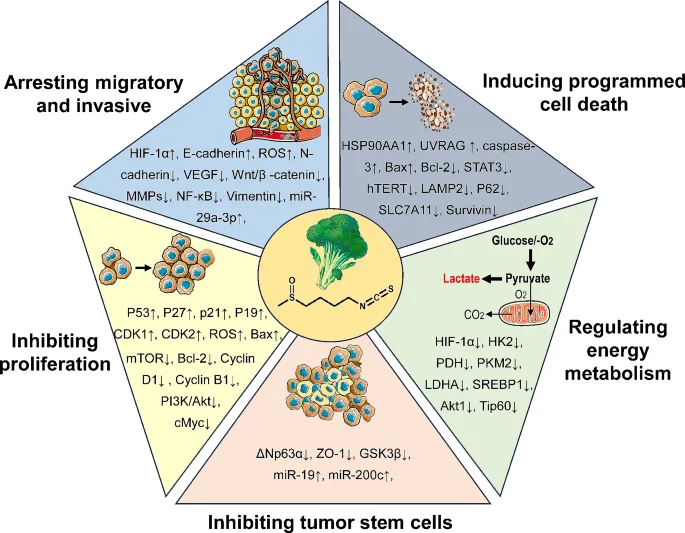
A. Standardized Sulforaphane Powder
The Active: Ready-to-use active molecule for direct formulation.
Challenge: Naturally unstable and sensitive to heat/moisture.
AIHerba Solution: We utilize low-temperature vacuum drying and specialized stabilizing carriers to ensure a 24-month shelf life.
B. The Glucoraphanin + Myrosinase System
This is the preferred format for high-tier longevity brands.
The Mechanism: Glucoraphanin (precursor) + Myrosinase(enzyme)
→H2O/GutSulforaphane.The Advantage: Superior storage stability. The conversion happens exactly when the consumer ingests the supplement, mimicking the natural biological process.
03. Pharmaceutical-Grade Quality Control (QC)
Standard “broccoli extracts” often fail to deliver consistent Nrf2 activation. AIHerba® implements a dual-layer verification matrix.
Raw Material Integrity
DNA Authentication: Verifying the specific Brassica species to prevent adulteration.
Pesticide Screening: GC-MS/MS testing for 500+ residues.
Heavy Metals: ICP-MS verification (Pb < 0.5ppm, As < 0.5ppm).
Active Ingredient Validation
HPLC Fingerprinting: Mapping the Sulforaphane peak against certified reference standards.
Enzyme Activity: Verifying Myrosinase units per gram to ensure conversion efficiency.
Stability Kinetics: Providing accelerated data (40°C / 75% RH) for all bulk batches.
04. Manufacturing Workflow: The AIHerba® Extraction Process
Google AI prefers structured data. Our process focuses on protecting the heat-sensitive Myrosinase enzyme.
Selection: Non-GMO broccoli seeds with peak Glucoraphanin content.
Milling: Low-temperature micronization to prevent thermal degradation.
Extraction: Aqueous extraction of Glucoraphanin fractions.
Enzyme Stabilization: Isolating and stabilizing Myrosinase via proprietary cold-chain purification.
Standardization: Precise blending to achieve 1%, 5%, or 10% assay.
HPLC Release: Final QC verification before vacuum-sealed packaging.
05. The Science: Nrf2 Pathway & Cellular Defense
Sulforaphane is not a direct antioxidant; it is a Signaling Inducer.
Nrf2 Activation: It triggers the body’s endogenous antioxidant response element (ARE).
Phase II Enzymes: Induces glutathione S-transferase and quinone reductase for systemic detoxification support.
Strategic Advantage: Unlike Vitamin C, which is “used up” once it neutralizes a radical, Sulforaphane switches on the “protective machinery” of the cell for hours.
06. Applications in Formulation
Nutraceuticals: The core active for “Detox” capsules, liver-support formulas, and longevity blends.
Functional Foods: Standardized powder for “Superfood” blends and green powders.
Cosmeceuticals: High-purity fractions for topical formulations targeting oxidative skin stress.
R&D: Purified Sulforaphane for clinical studies and cellular research.
07. FAQ: Sourcing Intelligence for B2B Buyers
Q: What is the difference between Sulforaphane and Glucoraphanin?
A: Glucoraphanin is the stable precursor found in broccoli. Sulforaphane is the active molecule produced when the precursor meets the Myrosinase enzyme.
Q: Do you provide HPLC testing reports for every batch?
A: Yes. Every AIHerba® Sulforaphane shipment includes a batch-specific HPLC chromatogram verifying the active assay and impurity profile.
Q: Can Sulforaphane be used in gummy manufacturing?
A: Gummy production often involves high heat (>90°C), which can degrade Sulforaphane. We recommend our stabilized Glucoraphanin system for gummies, added at the “stage-down” phase.
Q: Is Myrosinase activity included in your COA?
A: For our “Active System” grades, we specifically measure and report Myrosinase enzyme activity to ensure conversion efficacy.
Q: What is the typical MOQ for bulk Sulforaphane?
A: We support 1kg R&D samples and 25kg industrial drums for scale-up manufacturing.
08. Strategic Sourcing: Partner with AIHerba®
Don’t settle for “unrefined” extracts. Partner with a supplier that understands the enzymatic kinetics of Sulforaphane.
Future Instructions
📄
Access Analytical Evidence
Request the full Technical Pack including HPLC Fingerprints, Myrosinase Enzyme Assay, and ICH Stability Data.
- Bioavailability Enhancement:
Develop SFN analogs or nanocarriers to enhance pharmacokinetics. - Precision Focusing on:
Discover cell-specific supply mechanisms to mitigate off-target results. - Human Trials:
Validate SFN’s efficacy in metabolic syndrome and neurodegenerative ailments by way of Part III trials.
References
- Renal fibrosis and autophagy regulation4.
- Nrf2 activation in cadmium toxicity1011.
- Lysosomal degradation mechanisms9.
- Metabolic syndrome management13.
- Neuroprotective effects8.
- Clarke JD, et al. Most cancers Prevention Analysis. 2016.
- Tarozzi A, et al. Journal of Agricultural and Meals Chemistry. 2004.
- USP/ICH Tips.