
Rosmarinic Acid vs. Carnosic Acid: A Formulator’s Guide to Rosemary Extracts
By [Aiherba], Senior Ingredient Consultant (28+ Years Experience)
In my 28 years of advising nutraceutical brands and dietary supplement manufacturers, one of the most common formulation failures I see involves the misapplication of rosemary extracts. As the industry rapidly shifts away from synthetic preservatives like BHT, BHA, and EDTA, formulators are flocking to natural alternatives. However, many mistakenly treat all rosemary extracts as the same.
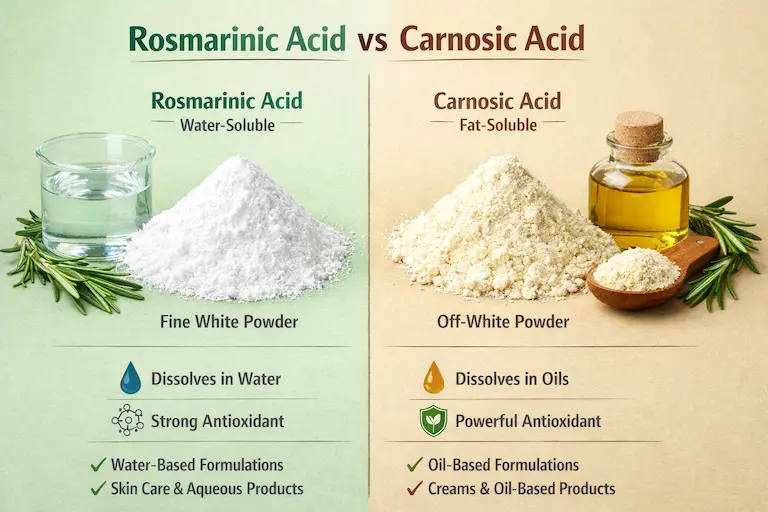
Using lipid-soluble Carnosic Acid in a clear beverage will result in severe turbidity and sedimentation. Conversely, using water-soluble Rosmarinic Acid to protect an Omega-3 fish oil softgel will lead to rapid lipid peroxidation because the polarities do not match.
In this guide, I will break down the crucial physicochemical differences between Rosmarinic Acid and Carnosic Acid, and how to source the right active compound for your specific B2B manufacturing needs.
What is Rosmarinic Acid? (The Water-Soluble Powerhouse)
Rosmarinic Acid is a naturally occurring polyphenolic compound found in Rosmarinus officinalis. Because of its molecular structure, it is highly hydrophilic (water-soluble).
In industrial applications, Rosmarinic Acid excels at neutralizing free radicals in aqueous environments. I frequently recommend our high-purity (up to 98%) Rosmarinic Acid for:
- Clear Functional Beverages & RTD Teas: It protects natural pigments (like anthocyanins) and flavor profiles from oxidative degradation without causing cloudiness.
- Cosmetics & Aqueous Serums: It acts as a soothing agent and structural protector in water-based anti-aging matrices.
What is Carnosic Acid? (The Lipid-Soluble Guardian)
Carnosic Acid is a diterpene with highly lipophilic (fat-soluble) properties. When a brand needs to extend the shelf-life of edible oils, this is the gold standard.
When added to fats, Carnosic Acid acts as a chain-breaking antioxidant, preventing rancidity. It is the mandatory choice for:
- Frying Oils & Processed Meats: Withstanding high temperatures to prevent fat oxidation.
- Softgel Formulations: Protecting sensitive Omega-3s, Krill Oil, or Astaxanthin from degrading inside the capsule.
Head-to-Head Comparison: Rosmarinic vs. Carnosic Acid
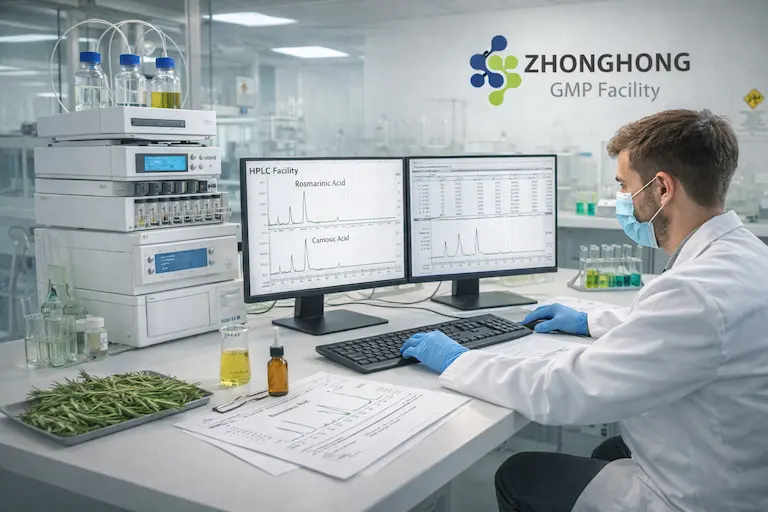
To simplify your R&D decision-making, I’ve compiled this quick-reference matrix based on our strictGMP Herbal Extract Quality Consistency protocols:
| Feature / Specification | Rosmarinic Acid | Carnosic Acid |
| Solubility (Polarity) | Water & Ethanol Soluble (Hydrophilic) | Oil & Fat Soluble (Lipophilic) |
| Primary Industrial Function | Color/flavor protection in liquids; anti-aging | Prevents lipid rancidity and oil oxidation |
| Common B2B Applications | RTD Beverages, Toners, Serums, Hard Capsules | Edible Oils, Softgels, Meat Processing |
| Typical AIHerba Assays | 5%, 10%, 20%, 98% (HPLC) | 5%, 10%, 20%, 60% (HPLC) |
| Solvent Used in Extraction | Purified Water & Food-Grade Ethanol | Ethanol (Hexane-Free Extraction) |
Formulation Challenges: Color, Odor, and Extraction Purity
A major challenge when sourcing bulk botanical extracts is the “herbaceous odor” and dark color typical of lower-grade powders.
If you are formulating a highly transparent, flavor-sensitive energy drink, using a crude 5% extract will introduce an unwanted yellow tint and a strong rosemary smell. In these cases, upgrading to a 98% HPLC standardized Rosmarinic Acid is essential. At AIHerba’s Advanced Extraction Facility, we utilize specialized solvent recovery and deodorization processes to ensure our high-purity grades are virtually colorless and odorless in solution.
Furthermore, we completely eliminate the use of toxic solvents like Hexane or Methanol, ensuring clean-label compliance for European and North American markets.
Procurement Guide: Evaluating Your Extract Manufacturer
When evaluating a supplier for your next OEM & ODM formulation, do not just look at the price per kilogram. Ask your supplier these three questions:
- What is the exact assay method? (Always demand HPLC testing, not UV).
- Are heavy metals strictly controlled? (AIHerba tests every batch to ensure Pb < 2ppm).
- Is the factory GMP-certified? (Learn more about AIHerba’s Company Strength here).
💡 Need to replace synthetic antioxidants in your formula?Sourcing stable, clean-label botanical extracts doesn’t have to be a headache. Whether you need water-soluble Rosmarinic Acid or oil-soluble Carnosic Acid, our technical team is ready to assist.👉 Explore Our Full Ingredient Catalog or Request a Free R&D Sample & HPLC COA Today!
Frequently Asked Questions (Formulator & Procurement FAQ)
To further assist your R&D and purchasing teams, I have compiled the most common questions we receive at AIHerba regarding Rosemary extracts:
Q1: Can Rosmarinic Acid completely replace synthetic antioxidants like BHT, BHA, and EDTA?
A: Yes. In aqueous (water-based) systems and emulsions, Rosmarinic Acid is a highly effective, clean-label alternative to EDTA and BHA/BHT. It successfully scavenges free radicals and chelates metal ions. For pure lipid (fat) systems like frying oils, you should use Carnosic Acid to replace synthetic antioxidants.
Q2: Will Rosmarinic Acid alter the color or flavor of my transparent beverage?
A: Lower purity extracts (5%-20%) naturally possess a yellowish-brown hue and a distinct herbaceous odor. If you are formulating a clear, flavor-sensitive RTD beverage or a transparent cosmetic toner, we strongly recommend our 98% HPLC deodorized Rosmarinic Acid. It is an off-white powder that is virtually colorless and odorless in solution at standard dosages.
Q3: Are AIHerba’s Rosemary Extracts hexane-free?
A: Absolutely. We use a 100% clean solvent system consisting only of Purified Water and Food-Grade Ethanol. We strictly prohibit the use of toxic solvents like Hexane, Methanol, or Ethyl Acetate in our Rosmarinic Acid extraction process, ensuring full compliance with premium organic and clean-label standards.
Q4: What is the typical industrial dosage for Rosmarinic Acid?
A: While formulations vary, typical industrial usage for cosmetic serums and lotions ranges from 0.05% to 0.5%. In food, beverage, and meat processing applications, the effective dosage usually falls between 0.02% and 0.1%, depending on the specific matrix and desired shelf-life extension.
Q5: How does high-temperature processing (like UHT) affect Rosmarinic Acid?
A: Rosmarinic Acid exhibits excellent thermal stability. It can withstand standard pasteurization and Ultra-High Temperature (UHT) processing without significant degradation of its antioxidant capacity, making it highly suitable for commercial beverage manufacturing.
Scientific References & Regulatory Guidelines
Transparency and scientific validation are the cornerstones of safe formulation. Below are the regulatory statuses and peer-reviewed mechanisms supporting the industrial use of Rosemary Extracts.
1. Regulatory Approvals & Safety Standards:
- U.S. FDA (Food and Drug Administration): Rosemary extract is Generally Recognized as Safe (GRAS) when used as a natural flavoring substance and antioxidant in food.
👉 Source:FDA CFR – Title 21, Vol 3. Sec. 182.20 Essential oils, oleoresins (natural extractives) - European Food Safety Authority (EFSA): Rosemary extracts are authorized as a food additive under the number E 392. EFSA has established clear specifications regarding the purity and solvent residue limits for these extracts in food preservation.
👉 Source: EFSA Scientific Opinion on the use of rosemary extracts as a food additive
2. Peer-Reviewed Mechanisms (PubMed / NIH):
- Antioxidant Mechanism: A comprehensive review detailing how the polyphenolic structure of Rosmarinic Acid effectively scavenges reactive oxygen species (ROS) and prevents lipid peroxidation in biological and food matrices.
👉 Reference:Ngo et al., “Rosmarinic acid and its derivatives: Phytochemical and pharmacological properties.” National Institutes of Health (NIH) / PubMed - Application in Clean-Label Preservation: Research highlighting the superior efficacy of Rosmarinic Acid over synthetic preservatives (like BHT) in extending the shelf-life of processed foods and stabilizing cosmetic emulsions.
👉 Reference:Birtić et al., “Carnosic acid and rosmarinic acid: from formulation to physiological efficacy.” National Institutes of Health (NIH) / PubMed
Bulk Supply & Technical Support
Get direct factory quotes, COA, and MSDS within 12 hours. We support bulk supply and custom specifications.