
Rosmarinic Acid in Cosmetics: Formulating Clean-Label Anti-Aging Serums
By[Aiherba], Senior Ingredient Consultant (28+ Years Experience)
In my 28 years consulting for global personal care and “clean beauty” brands, the skincare industry has undergone a radical transformation. Consumers are no longer satisfied with just “anti-aging” promises; they demand ingredient transparency. They are actively rejecting synthetic preservatives (like parabens and BHT) and seeking out plant-derived, multifunctional active compounds.
One of the most impressive botanical extracts I recommend to R&D teams today is Rosmarinic Acid (INCI: Rosmarinic Acid). Derived from Rosmarinus officinalis, it is far more than just a natural preservative.
In this guide, I will explore the biochemical mechanisms that make Rosmarinic Acid a powerhouse for anti-aging serums, how to stabilize it in cosmetic emulsions, and the crucial procurement specifications your sourcing team must verify.
1. The Anti-Aging Mechanism: Defending the Dermal Matrix
When formulating anti-aging skincare, the primary adversary is photoaging caused by UV radiation. UV exposure triggers an overproduction of Reactive Oxygen Species (ROS), which in turn activates Matrix Metalloproteinases (MMPs)—enzymes like collagenase and elastase that literally break down the skin’s structural proteins.
Here is why Rosmarinic Acid is highly prized in advanced cosmetic formulation:
- Collagenase & Hyaluronidase Inhibition: Clinical and in vitro studies show that Rosmarinic Acid effectively inhibits the activity of hyaluronidase and collagenase. By doing so, it protects the degradation of hyaluronic acid and collagen in the dermal matrix, helping maintain skin elasticity.
- Potent ROS Scavenger: Its unique polyphenolic structure acts as a rapid hydrogen donor, neutralizing free radicals before they can damage cell membranes. It acts as a powerful first line of defense in daily-wear serums and sun care formulations.
2. Formulating with Rosmarinic Acid: Emulsions and Serums
Unlike Carnosic Acid (which is strictly lipophilic/oil-soluble), Rosmarinic Acid is hydrophilic (water-soluble). This polarity distinction is the secret to successful formulation.
Aqueous Serums and Toners
Because of its excellent water solubility, Rosmarinic Acid dissolves seamlessly into the aqueous phase of clear serums, toners, and essence waters without leaving a greasy residue or causing turbidity.
Oil-in-Water (O/W) Emulsions (Creams & Lotions)
In cosmetic emulsions, protecting the lipid phase from oxidation is critical to prevent rancid odors over time. I strongly recommend a synergistic approach:
Add Rosmarinic Acid to your water phase to scavenge free radicals, and combine it with Tocopherols (Vitamin E) in your oil phase. This dual-phase antioxidant network drastically extends the shelf life of the cream while meeting strict “Clean Beauty” standards.
3. The Sensory Challenge: Color and Odor in Cosmetics
The biggest complaint I hear from cosmetic chemists regarding botanical extracts is the sensory profile. If you use a standard 5% or 10% rosemary extract in a premium face cream, it will turn the formulation muddy brown and impart a strong, herbaceous “kitchen” smell.
To create elegant, fragrance-free cosmetics, you must specify high-purity extraction.
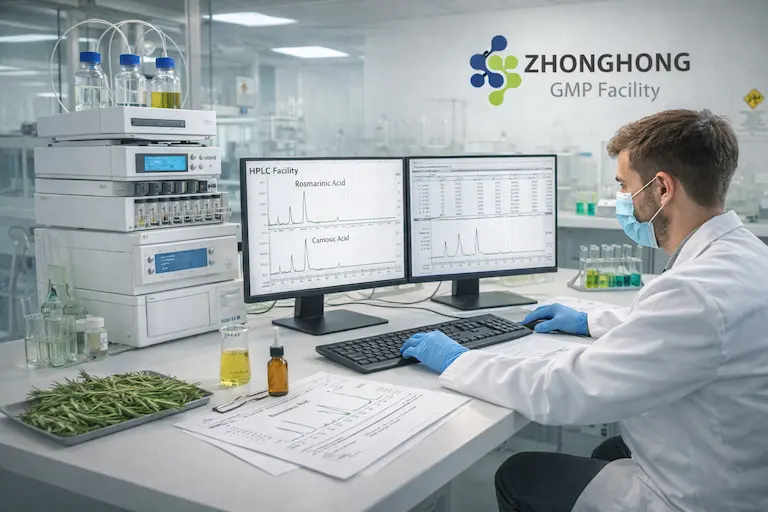
At AIHerba’s GMP-certified extraction facility, we manufacture an ultra-refined 98% Rosmarinic Acid (HPLC standardized). Through advanced solvent-recovery and deodorization technologies, this grade presents as a near-white crystalline powder. When formulated at the typical cosmetic dosage of 0.05% to 0.5%, it is virtually colorless and odorless, allowing your intended sensory profile to shine.
4. Procurement Checklist for Clean-Beauty Brands
When your sourcing managers are evaluating a botanical manufacturer for cosmetic ingredients, ensure they demand the following:
- Hexane-Free Extraction: For organic and clean-label compliance, ensure the solvent system uses only Purified Water and Food-Grade Ethanol.
- Heavy Metal Limits: Your supplier’s COA must show strict control. AIHerba guarantees Total Heavy Metals ≤ 10 ppm (typically much lower) to comply with stringent global cosmetic regulations.
- (Learn more about our rigorous QA testing on ourGMP Quality Consistency Page).
💡 Elevate Your Next Skincare FormulationStop compromising between clean-label claims and product stability. AIHerba’s 98% deodorized Rosmarinic Acid is the ideal multifunctional active for your next anti-aging serum or premium emulsion.👉 Explore Our Cosmetic Ingredients or Request a Free Lab Sample & COA Today!
Frequently Asked Questions (Cosmetic Formulation FAQ)
Q1: What is the INCI name and CAS number for Rosmarinic Acid?
A: The official INCI name is Rosmarinic Acid, and the CAS number is 20283-92-5. It is globally approved for use in personal care and cosmetic products.
Q2: What is the recommended usage rate of Rosmarinic Acid in skincare?
A: For high-purity grades (90%-98%), the typical usage rate in cosmetic emulsions, lotions, and serums ranges from 0.05% to 0.5%. We recommend starting at 0.1% and conducting accelerated stability testing.
Q3: Can Rosmarinic Acid cause skin irritation?
A: Rosmarinic Acid is highly regarded for its soothing properties and is commonly used in formulations designed to protect skin against environmental stressors. However, as with all active botanicals, formulators should conduct standard patch testing (HRIPT) on the final finished product.
Q4: Can I use Rosmarinic Acid to stabilize organic plant oils in my formulation?
A: Because Rosmarinic Acid is water-soluble, it remains in the aqueous phase. To protect pure lipid systems (like 100% facial oils or the oil phase of an emulsion), you should use Carnosic Acid, which is the oil-soluble antioxidant derived from rosemary.
Scientific References & Regulatory Guidelines
AIHerba prioritizes scientific validity. Below are peer-reviewed mechanisms supporting Rosmarinic Acid’s efficacy in dermatology and cosmetics.
1. Cosmetic Regulatory Status:
- CosIng (European Commission): Rosmarinic Acid is listed in the EU cosmetic ingredient database with functions including antioxidant, soothing, and skin conditioning.
👉 Source: European Commission CosIng Database
2. Peer-Reviewed Mechanisms (PubMed / NIH):
- Inhibition of Collagenase and Photoaging: A detailed study demonstrating that Rosmarinic Acid inhibits the expression of Matrix Metalloproteinase-1 (MMP-1) and prevents UV-induced collagen degradation in human dermal fibroblasts.
👉 Reference: Lee et al., “Rosmarinic acid prevents UV-induced photoaging in human dermal fibroblasts.” PubMed / NIH. PMID: 18992030 - Hyaluronidase Inhibition: Research highlighting the potent inhibitory effects of Rosmarinic Acid on hyaluronidase, effectively protecting the skin’s moisture retention matrix.
👉 Reference: F. Vilela et al., “Anti-inflammatory and skin barrier repair effects of topical application of Rosmarinic Acid.” PubMed.PMID: 24305429
(Disclaimer: The scientific references provided are for informational and cosmetic R&D formulation purposes only. AIHerba’s botanical extracts are raw materials intended for industrial B2B manufacturing and are not intended to diagnose, treat, cure, or prevent any medical disease.)
Bulk Supply & Technical Support
Get direct factory quotes, COA, and MSDS within 12 hours. We support bulk supply and custom specifications.