
By Aiherba, Senior Ingredient Consultant (28+ Years Experience)
In my 28 years consulting for the global food and beverage industry, I have seen consumer demand shift dramatically. Today, a product with “BHT,” “TBHQ,” or “EDTA” on its ingredient list is often left on the supermarket shelf. Food manufacturers and meat processors are under immense pressure to reformulate using clean-label, natural antioxidants without sacrificing shelf life or sensory quality.
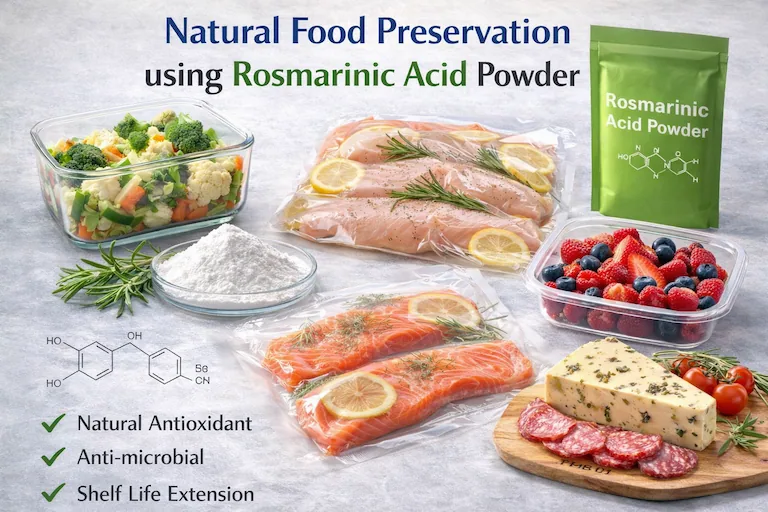
Enter Rosmarinic Acid, the powerhouse polyphenolic compound derived from Rosmarinus officinalis. While Carnosic Acid is often used for high-fat frying oils, Rosmarinic Acid is the premier choice for aqueous food matrices, marinades, and processed meats.
In this guide, I will break down the chemistry of how Rosmarinic Acid prevents food spoilage, protects meat color, and what quality specifications procurement managers must demand.
1. The Chemistry of Spoilage: Lipid and Protein Oxidation
In processed foods, particularly meats (like sausages, patties, and deli slices), spoilage isn’t just microbial; it’s heavily driven by oxidation.
When muscle lipids and myoglobin (the protein responsible for meat color) are exposed to oxygen, a chain reaction occurs. This leads to rancidity (off-flavors) and the dreaded discoloration (meat turning from fresh red to unappetizing brown).
How Rosmarinic Acid Intervenes:
- Free Radical Scavenging: Rosmarinic Acid acts as a highly efficient hydrogen donor. It neutralizes peroxyl radicals before they can propagate the oxidation chain in the meat’s lipid and protein structures.
- Metal Chelation: Transition metals (like iron present in meat) act as catalysts for oxidation. Rosmarinic Acid chelates (binds to) these metal ions, effectively mimicking the function of synthetic EDTA, but 100% naturally.
2. Retaining Color and Flavor in Processed Meats
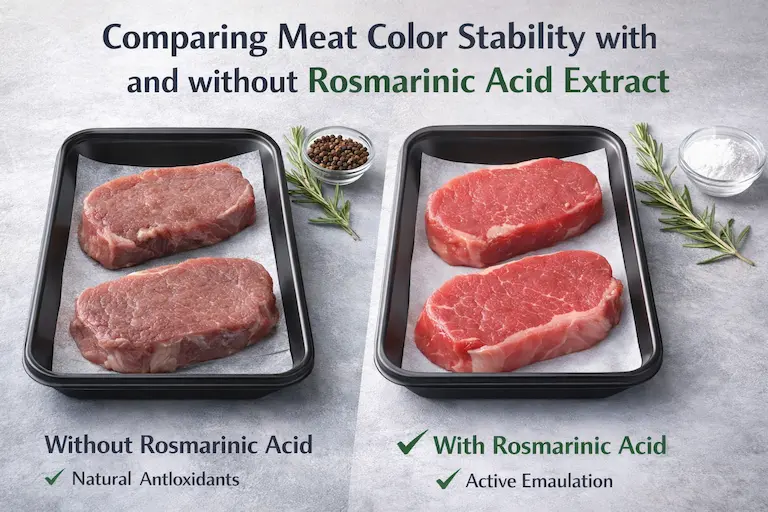
One of the biggest formulation challenges in meat processing is maintaining the vibrant, fresh color during refrigerated display.
When you incorporate water-soluble Rosmarinic Acid into your aqueous marinades or brine injections, it distributes evenly throughout the muscle fibers. Studies have shown that adding just 0.02% to 0.05% of high-purity Rosmarinic Acid significantly delays the oxidation of oxymyoglobin to metmyoglobin. The result? Your product stays visually appealing and fresh-tasting for weeks longer.
3. Overcoming the “Herbal Odor” in Food Formulation
A valid concern for R&D teams is the sensory impact. Nobody wants their hot dogs or functional beverages tasting like a Thanksgiving turkey due to strong rosemary notes.
This occurs when manufacturers use low-grade (5-10%) unrefined extracts. AtAIHerba’s GMP-certified facility, we solve this by offering highly standardized, deodorized Rosmarinic Acid (up to 98% HPLC). By removing the volatile essential oils during our hexane-free extraction process, we deliver a clean, off-white powder that provides maximum antioxidant protection with zero impact on the flavor profile of your finished food product.
4. Sourcing Food-Grade Extracts: The Procurement Checklist
When purchasing bulk botanical extracts for food application, regulatory compliance is non-negotiable. Ensure your supplier meets these criteria:
- Solvent Residue Compliance: Ensure extraction uses only Purified Water and Food-Grade Ethanol (no toxic solvents like Hexane).
- Microbial Control: Require steam sterilization to guarantee negative results for Salmonella and E. Coli, without the use of irradiation or Ethylene Oxide (ETO).
- (Review AIHerba’s strict GMP Quality Consistency Protocols here).
💡 Secure Your Supply of Clean-Label AntioxidantsReformulating your food products shouldn’t mean compromising on stability. AIHerba supplies commercial quantities of deodorized, highly soluble Rosmarinic Acid specifically engineered for the F&B industry.👉 Explore Our Food Ingredients orRequest a Free Trial Sample & COA Today!
Frequently Asked Questions (F&B Formulation FAQ)
Q1: What is the recommended dosage of Rosmarinic Acid for meat preservation?
A: In processed meats and sausages, formulators typically use 0.02% to 0.1% (based on total product weight), depending on the fat content and desired shelf life.
Q2: Is Rosmarinic Acid heat stable during cooking and pasteurization?
A: Yes. Rosmarinic Acid exhibits excellent thermal stability. It effectively survives standard meat processing temperatures, smoking, pasteurization, and typical consumer cooking without losing its antioxidant capacity.
Q3: Is Rosmarinic Acid approved as a food additive globally?
A: Yes. In the EU, extracts of rosemary are approved as food antioxidants under E 392. In the US, it is affirmed as GRAS (Generally Recognized as Safe) by the FDA for use in food processing.
Scientific References & Regulatory Guidelines
1. Regulatory Approvals:
- European Food Safety Authority (EFSA): Specifications and safety evaluation of rosemary extracts (E 392) as a natural food antioxidant.
👉 Source:EFSA Scientific Opinion on Rosemary Extracts
2. Peer-Reviewed Mechanisms (PubMed):
- Meat Preservation & Color Stability: A key study demonstrating the efficacy of Rosmarinic Acid in inhibiting lipid oxidation and protecting myoglobin color in processed pork and beef patties.
👉 Reference: Rojas et al., “Antioxidant effect of rosemary extract… in meat systems.” PubMed / NIH.PMID: 10458633
(Disclaimer: The references provided are for R&D formulation purposes. AIHerba’s extracts are industrial raw materials.)
Bulk Supply & Technical Support
Get direct factory quotes, COA, and MSDS within 12 hours. We support bulk supply and custom specifications.