
Replacing BHT and EDTA: A Formulator’s Guide to Rosmarinic Acid in Clean-Label R&D
By Aiherba, Senior Ingredient Consultant (28+ Years Experience)
During my 28 years consulting for global food, beverage, and dietary supplement brands, the most significant shift I’ve witnessed is the aggressive move toward Clean-Label formulations. Today’s consumers and regulatory bodies are scrutinizing synthetic antioxidants and chelating agents like BHT (Butylated Hydroxytoluene), BHA, and EDTA.
For R&D formulators and procurement managers, finding a natural, highly effective replacement that doesn’t ruin the color, clarity, or flavor profile of the finished product is a major challenge.
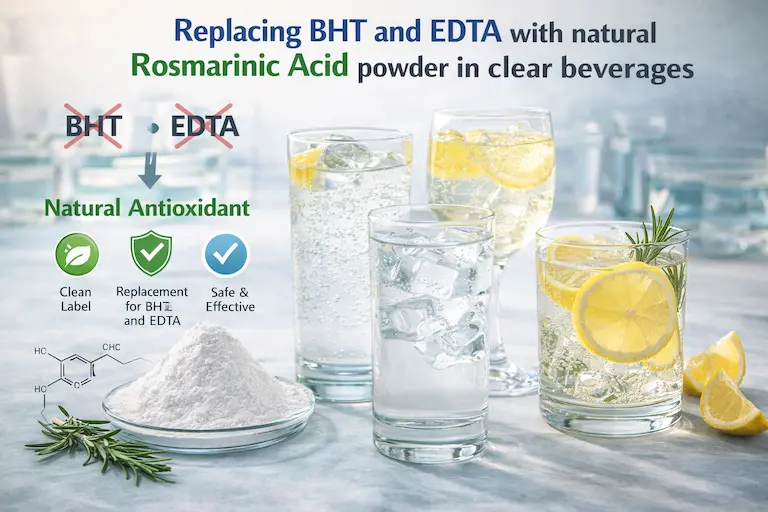
Enter Rosmarinic Acid Powder—a potent, water-soluble polyphenolic antioxidant derived from Rosmarinus officinalis. In this guide, I will detail how you can successfully phase out synthetic preservatives and integrate high-purity Rosmarinic Acid Extract into your aqueous matrices, RTD (ready-to-drink) beverages, and functional foods.
The Industry Shift: Why Phase Out BHT and EDTA?
Synthetic antioxidants have been industry staples for decades due to their low cost and high efficacy in preventing lipid peroxidation and color degradation. However, growing regulatory pressure from the European Union (EFSA) and changing consumer preferences are forcing brands to adapt.
When transitioning to a botanical alternative, formulators need an ingredient that offers equivalent free radical scavenging capabilities. Rosmarinic Acid, with its multiple phenolic hydroxyl groups, not only halts oxidative chain reactions but also acts as a natural chelating agent, mimicking the stabilization effects of EDTA in aqueous solutions.
Formulating with Rosmarinic Acid: The Polarity & Clarity Advantage
One of the critical mistakes formulators make is sourcing a generic “rosemary extract” without verifying its exact active compound.
As I frequently advise our OEM partners at AIHerba’s Advanced Extraction Facility, you must match the polarity of your antioxidant to your product matrix:
- Lipid Matrices (Oils/Fats): Require lipophilic Carnosic Acid.
- Aqueous Matrices (Beverages/Serums): Require hydrophilic Rosmarinic Acid.
1. Solving the Turbidity Problem in Clear Beverages
If you are formulating a highly transparent functional water or energy drink, using an oil-soluble extract will cause immediate turbidity (cloudiness) and sedimentation. Rosmarinic Acid Powder is highly water-soluble. When properly standardized and deodorized, it dissolves completely, leaving your beverage crystal clear while protecting delicate flavor compounds from UV and oxygen degradation.
2. Thermal Stability During Pasteurization
Unlike some fragile botanical compounds, Rosmarinic Acid exhibits outstanding thermal stability. It easily withstands standard pasteurization and Ultra-High Temperature (UHT) processing (typically up to 120°C for short durations) without significant loss of its antioxidant capacity.
Overcoming Color and Odor Challenges
A common hesitation among procurement managers is the distinct “herbaceous odor” and yellowish-brown color associated with standard 5% or 10% rosemary extracts.
To solve this, you must rely on advanced GMP Herbal Extract Quality Consistency. At AIHerba, we offer an ultra-refined 98% Rosmarinic Acid Powder (HPLC). Through specialized solvent-recovery and deodorization technology, this high-purity grade presents as an off-white, virtually odorless crystalline powder. At the typical industrial usage rate of 0.02% to 0.1%, it is imperceptible to the consumer’s palate, ensuring your product’s organoleptic profile remains flawless.
Sourcing & Quality Control: The Hexane-Free Mandate
When auditing a supplier for clean-label botanical extracts, the extraction solvent is just as important as the active assay.
Many low-cost suppliers use toxic solvents like Hexane or Methanol to maximize yield. To meet strict EU and US organic/clean-label standards, you must source extracts processed exclusively with Purified Water and Food-Grade Ethanol.
To understand how rigorous solvent control works in practice, I encourage you to review AIHerba’s Company Strength and QA Protocols, where we guarantee solvent residues are kept well below ICH Q3C limits and heavy metals are strictly controlled (e.g., Lead < 2ppm).
💡 Ready to upgrade your formulation with Natural Antioxidants?Don’t let synthetic preservatives hold back your brand’s clean-label potential. Whether you need a 5% standard extract for meat processing or a 98% deodorized powder for clear beverages, we provide full traceability from farm to drum.👉 Browse Our High-Purity Ingredients or Request a Free Lab Sample & COA Today!
Frequently Asked Questions (Formulator & Procurement FAQ)
Q1: What is the recommended dosage of Rosmarinic Acid to replace BHT/BHA?
A: Dosage depends heavily on the product matrix and purity of the extract. For high-purity Rosmarinic Acid Powder (≥90%), formulators typically use 0.01% to 0.05% in beverages to achieve shelf-life stability comparable to synthetic antioxidants. For 5%-20% extracts in food matrices, dosages may range from 0.05% to 0.2%. Always conduct accelerated stability testing.
Q2: Will Rosmarinic Acid interact with other vitamins in my dietary supplement?
A: Yes, in a positive way. Rosmarinic Acid exhibits excellent synergistic compatibility with Ascorbic Acid (Vitamin C) and Tocopherols (Vitamin E). Using them together provides a broad-spectrum defense against oxidative stress in both the aqueous and lipid phases of complex emulsion systems.
Q3: Are AIHerba’s Rosemary Extracts tested for pesticide residues?
A: Absolutely. As a leading botanical manufacturer, we screen every batch for over 500 pesticide items in accordance with USP <561> and EC 396/2005 standards, ensuring our material is safe for premium and infant-grade nutritional products.
Q4: How does AIHerba verify the exact assay of Rosmarinic Acid?
A: We strictly use High-Performance Liquid Chromatography (HPLC) against verified reference standards to quantify the active assay. We do not rely on less accurate UV spectrophotometry methods, ensuring you receive exactly the potency you paid for.
Scientific References & Regulatory Guidelines
Transparency and scientific validation are critical for B2B procurement. Below are the regulatory and peer-reviewed mechanisms supporting Rosmarinic Acid as a natural antioxidant.
1. Regulatory Approvals:
- European Food Safety Authority (EFSA): Extracts of rosemary are authorized as a natural food antioxidant under the E-number E 392. EFSA guidelines dictate strict limits on extraction solvents (restricted to ethanol, water, acetone, or supercritical CO2 for clean-label compliance).
👉 Source:EFSA Panel on Food Additives – Scientific Opinion on Rosemary Extracts (E 392) - U.S. FDA (Food and Drug Administration): Rosemary extracts and essential oils are classified as Generally Recognized as Safe (GRAS) for use as natural flavoring substances and adjuvants.
👉 Source:FDA CFR – Title 21, Vol 3. Sec. 182.20
2. Peer-Reviewed Mechanisms (PubMed / NIH):
- Replacement of Synthetic Antioxidants: A pivotal study demonstrating that Rosmarinic Acid exhibits superior free radical scavenging activity compared to BHT and Trolox in aqueous systems, making it highly viable for food preservation.
👉 Reference:Erkan et al., “Antioxidant activity of rosemary extract… compared with synthetic antioxidants.” PubMed / NIH - Chelating and Peroxidation Inhibition: Research outlining the mechanism by which Rosmarinic Acid chelates transition metals and interrupts the chain reaction of lipid peroxidation.
👉 Reference: Petersen et al., “Rosmarinic acid.” Phytochemistry, PubMed / NIH
Disclaimer: The scientific references provided are for informational and R&D formulation purposes only. AIHerba’s botanical extracts are raw materials intended for industrial manufacturing and are not intended to diagnose, treat, cure, or prevent any disease.
Bulk Supply & Technical Support
Get direct factory quotes, COA, and MSDS within 12 hours. We support bulk supply and custom specifications.