
Introduction: Why Red Kidney Beans Are Gaining Attention in Ingredient Science
In recent years, hyperuricemia (HUA) has drawn growing attention from researchers, nutrition professionals, and food manufacturers alike. Rather than viewing it solely as a clinical issue, many scientists now approach uric acid imbalance as a metabolic and dietary challenge—one that may be influenced by long-term food patterns and bioactive compounds.
Among plant-based ingredients, red kidney beans (Phaseolus vulgaris L.) have emerged as an unexpected focus of scientific research. Traditionally known as a staple legume rich in protein and fiber, red kidney beans are now being studied for their anthocyanin content, particularly delphinidin-3-glucoside (Dp-3G), and its interaction with xanthine oxidase (XO)—a key enzyme involved in uric acid production.
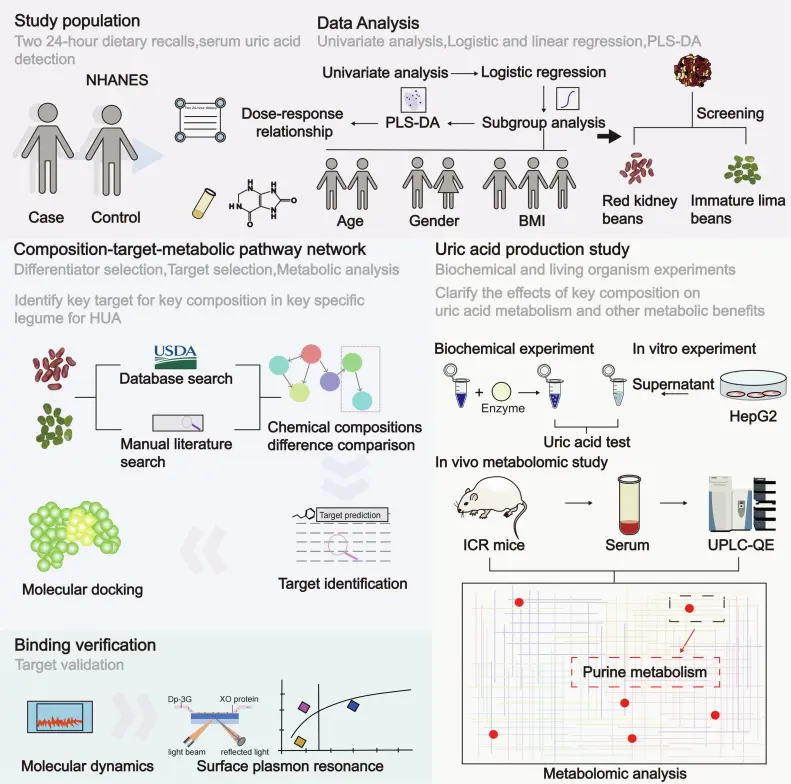
This article does not promote red kidney beans or their extracts as a treatment or substitute for medication. Instead, it provides a science-based, ingredient-focused interpretation of current research, helping food, dietary supplement, and functional nutrition manufacturers understand why red kidney bean extract is being explored, how it may function at a biochemical level, and where it may fit within compliant product development strategies.
Understanding Uric Acid from a Metabolic Perspective
Uric acid is a natural metabolic by-product formed during the breakdown of purines, compounds found both in certain foods and in the body’s own cells. Under normal conditions, uric acid is filtered by the kidneys and excreted through urine.
However, when production exceeds excretion, uric acid levels may rise. From a nutritional science standpoint, this imbalance is associated with:
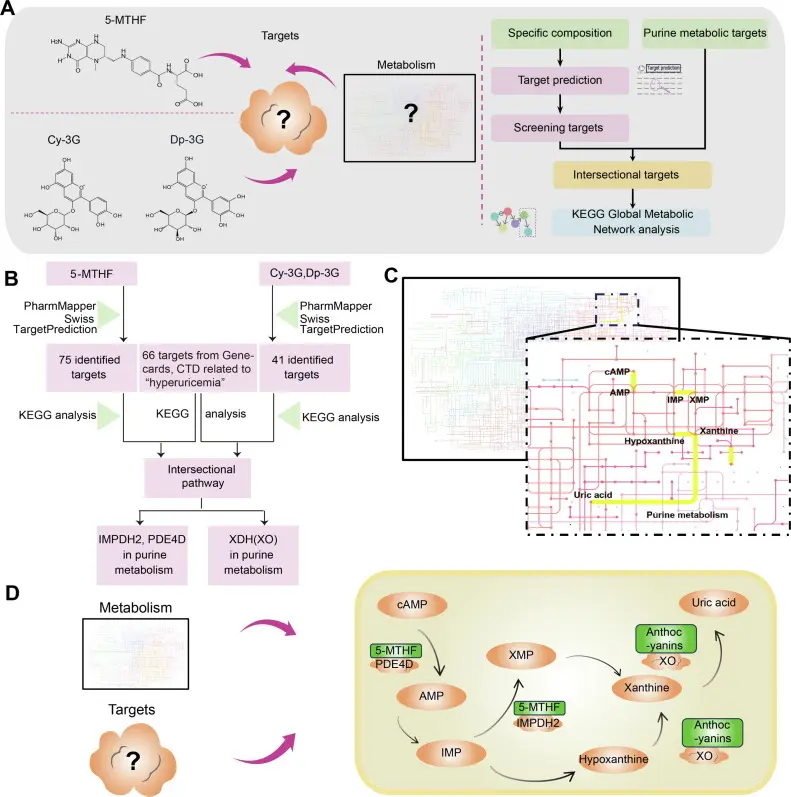
- Altered purine metabolism
- Oxidative stress
- Enzyme activity changes, particularly involving xanthine oxidase (XO)
Because XO plays a central role in converting hypoxanthine and xanthine into uric acid, it has become a frequent target in both pharmaceutical and nutritional research. Importantly, studying enzyme interaction does not equal making medical claims—it simply helps researchers understand biochemical pathways relevant to food-derived compounds.
Why Plant-Derived XO-Related Compounds Are Being Studied
Interest in plant-based ingredients that interact with metabolic enzymes has increased for several reasons:
- Consumer demand for naturally sourced ingredients
- Regulatory preference for food-derived bioactives with historical dietary exposure
- Formulation flexibility in functional foods and supplements
- Synergy potential with other nutrients (fiber, polyphenols, vitamins)
Anthocyanins—a class of flavonoids responsible for red, purple, and blue pigments—are of particular interest due to their antioxidant properties and documented interactions with metabolic pathways. Red kidney beans represent a less explored but promising anthocyanin source.
Overview of the Nanjing Medical University Research
A recent study published in the Journal of Advanced Research by researchers from Nanjing Medical University investigated the relationship between red kidney bean consumption, specific bioactive compounds, and uric acid-related metabolic pathways.
The research combined:
- Population-level dietary data (NHANES database)
- In-silico molecular modeling
- In vitro enzyme assays
- Cell-based metabolic models
- Animal studies
It is critical to note that these findings are preclinical and mechanistic in nature. They are valuable for ingredient science and formulation insight, but they do not constitute clinical evidence or therapeutic recommendations.
Delphinidin-3-Glucoside (Dp-3G): A Key Bioactive Compound
Among the compounds analyzed, delphinidin-3-glucoside (Dp-3G) emerged as a focal point. Dp-3G is a naturally occurring anthocyanin also found in berries and other pigmented plants, but red kidney beans provide a distinct legume-based source.
From an ingredient science perspective, Dp-3G is notable because:
- It is water-soluble
- It is compatible with food and supplement matrices
- It belongs to a well-studied flavonoid family with established analytical methods
Mechanistic Insights: Interaction with Xanthine Oxidase (XO)
Using molecular docking and molecular dynamics simulations, the researchers examined how Dp-3G interacts with XO at the molecular level.
Key observations included:
- Dp-3G showed strong binding affinity in computational models
- The interaction occurred at the FAD-related region of XO
- Enzyme activity assays demonstrated a measurable reduction in XO catalytic activity under experimental conditions
From a formulation standpoint, this suggests that red kidney bean-derived anthocyanins may influence enzyme-related metabolic pathways, which helps explain why ingredient developers are paying attention to this category.
Again, this is mechanistic insight, not a health claim.
Safety, Dietary Context, and Research Boundaries
Red kidney beans have a long history of dietary use worldwide. When properly processed and cooked, they are considered safe for consumption. However, ingredient applications require additional considerations:
- Processing methods (extraction, concentration, stabilization)
- Standardization of anthocyanin content
- Food-grade or supplement-grade compliance
- Regional regulatory classification
Current evidence supports further research and responsible formulation—not consumer-facing medical claims.
Implications for Food, Supplement, and Nutrition Product Development
For manufacturers and brand owners, red kidney bean extract presents several practical opportunities:
Potential Application Areas
- Functional foods
- Plant-based nutrition products
- Polyphenol-focused formulations
- Ingredient blends targeting metabolic wellness (non-medical positioning)
Ingredient Advantages
- Legume-derived (diversifies anthocyanin sourcing beyond berries)
- Suitable for clean-label strategies
- Compatible with fiber, protein, and botanical blends
Procurement Considerations
- Raw material origin and traceability
- Extraction method (water / ethanol)
- Anthocyanin specification range
- Batch consistency and COA availability
- OEM and private-label customization
These factors matter far more to professional buyers than simplified consumer health messaging.
From Research to Supply Chain: Where the Blog Fits in the Buyer Journey
This article is designed as the educational and trust-building entry point:
High-Authority Blog (this page)
↓
Product Page – specifications, COA, MOQ
↓
Factory / OEM Page – manufacturing capability, certifications
↓
Inquiry Form – B2B communication (not e-commerce checkout)
This structure aligns with how Google evaluates E-E-A-T and how professional buyers actually make sourcing decisions.
Frequently Asked Questions (FAQ)
Is red kidney bean extract a drug or medicine?
No. It is a food-derived ingredient studied for its biochemical properties. It is not approved or marketed as a drug.
Can red kidney bean extract replace prescription medication?
No. Research findings should not be interpreted as treatment or substitution for medical therapies.
What active compounds are typically standardized?
Anthocyanins, particularly delphinidin-3-glucoside, are commonly referenced in research contexts.
Is red kidney bean extract suitable for dietary supplements?
Formulation suitability depends on regulatory requirements in the target market and proper compliance documentation.
What should buyers request from suppliers?
COA, specification sheets, extraction method details, allergen status, and regulatory support files.
References (Authoritative Sources)
- Chen Y. et al., Journal of Advanced Research (2025). DOI: 10.1016/j.jare.2025.04.022
- NIH – Uric Acid Overview: https://www.ncbi.nlm.nih.gov
- PubMed – Xanthine Oxidase Research: https://pubmed.ncbi.nlm.nih.gov
- FDA Dietary Supplement Guidance: https://www.fda.gov
- EFSA Botanical Safety Framework: https://www.efsa.europa.eu
Bulk Supply & Technical Support
Get direct factory quotes, COA, and MSDS within 12 hours. We support bulk supply and custom specifications.
Fast Response via Email/WhatsApp
Get direct factory quotes, COA, and MSDS within 12 hours. We support bulk supply and custom specifications.