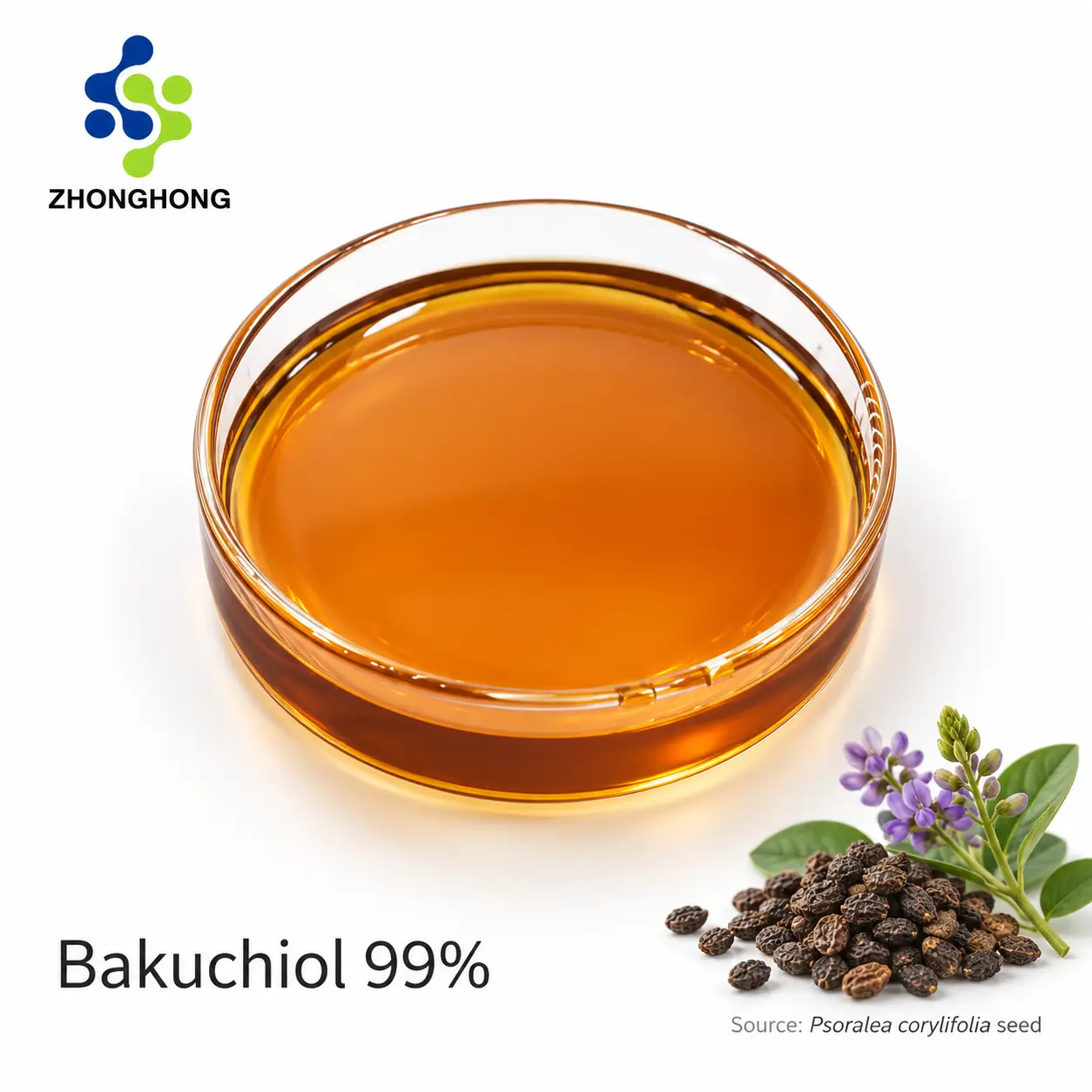
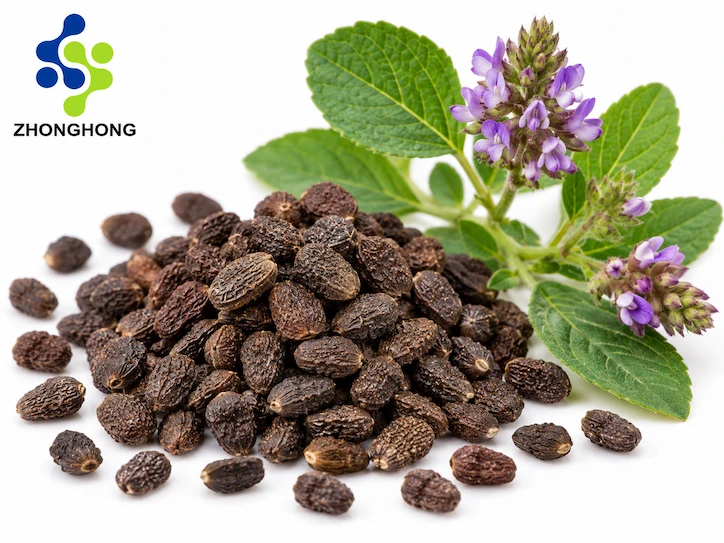

Oil-soluble Bakuchiol derived from Psoralea corylifolia seeds, specified at ≥99.0% HPLC assay for professional cosmetic development and industrial sourcing. Qualification extends beyond assay to identity, furanocoumarin impurities, relevant solvent residues and batch documentation.
CAS 10309-37-2
Viscous liquid
01. Bakuchiol 99% Manufacturer — Cosmetic Ingredient Overview
AIHerba® works with cosmetic brands, OEM/ODM developers, contract manufacturers and sourcing teams evaluating a defined Bakuchiol 99% raw-material grade. The material described here is a concentrated cosmetic active, not a finished serum or a diluted babchi oil blend.
Our commercial focus is a specification-led procurement workflow: identify the grade, review method-linked quality data, test performance in the intended matrix, and then confirm lot release, packaging and delivered terms. These steps create a practical bridge between ingredient research and production purchase orders.
B2B decision in one sentence
02. Two Evaluation Tracks — Procurement and Formulation R&D
Most ingredient pages speak to everyone in the same way. Our two-track approach lets commercial purchasers and technical evaluators reach the evidence relevant to their approval decision.
Ask for current lot status, assay specification, MOQs, packing, lead time, trade terms, manufacturing-site documentation and QA release requirements.
Ask for batch COA, assay method, impurity reporting limits, solvent data, TDS, SDS, solubility guidance and sample size matched to your process.
03. Bakuchiol Identity — Purified Active vs Babchi Seed Oil
Bakuchiol is a meroterpene phenol associated with Psoralea corylifolia (babchi). The purified ingredient is chemically different from retinol and should not be confused with a crude botanical oil whose constituent profile can vary.
| Buyer question | Bakuchiol 99% grade | Crude botanical oil |
|---|---|---|
| Identity | Defined molecule: Bakuchiol (CAS 10309-37-2) | A mixture that requires separate characterization |
| Assay | A quantitative Bakuchiol target, specified by HPLC | Bakuchiol concentration may be unspecified |
| Impurities | Explicit psoralen/isopsoralen qualification required | Impurity profile may vary with sourcing and refining |
| Formulation | Concentrated active for controlled addition | Different dilution and compatibility behavior |
For supplier screening, ask whether a listing describes pure Bakuchiol, a standardized Bakuchiol extract, or a formulated product. These are not automatically interchangeable.
04. Technical Specification Dashboard — Bakuchiol ≥99% HPLC
This engineering dashboard separates stable chemical identity from lot-specific tests. The quality dossier specifies Bakuchiol assay ≥99.0% by the external-standard HPLC method; values outside that core grade are subject to the controlled current specification.
Controlled specification label
Do not replace this with marketing phrases such as “ultra-high quality” or an unsupported batch average.
Note: a liquid active does not have a meaningful standard powder mesh size. If a buyer requests 80/120 mesh, clarify whether they require a carrier-based dry dispersion, microencapsulation or a different product grade. Availability: to be confirmed.
05. Analytical Verification Center — HPLC, NMR, LC-MS & COA Review
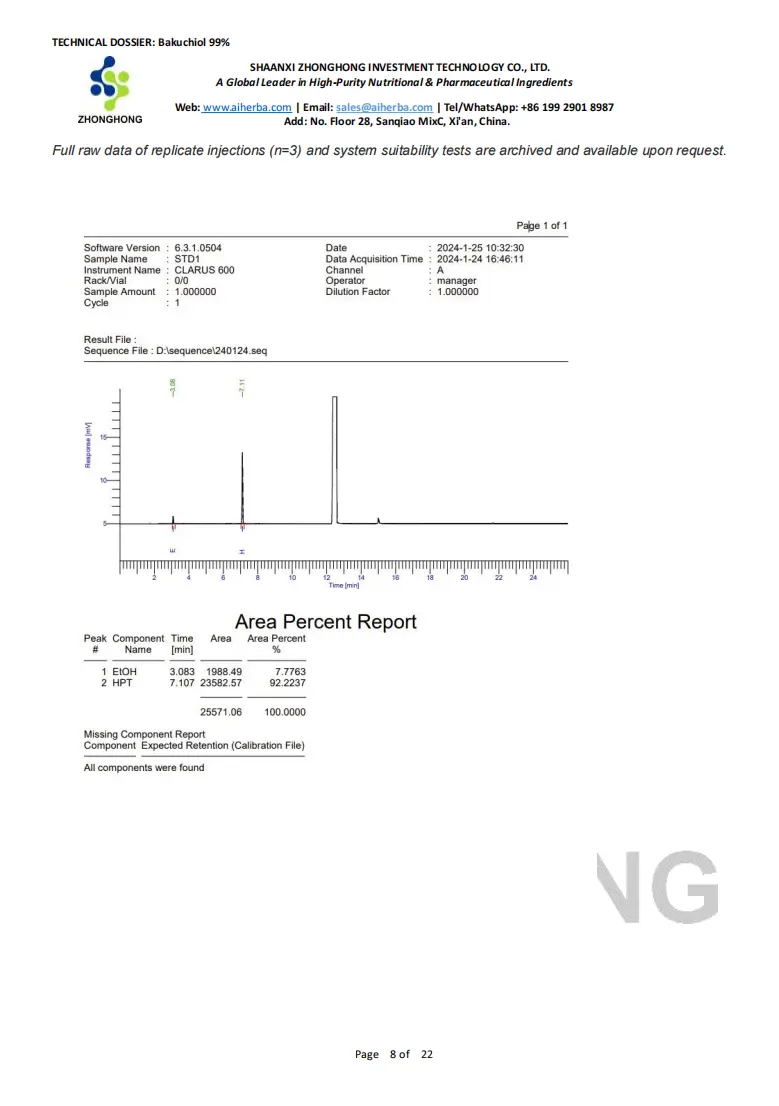
A 99% label is only as informative as the method behind it. For a quantitative assay, buyers should review reference-standard qualification, calibration, peak identification, integration criteria, system suitability and whether the result represents external-standard assay or area-percent reporting.
| Evidence | Purpose | Document status / verification |
|---|---|---|
| HPLC external-standard assay | Quantifies Bakuchiol content | Method described in the reference dossier; request signed lot COA |
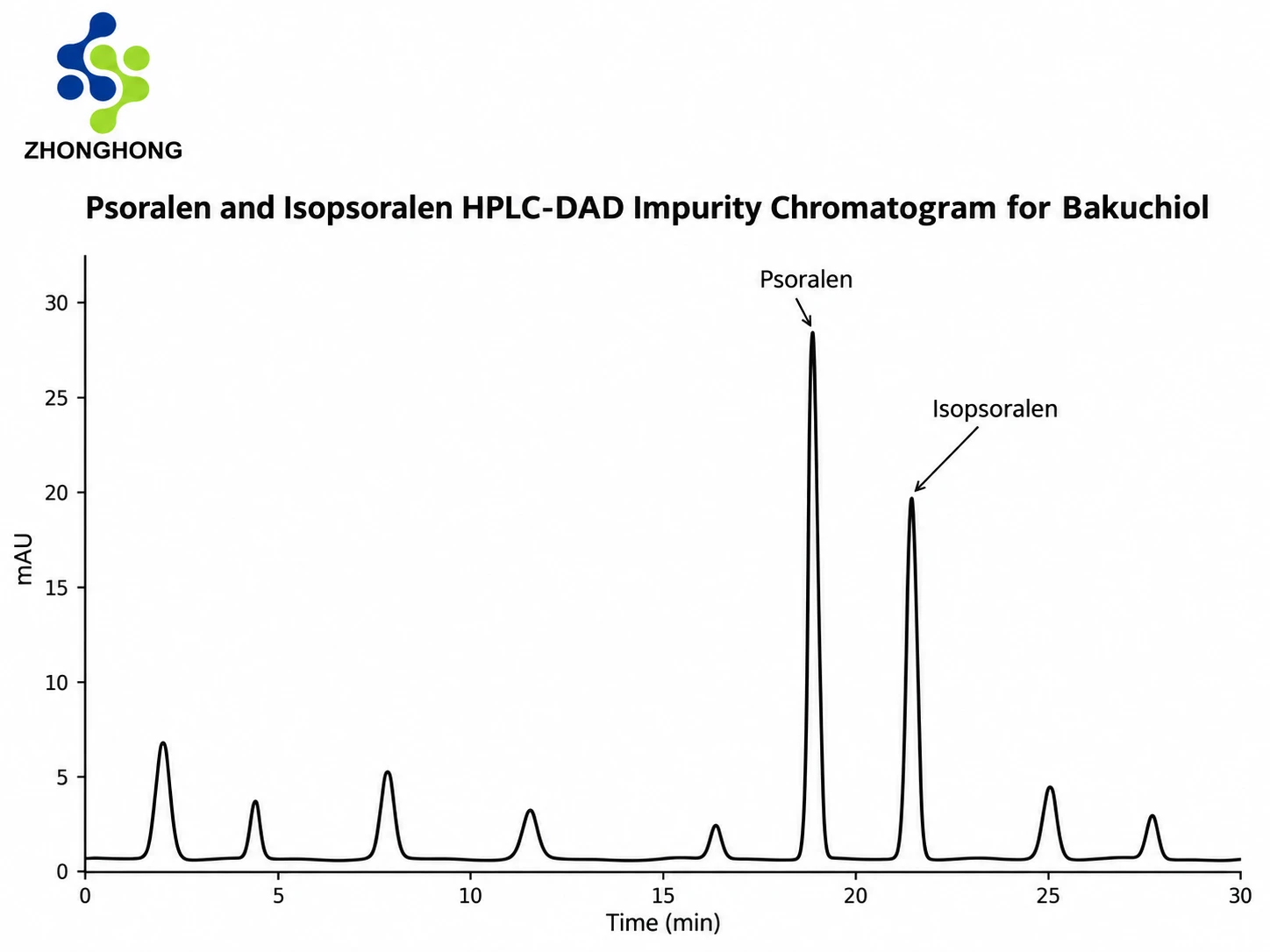
| HPLC-DAD for furanocoumarins | Separately evaluates psoralen and isopsoralen | Referenced in archival COA; verify final lot limits |
| NMR identification | Supports chemical identity | Reported in reference dossier; raw spectral availability to be confirmed |
| LC-MS identity confirmation | Optional orthogonal identity method | Not established in supplied records; availability to be confirmed |
| GC-HS solvents | Measures named volatile residual solvents | Archive reports require reconciliation before lot figures are public |
Evidence boundary
For deeper supplier qualification, use our high-purity Bakuchiol sourcing guide.
06. Psoralen and Isopsoralen — Furanocoumarin Impurity Control
Psoralen and isopsoralen are individual furanocoumarin analytes relevant to Psoralea corylifolia-derived materials. They should not be treated as synonyms or merged into a single unqualified “psoralen-free” statement.
- The supplied historical COA lists an individual specification of ≤50 ppm for psoralen and ≤50 ppm for isopsoralen, with each reported below 10 ppm in that archived example.
- The total/summed impurity definition in the broader dossier is inconsistent and requires QA reconciliation. Final combined limit: to be confirmed.
- For a new order, request the actual psoralen and isopsoralen results, LOD/LOQ, method and destination-market acceptance criteria.
Do not infer a combined limit
07. Residual Solvents, Heavy Metals & Microbiological Qualification
Industrial Bakuchiol evaluation can involve residual solvents from extraction and purification, elemental impurities, and microbiological criteria relevant to the intended cosmetic application.
| Control area | Analytical approach | Buyer decision |
|---|---|---|
| Ethanol and n-heptane | GC headspace / confirmed method | Verify lot-specific values and regulatory acceptance basis |
| n-Hexane | Validated GC method and stated detection limit | “Not detected” is not equivalent to absolute solvent absence |
| Pb, As, Cd, Hg | ICP-MS (described in archived dossier) | Confirm destination-market limits and signed current COA |
| Microbiological criteria | Applicable count and specified pathogen tests | Check product risk profile, method and release criteria |
The supplied records contain two different residual-solvent result sets. Accordingly, we do not publish a reconciled batch solvent table here. Current approved values: to be confirmed by QA.
Third-party laboratory requests
08. Botanical Origin and Lot Traceability — From Seed to Ingredient
The reference material identifies Psoralea corylifolia L. seed as the botanical source. For a botanical-derived active, documentation should connect botanical identification, raw-material intake, processing and the released finished ingredient.
- Confirm botanical name and plant part on the incoming material and finished-grade specification.
- Use material and processing records to link the raw-material lot to the final released batch.
- Request geographic source, crop/harvest records and GACP evidence where relevant; availability is to be confirmed.
- Ask for a defined change-control process if a new source or purification route may affect impurity profile.
The company contact location in Xi’an is not, by itself, independent proof of the physical manufacturing-site address. Manufacturing-site disclosure should be supported by current company qualification records.
09. Manufacturing and Purification Control — Molecular Distillation Context
The submitted AIHerba technical dossier describes molecular distillation as part of its purification story. A process description is useful, but buyers should still verify actual batch identity and assess the resulting impurity profile.
Typical industrial qualification questions include the raw-material identity-control step, assay standardization, relevant processing aids, solvent removal, hold conditions, equipment-cleaning controls and final QA disposition. The exact equipment train and proprietary parameters are not disclosed in the provided source and are to be confirmed where commercially required.
AIHerba is a brand operated by Shaanxi Zhonghong Investment Technology Co., Ltd. Its management team cites 29 years of botanical-ingredient experience. Applicable GMP/ISO certification must always be checked for the specific site, scope and validity period, not inferred solely from corporate marketing materials.
Explore botanical engineering and OEM/ODM capabilities for related manufacturing services.
10. Bakuchiol Solubility — Oil Phase, Emulsions and Delivery Systems
Bakuchiol is lipophilic and is not suitable for straightforward dissolution in neat water. The source TDS describes compatibility with cosmetic oils and certain organic formulation carriers. Practical solubility must be confirmed at the intended concentration and temperature.
| Formulation system | Initial R&D approach | Main risk to examine |
|---|---|---|
| Anhydrous facial oil / oil serum | Screen in squalane or caprylic/capric triglyceride | Clarity, oxidation, packaging and odor |
| Oil-in-water cream / lotion | Preblend into a compatible oil phase; validate processing | Droplet stability, active recovery and color changes |
| Water-based serum | Investigate appropriate solubilization or delivery technology | Precipitation, surfactant compatibility, long-term stability |
| Carrier-based dry system | Request a separately engineered dispersion grade | Actual grade existence and mesh specification to be confirmed |
An attractive laboratory appearance at 24 hours is not sufficient. Test the finalized product using real-life packaging, relevant thermal cycles and an analytical assay appropriate to the matrix.
11. Stability Engineering — Heat, Oxygen, Light, pH & Packaging
The reference TDS recommends evaluating Bakuchiol addition during a validated cooling stage, typically below 40°C, and storing concentrated material in light-protective, tightly sealed packaging. These are starting instructions from the supplied document—not a stability guarantee for every end formulation.
Critical distinction for R&D
The archived dossier states a 24-month shelf-life under specified original-package conditions. It should not be converted into a universal promise for a newly manufactured batch; request the current product shelf-life statement and dated COA.
12. Regulatory Documentation — COA, TDS, SDS, GMP and EU/US Review
A technical dossier supports ingredient qualification, but it does not replace the safety assessment of a completed cosmetic product. Document expectations depend on the market, formulation, ingredient status and buyer’s internal QA procedures.
| Document or status | What it should establish | Current handling |
|---|---|---|
| Certificate of Analysis (COA) | Actual lot, methods, specifications and signed results | Request the current released lot |
| Technical Data Sheet (TDS) | Identity, formulation guidance, storage, specifications | Version-controlled document on request |
| Safety Data Sheet (SDS/MSDS) | Handling, hazard, transport and storage information | Current version and correct supplier contact |
| ISO / GMP quality evidence | Scope, manufacturing location, certification dates | Site-specific evidence to be confirmed |
| EU / US cosmetic compliance | Ingredient and finished-product obligations | Must be reviewed by responsible market operator |
For EU cosmetics, the responsible person and safety assessor must evaluate the finished product under the applicable cosmetics framework. For US market entry, companies must assess the relevant FDA cosmetics requirements, including applicable MoCRA responsibilities where relevant.
Regulatory status: No universal FDA approval, EU product registration, or specific regulatory clearance is claimed for this ingredient. Document availability and applicability must be reviewed per project.
13. Bakuchiol Serum Formulation — Concentration and Process Design
For leave-on serums and emulsions, the reference technical dossier describes 0.5–1.0% w/w as a preliminary evaluation range. The appropriate finished-product concentration is a formulation and safety-assessment decision, not a standard that can be imposed on every product.
- Select the delivery format: anhydrous oil, emulsion or engineered water-based system.
- Establish incorporation order and controlled temperature before testing at pilot scale.
- Measure assay retention under accelerated and real-time stability conditions.
- Check odor, color, viscosity, separation, packaging contact and relevant microbial protection.
- Document substantiation for any consumer-facing skin-appearance claim.
An R&D sample should be accompanied by a batch identity and appropriate methods. A specific powder mesh size is not applicable to the neat liquid grade; alternative solid delivery systems require their own specification.
Need impurity targets, a formulation sample, a verified COA or a factory quotation? Share your batch specification, application, intended volume and destination to receive the appropriate qualification workflow.
See our Bakuchiol serum formulation discussion for related development questions.
14. OEM / ODM Capability — Custom Grades, Sampling and Scale-up
Commercial partners may need differences in packaging, specification windows, analytical reporting, or delivery format. AIHerba can evaluate technical requests against actual manufacturing and quality capabilities; a request does not imply that every custom grade exists or is commercially validated.
When requesting a customized product, state the INCI requirement, target purity, maximum individual/summed impurities, format, annual forecast, destination regulations and your technical acceptance tests. This reduces quoting delays and prevents confusion between neat Bakuchiol and formulated derivatives.
Lead time, exact OEM minimum quantity and release criteria must be confirmed against the selected manufacturing plan.
15. Bakuchiol vs Retinol — Chemistry, Evidence and Claim Boundaries
Bakuchiol and retinol have different molecular structures. Peer-reviewed studies have reported overlapping cosmetic-relevant pathways and skin-appearance endpoints under the specific formulations and conditions studied. This does not make the substances chemically equivalent or guarantee identical behavior in a buyer’s product.
| Comparison | Bakuchiol | Retinol |
|---|---|---|
| Chemical identity | Distinct plant-derived meroterpene phenol | Vitamin A compound |
| Formulation challenge | Oil-phase solubility and compatibility verification | Oxidation and formulation-stability considerations |
| Evidence | Selected mechanistic and human studies | Longer research history in skin applications |
| Buyer conclusion | Test active concentration, finished product and claims | Test active concentration, finished product and claims |
Avoid blanket statements such as “safe in pregnancy,” “no irritation in anyone,” “UV protection,” or “identical to retinol.” Consult our Bakuchiol vs retinol evidence overview.
16. Bulk Bakuchiol Pricing, MOQ, Samples and International Shipping
Factory quotations should distinguish active grade, requested quantity, batch requirements, packaging, destination, shipping term and any agreed third-party testing. A price per kilogram without these conditions is not a comparable industrial quotation.
| Quotation input | Why it matters |
|---|---|
| Requested quantity (sample / 1 kg / 5 kg / 25 kg+) | Determines pack size and applicable manufacturing economics |
| HPLC assay and impurity targets | Defines acceptance testing and potential production adjustments |
| Destination and Incoterms | Changes shipping, clearance responsibility and taxes |
| Current COA and testing needs | Determines QA release and documentation handling |
| Target delivery and forecast | Supports capacity planning and repeat-purchase scheduling |
Pricing: quotation only; no public fixed price is represented. Inventory: to be confirmed. Lead time: to be confirmed for the requested lot and destination. Custom duties: governed by agreed delivery terms and local rules.
For a quote, use the AIHerba B2B inquiry page or email sales@aiherba.com.
17. Bakuchiol Manufacturer Qualification Checklist for Brands and CMOs
A technical buyer can use this shortlist to compare ingredient manufacturers on evidence instead of marketing claims. It is particularly useful when screening multiple bids that all advertise “99% Bakuchiol.”
- Match product name, INCI, CAS, botanical source and plant part.
- Compare quantitative HPLC external-standard assay, not only a chromatogram screenshot.
- Require separate psoralen and isopsoralen values, method and combined-limit definition.
- Cross-check GC solvent tables against chromatogram batch IDs and dates.
- Confirm actual manufacturing-site identity, quality system and valid certification scope.
- Verify sample/production lot linkage, remaining shelf life and packaging.
- Document Incoterms, lead time, change notification, import requirements and claim boundaries.
Practical sourcing rule
18. FAQ — Bakuchiol Grade, Testing, Stability, Documents & OEM
These questions connect specification, analytical verification, stability, regulatory documentation and procurement back to the corresponding technical sections above. Answers refer to the described reference grade, not an unverified future production batch.
What is the specification for bulk Bakuchiol 99%?
Does a 99% HPLC result prove the identity of Bakuchiol?
Is Bakuchiol 99% a powder or an oil?
How should psoralen and isopsoralen be reported?
Is Bakuchiol soluble in water?
What is the recommended Bakuchiol concentration in serum?
How should bulk Bakuchiol be stored and shipped?
Can you supply COA, TDS, SDS and certification documents?
Can OEM/ODM clients request a specific mesh size or carrier?
What is the MOQ, price and lead time for Bakuchiol 99%?
19. Request Batch COA, Technical Sample & Factory Quotation
Choose the pathway closest to your current stage. Procurement: quantity, terms, batch documents and delivery. R&D/QA: assay, impurity limits, compatibility and sample testing. For production-scale decisions, both tracks should converge on the same approved specification.
Send your target specification, annual forecast, first-order quantity, formulation type and destination. We will discuss appropriate available records, sample options and commercial terms.
20. References & Regulatory Context
1. Dhaliwal S. et al. (2019). Prospective, randomized, double-blind assessment of topical bakuchiol and retinol for facial photoageing. British Journal of Dermatology. PMID: 29947134. PubMed source. Clinical comparison is formulation-specific, not proof of performance of an untested commercial batch.
2. Chaudhuri R.K. & Bojanowski K. (2014). Bakuchiol: a retinol-like functional compound revealed by gene expression profiling and clinically proven to have anti-aging effects. International Journal of Cosmetic Science. PMID: 24471735. PubMed source. Mechanistic findings must not be presented as direct proof of finished-product safety or efficacy.
3. European Union. Regulation (EC) No 1223/2009 on cosmetic products. Official EUR-Lex text. Provides the cosmetic regulatory framework, not a Bakuchiol-specific registration certificate.
Scientific and regulatory disclaimer
Source distinction: chemical specification and process descriptions reflect the supplied AIHerba Bakuchiol dossier; published research reflects the cited third-party studies; unresolved commercial, certification and lot-specific matters are explicitly identified for confirmation.