
Industrial Gummy Formulation Guide: Preventing Turbidity and Achieving Crystal-Clear Clarity with High-Potency Botanical Extracts
In modern nutraceutical manufacturing, moving from a simple vitamin gummy to a high-potency botanical delivery system is a significant technical jump. At AIHerba®, we’ve spent 29 years bridging the gap between raw extraction and finished product success.
This guide is designed for R&D teams and procurement managers who need to solve the most common “nightmare” in functional gummies: Turbidity and Active Fallout.
01. Industry Challenges: Why Do Functional Gummies Fail?
Most botanical gummy projects fail during the scale-up phase (from 5kg lab batches to 600kg+ industrial runs). Google PAA (People Also Ask) frequently highlights these pain points:
- Why do gummies become cloudy after adding extracts? (Usually due to lipophilic fractions).
- What causes precipitation in Valerian gummies? (Incorrect thermal integration).
- Why does HA make the slurry too viscous to pour? (Improper molecular weight selection).
02. Ingredient Compatibility Matrix
Choosing the right extract format is the first step in ensuring transparency and stability.
| Ingredient | Active Marker | Solubility | Transparency | Recommended Process |
| Valerian Extract | 0.8% Valerenic Acid | Lipophilic | Low (Turbid) | Thermal Emulsification + Inline Filter |
| Sodium Hyaluronate | Full-Spectrum HA | High | High (Glass-like) | Sub-phase 40°C Dissolution |
| Astaxanthin | 2.5% CWS Beadlets | CWS (Cold Water) | Vibrant Red | High-Shear Mixing < 85°C |
03. The Root Causes of Turbidity in High-Potency Gummies
Achieving “Glass-Like Clarity” requires solving three physical hurdles:
- Particle Size Variance: Standard extracts (>80 mesh) create a “sandy” texture and block light.
- Lipid Precipitation: Many standardized actives (like Valerenic acid) are natural lipids that separate when the pectin/gelatin matrix cools.
- Refractive Index Mismatch: Ingredients with high refractive indices disrupt the clear matrix of the gummy base.
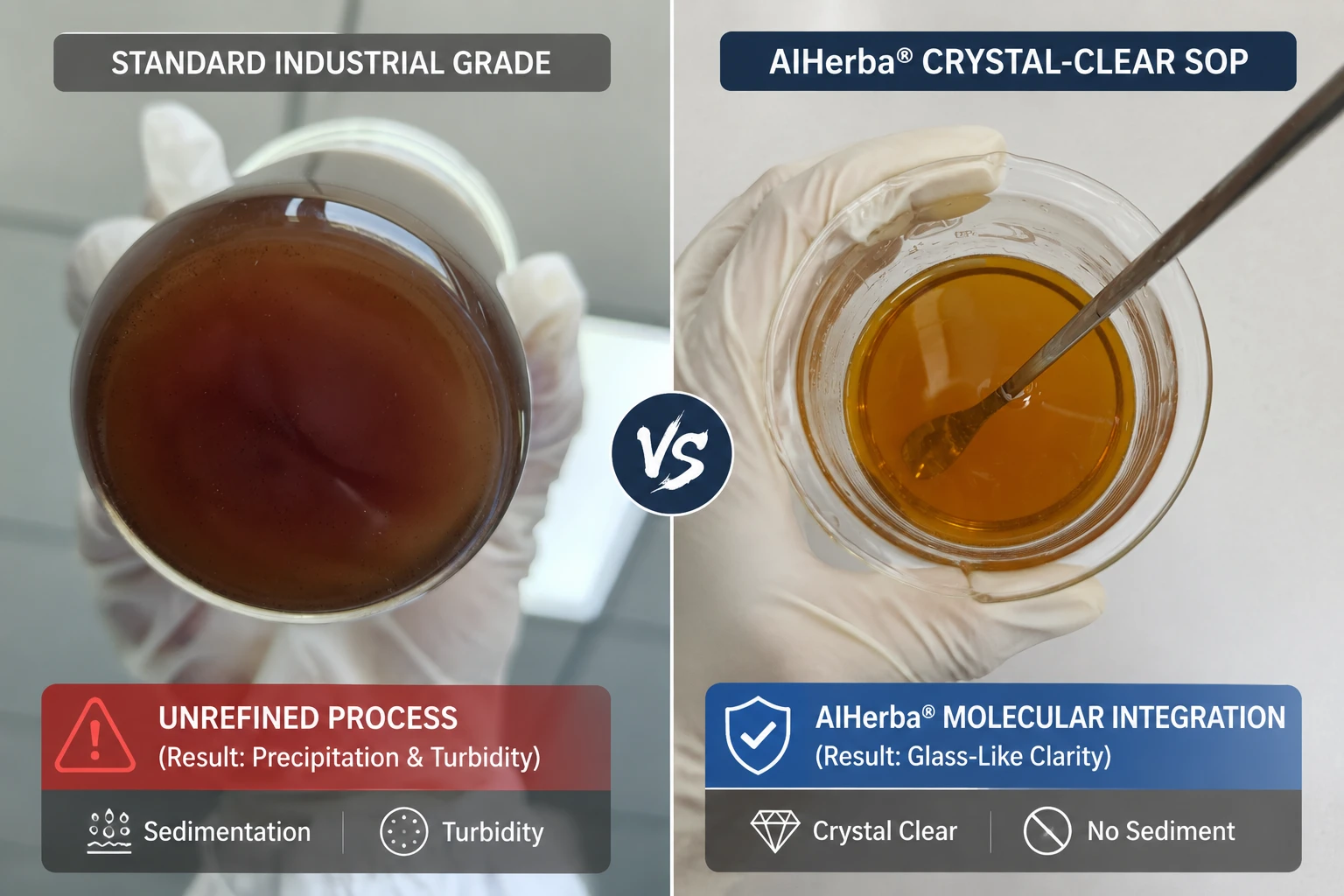
Figure 1: A visual proof of molecular integration. Left shows common precipitation in high-load Valerian formulas; Right demonstrates AIHerba’s 150-mesh filtration and thermal integration success.
04. Six-Step Industrial SOP: Achieving Molecular Integration
This is the AIHerba® Standardized Operating Procedure for high-load botanical gummies.
Step 1: Raw Material Qualification (Micronization)
Raw materials must pass a 100-mesh screen. Anything larger will cause sedimentation.
Step 2: Slurry Particle Engineering
Dry-blend the extract with a flow aid (Silicon Dioxide) at a 1:3 ratio. This prevents “clumping” during introduction to the moisture-rich slurry.
Step 3: Thermal Integration (80°C – 85°C)
Integrate the actives while the gelatin/pectin base is at its peak emulsification state.
Step 4: High-Shear Mixing (420 Seconds)
Apply high-shear force to ensure the lipophilic actives are fully “wrapped” by the hydrophilic matrix.
Step 5: Inline Filtration (150 Mesh)
Use a 150-mesh stainless steel filter to remove natural lignins and heavy lipids.
Step 6: Controlled Acidification
Add citric acid last to lock the matrix. Early acidification can trigger premature setting and trap air bubbles (causing cloudiness).
[Button: Need Formulation Support? Talk with our R&D Engineers]
05. Manufacturing Workflow: From Extraction to Shelf
Fermentation/Extraction ↓ Purification ↓ Particle Engineering (100-mesh) ↓ Factory Slurry Prep ↓ High-Shear Integration ↓ Inline Filtration ↓ QC Release.
06. Ingredient Selection Guide: Molecular Weights & Potency
Sodium Hyaluronate (HA) Selection:
- 8k – 50k Da (Low MW): Best for bio-absorption; adds zero viscosity. Ideal for clarity.
- 300k – 800k Da (Medium MW): Provides “body” and structure.
- 1500k Da+ (High MW): Avoid for gummies. It creates “fish eyes” and ruins the pour.
07. Troubleshooting Guide: Common Industrial Problems
| Problem | Likely Cause | Solution |
| Cloudy Appearance | Residual lipids / Particle size | 150-mesh inline filtration + High-shear |
| Sticky Surface | Improper pH / Moisture | Optimize Citric acid timing; check Aw (<0.6) |
| Color Fading | Thermal shock (Astaxanthin) | Keep temperature < 85°C; add at Step 4 |
| Off-Odor (Valerian) | Volatile organic compounds | Drum-Isolation Strategy during R&D |
08. Industrial Case Studies: Proven Results
Case Study 1: Reducing Sediment in 0.8% Valerian Gummies
- Challenge: A US client faced significant black speckling and sediment in their “Sleep Gummy” line.
- Solution: We implemented our Step 2 Slurry Prep and Step 5 Inline Filtration.
- Result: 100% removal of visible speckling; achieved a clear, deep amber color with consistent 0.8% assay across all batches.
Case Study 2: Stabilizing Astaxanthin in High-Heat Processing
- Challenge: A UK brand saw a 30% loss of Astaxanthin potency after 90°C boiling.
- Solution: Switched to AIHerba® Yeast-Fermented 3S, 3’S Astaxanthin added at a “Stage-Down” temperature of 82°C.
- Result: Potency retention increased to 96% post-manufacturing.
09. Supplier Selection Checklist for Procurement
Before selecting a botanical partner for your gummy line, verify the following 5 safety and technical benchmarks:
- Batch Consistency: Can they provide HPLC chromatograms of 3 consecutive batches to prove stability?
- Mesh Size: Can they guarantee a 100-mesh pass to ensure zero-grit mouthfeel in your gummies?
- Residual Solvents: Is n-Hexane verified at < 1ppm to meet premium “Clean Label” standards?
- DDP Logistics: Can they deliver door-to-door (DDP) to handle all customs risks and duties?
- R&D Support: Do they offer active formulation assistance, or just a “bag of powder”?
Need AIHerba® to provide these documents for your next audit?
10. Global Compliance & Regulatory Trust
We align every batch with USP-NF 2024 and CP 2020 standards. For high-purity singletons (like Urolithin A or Bimatoprost), we provide full Hague Certification (EUS) and export licenses.
FAQ: What R&D Managers Ask (PAA)
Q: Can botanical extracts remain transparent in gummies?
A: Yes, through a combination of high-shear emulsification and 150-mesh inline filtration. This removes the light-scattering lignins while retaining bio-actives.
Q: Which molecular weight of HA is suitable for clear gummies?
A: We recommend a blend weighted toward Low Molecular Weight (8k-50k Da) to ensure absorption and prevent the gummy from becoming too “rubbery” or opaque.
Q: What mesh size should the powders pass?
A: Industrial excellence requires a 100-mesh pass. Anything larger (like standard 80-mesh) will be perceived as “sandy” by the consumer.
Conclusion: Partner with an Industrial Authority
At AIHerba®, we don’t just sell ingredients; we provide industrial success stories. Whether you are launching a new 100kg pilot or a 10,000kg production run, our R&D support ensures your product is clear, stable, and compliant.
References & Technical Authority
- Journal of Food Science: Emulsification kinetics in Pectin-based delivery systems.
- USP-NF: Standardized assay methods for Valerenic acids and Prostaglandins.
- PubMed: Bioavailability of Low vs High Molecular Weight Hyaluronic Acid.