
Sourcing Bulk Freeze-Dried Fucus Vesiculosus: How to Navigate Heavy Metal & Iodine Limits
For a procurement manager in the nutraceutical or dermaceutical sectors, sourcing Bulk Fucus Vesiculosus Extract (Bladderwrack) is notoriously complex. Unlike land-based botanicals, marine ingredients carry a unique set of biological risks—specifically regarding heavy metal bioaccumulation and extreme natural variance in iodine levels.
When you are scaling a formulation, the goal isn’t just to find the lowest price per kilo; it is to secure a material that passes third-party audits and ensures finished product safety. This guide analyzes the technical hurdles of seaweed procurement and how advanced manufacturing protocols, such as ICP-MS testing and physical purification, are utilized to mitigate these risks.
1. The Marine Sourcing Dilemma: Why Seaweed is Different
Fucus Vesiculosus is a sublittoral seaweed that naturally absorbs minerals from its environment. While this makes it a powerhouse of trace elements, it also makes it a sponge for marine contaminants.
From a supply chain perspective, the “crude powder” market is flooded with low-cost options. However, for professional manufacturers, these crude materials often fail to meet the EU Commission Regulation (EC) No 1881/2006 or the USP <2232> standards for elemental impurities. Sourcing a “standardized extract” is not a luxury—it is a regulatory necessity to prevent batch recalls and protect brand equity.
2. Heavy Metal Remediation: Navigating Arsenic and Mercury
The most significant hurdle in Wholesale Bladderwrack Extract procurement is the presence of Inorganic Arsenic (As) and Mercury (Hg).
The Bioaccumulation Reality
Seaweeds naturally concentrate arsenic from seawater. However, global health authorities differentiate between organic arsenic (relatively safe) and inorganic arsenic (toxic). Many low-tier suppliers only provide “Total Arsenic” data, which can be misleading.
The AIHerba® Solution: ICP-MS and Physical Purification
To solve this, we implement a multi-stage remediation process:
- Selective Harvesting: We monitor marine “terroir,” sourcing biomass only from monitored waters with low industrial runoff.
- Ion-Exchange & Membrane Filtration: During the extraction phase, we utilize specific physical barriers and ion-exchange resins to selectively remove heavy metal ions while leaving the bioactive fucoidans and phlorotannins intact.
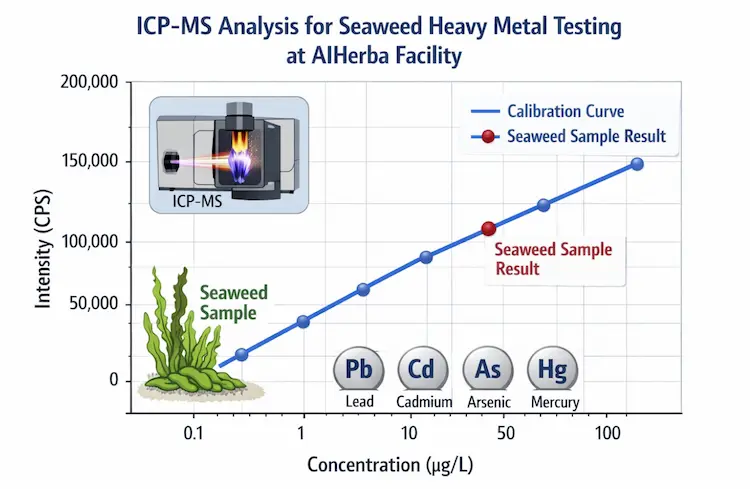
- ICP-MS Validation: We utilize Inductively Coupled Plasma Mass Spectrometry (ICP-MS) to detect contaminants at the parts per billion (ppb) level. This ensures that every 25kg drum we ship complies with the strictest global thresholds (As < 1.0 ppm, Pb < 2.0 ppm).
3. Iodine Standardization: The “Goldilocks” Challenge
Iodine is the primary functional marker of Fucus Vesiculosus, vital for metabolic support formulations. However, natural iodine levels can fluctuate by over 400% depending on the harvest season and water temperature.
The Risk of Over-Dosage
In the nutraceutical industry, iodine is a “narrow therapeutic index” ingredient. Too little makes the product ineffective; too much can lead to thyroid toxicity and regulatory scrutiny.
Precision Blending Protocols
A reliable Fucus Vesiculosus Manufacturer must provide more than a “ratio extract” (e.g., 10:1). At AIHerba®, we focus on Standardized Assays. By utilizing a “Master Batch” blending system, we combine various extraction lots to hit a precise 0.1% or 0.2% iodine target with a standard deviation of less than 5%. This allows your R&D team to formulate with confidence, knowing the dosage is consistent from the first capsule to the last.
4. Technical Comparison: Crude Powder vs. Standardized Extract
For procurement teams calculating ROI, the initial cost of raw materials is only part of the equation.
| Feature | Crude Seaweed Powder | AIHerba® Standardized Extract | Impact on ROI |
| Iodine Content | Highly Variable | Standardized 0.1% | Prevents batch failure |
| Heavy Metals | High Risk of Failure | Controlled via ICP-MS | Minimizes recall risk |
| Solubility | Poor / High Sediment | High Dispersibility | Better formulation feel |
| Microbial Control | High baseline counts | GMP-Controlled | Extended shelf life |
5. Regulatory Compliance: A Checklist for B2B Buyers
Before issuing a Purchase Order for Bulk Fucus Extract, ensure your supplier can provide the following documentation:
- Full Elemental Analysis: ICP-MS data for Pb, As, Cd, and Hg.
- Solvent Residue Statement: Confirmation of ethanol-only extraction (no MDC or hexane).
- GMO & Allergen Status: Essential for “Clean Label” certification.
- Batch Traceability: Documentation linking the finished drum back to the specific marine harvest area.
6. Manufacturing Rigor at AIHerba®
Our facility in Shaanxi (Shaanxi Zhonghong Investment Technology Co., Ltd.) is engineered to bridge the gap between raw marine biomass and pharmaceutical-grade ingredients. Our counter-current extraction line operates under vacuum low-temperature conditions, preserving the delicate Fucoidans that are often destroyed by the high-heat processes used by lower-cost competitors.
We understand that in the B2B world, transparency is the highest form of marketing. We welcome third-party audits and provide batch-retain samples for every wholesale shipment.
7. FAQ for Procurement Managers
Q: How do you handle the “seaweed smell” in cosmetic formulations?
A: We offer a specialized decolorized and deodorized grade of Fucus extract specifically for dermaceuticals, ensuring the anti-aging benefits remain without affecting the scent profile of your cream or serum.
Q: Is your material compliant with California Proposition 65?
A: Yes. Because we strictly control heavy metals (specifically Lead and Arsenic) via ICP-MS, our standardized extracts are designed to meet or exceed Prop 65 requirements.
Q: Can we request a custom standardization (e.g., 0.5% Iodine)?
A: Yes. As a direct manufacturer, we can adjust the concentration curve to meet your specific formulation requirements, provided the MOQ is met.
8. References & Regulatory Sources
To support your internal quality assurance and R&D teams, we recommend consulting the following authoritative sources:
- PubMed: Biological properties of Fucus vesiculosus in metabolic regulation.
- NIH Office of Dietary Supplements: Iodine Fact Sheet for Health Professionals.
- FDA: Guidelines on Elemental Impurities in Dietary Supplements.
- European Commission: Maximum levels for certain contaminants in foodstuffs (EC No 1881/2006).
Request Technical Documentation & Bulk Pricing
Secure your supply chain with lab-verified, heavy-metal-controlled Fucus Vesiculosus Extract. AIHerba® provides the technical partnership your brand needs to scale safely.
- Manufacturer: AIHerba® (Shaanxi Zhonghong Investment Technology Co., Ltd.)
- Inquiry Email: sales@aiherba.com | info@aiherba.com
- WhatsApp / Phone: +86 199 2901 8987
- Technical Support: [Request Full Specification & Sample COA]
Manufacturer & Quality Assurance
Manufactured by AIHerba® (Shaanxi Zhonghong Investment Technology Co., Ltd.), a GMP-certified manufacturer specializing in high-purity botanical extracts for dietary supplements, cosmetics, and pharmaceutical applications.
✔ GMP-certified production facility
✔ Full COA & technical specifications available
✔ Batch traceability & strict quality control
✔ Bulk supply & OEM/ODM services for global B2B buyers
If you are looking for a bulk supplier / OEM manufacturer of Fucus Vesiculosus Extract, contact us for specifications, COA, and pricing.
Bulk Supply & Technical Support
Get direct factory quotes, COA, and MSDS within 12 hours. We support bulk supply and custom specifications.