
AIHERBA® / COSMETIC ACTIVE IDENTITY / R&D + QA
Understand purity, psoralen and isopsoralen, ingredient identity, and the requirements for cosmetic formulation.
Distinguish a defined single active from a variable botanical oil before assessing the finished matrix.
Compare assay, impurity limits and lot-specific evidence, not only marketing names.
01. Quick Answer: Are Bakuchiol and Babchi Oil the Same?
No. Bakuchiol is a defined meroterpene phenol (CAS 10309-37-2). Babchi or bakuchi oil normally describes a botanical preparation associated with Psoralea corylifolia seeds. Both may originate from the same plant, but their chemical composition, level of standardization, impurity profile and cosmetic-ingredient identity can be different.
The name “Bakuchiol oil” is especially ambiguous. Because purified Bakuchiol itself can be a viscous liquid, the physical appearance of an oily material does not prove that it is crude seed oil, a diluted premix or a ≥99% purified active. Buyers and formulators need the actual INCI, assay method, composition and batch specification.
02. Understand the Four Material Names Used in the Market
Market listings frequently interchange terms such as Bakuchiol, babchi seed oil, bakuchi extract and Bakuchiol blend. These labels do not necessarily identify the same ingredient and should not be compared solely by unit price.
| Commercial description | What it may mean | Information required |
|---|---|---|
| Purified Bakuchiol | Defined active substance, typically sold against a Bakuchiol assay | Bakuchiol identity, quantitative assay, impurities, additive declaration |
| Babchi / Bakuchi seed oil | Oil obtained from botanical seeds; composition depends on process | Botanical identity, plant part, extraction process, complete chemical profile |
| Babchi seed extract | Broad botanical extract with variable constituents | DER, solvents, marker specification and furanocoumarin testing |
| Bakuchiol premix / blend | Bakuchiol dispersed or dissolved in an additional carrier | Bakuchiol assay on an as-supplied basis, complete carrier and INCI disclosure |
The distinction is not a blanket statement that every botanical oil is intrinsically unsafe. Rather, a crude preparation cannot be substituted for a purified active without its own composition and safety evaluation.
03. Botanical Source: Psoralea corylifolia Seeds
Bakuchiol is associated with the seeds of Psoralea corylifolia L. The plant also contains other classes of phytochemicals, including compounds that need separate consideration in a cosmetic ingredient assessment. A botanical source name verifies neither concentration nor absence of undesired constituents.
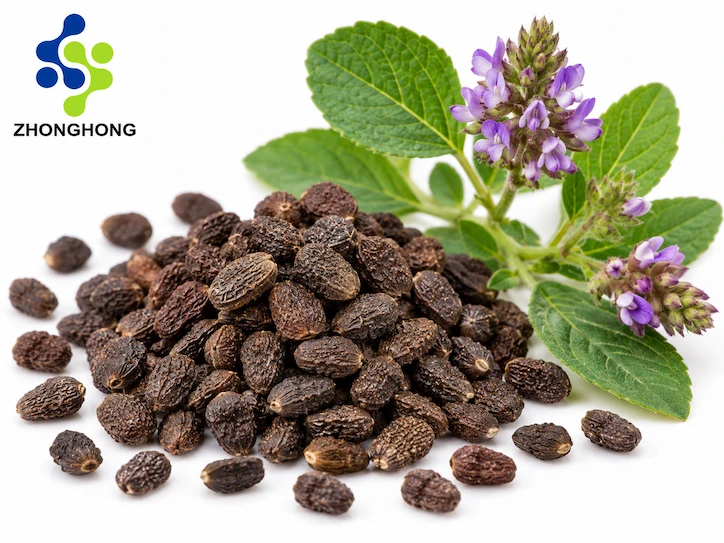
For manufacturing qualification, ask for origin and traceability of the source material as well as the identity and release data of the finished purified ingredient. They are two separate records.
04. CAS and INCI: Why Ingredient Identity Comes First
Purified Bakuchiol is identified by CAS 10309-37-2 and INCI BAKUCHIOL. These identifiers are useful to formulators building ingredient declarations, safety files and purchasing specifications. However, writing “Bakuchiol” in a product listing is not by itself evidence of purity or regulatory status.
A botanical oil or complex plant extract needs its own correct ingredient nomenclature based on the actual manufacturing process, material composition and destination market. Do not automatically copy the pure compound’s CAS or INCI to a crude oil or mixture.
05. Psoralen and Isopsoralen: Why Purification Matters
The botanical source can contain psoralen and isopsoralen, two furanocoumarins associated with light-related skin reactivity. Peer-reviewed literature on Bakuchiol isolation explains why separating these constituents is important when developing cosmetic ingredients from P. corylifolia.
The analytical question is not whether a seller advertises “psoralen-free.” It is what compounds were tested, by which method, with what limits, and what the actual lot results show. Each constituent should have an explicit result and appropriate reporting or detection limit.
| Term on a report | Correct interpretation |
|---|---|
| Psoralen <10 ppm | The reported psoralen result is below the stated limit; the reporting convention and method must be checked. |
| Isopsoralen <10 ppm | A distinct result for a separate analyte—not interchangeable with psoralen. |
| Both individually <10 ppm | Does not establish a combined total <10 ppm. |
| ND / Not detected | Only meaningful with the method-specific detection/reporting limit. |
| “Zero psoralen” | An absolute absence claim that should not replace analytical evidence. |
There is no universal cosmetic-buyer acceptance number established by the phrases above. A suitable specification must be defined for the material, product exposure and destination-market safety assessment; avoid presenting a voluntary target as a global legal limit.
06. HPLC Purity: 99% Bakuchiol Is a Defined Specification
A 99% claim should identify the tested substance, the analytical procedure and whether the number represents quantitative assay or chromatographic area percentage. These are not automatically equivalent. The external-standard method also requires appropriately qualified reference material and method controls.
AIHerba’s supplied reference technical dossier describes Bakuchiol ≥99.0% by HPLC external-standard assay and a light-yellow viscous liquid. A historical lot in that dossier reported 99.84%; that historical value must not be represented as the result of the current available lot.
07. HPLC-DAD, GC and Identity: Evidence Must Match the Question
Different analytical tests answer different questions. Identity may be supported by appropriate chromatographic or spectroscopic techniques; quantitative assay demonstrates active content under the defined method; targeted impurity methods examine psoralen and isopsoralen; headspace GC can examine named volatile residues.
| Technical question | Appropriate evidence | Common interpretation error |
|---|---|---|
| Is the ingredient Bakuchiol? | Suitable identification comparison; supporting NMR where available | Treating a botanical name as chemical identification |
| How much Bakuchiol? | Validated quantitative HPLC assay and calibration details | Confusing HPLC area % with a true mass assay |
| Are furanocoumarins controlled? | Specific psoralen/isopsoralen results, method and limits | Reporting only “low impurities” |
| Are process solvents controlled? | Current-lot GC report naming solvents and limits | Calling a product absolutely solvent-free because one solvent is ND |
A chromatogram should not be presented as batch-specific without a traceable lot, sample, test date, method and verified peak identities. AIHerba does not use a mislabeled residual-solvent chromatogram as Bakuchiol assay proof in this article.
08. Formulation Consequences: Pure Active vs. Botanical Oil
High-purity Bakuchiol is lipophilic and is normally evaluated with a suitable oil phase. A botanical oil may introduce a broader mixture of constituents that change color, odor, oxidative behavior and formulation design. The two materials are not necessarily 1:1 substitutes, even when both have an oily appearance.
For a cosmetic serum or emulsion, test active recovery, sensory properties, appearance, packaging compatibility and physical stability in the actual finished formula. A certificate for the incoming raw material cannot substitute for these tests.
For incorporation, dosage-system selection and emulsion stability methods, see the Bakuchiol serum formulation guide.
09. From Botanical Material to Purified Cosmetic Active
Public research describes extraction and separation workflows used to isolate Bakuchiol and distinguish it from furanocoumarins. Exact industrial parameters depend on the manufacturer and should not be inferred from an academic paper.
A high-quality industrial project needs a controlled material identity, traceable process and release specifications. For AIHerba, the supplied historic dossier references a purification approach involving molecular distillation. A customer should request a verified process summary and applicable site documentation if these are important to supplier qualification.
Browse manufacturing and quality capability information, while confirming the actual scope and validity of documents relevant to the selected material.
10. Which Material Should Brands and OEMs Specify?
For a formulation built around a defined Bakuchiol active, choose the grade by identity, verified content and relevant impurity controls. If a developer intentionally wishes to use a botanical seed oil, it requires a separate specification and cosmetic safety decision; simply replacing one item on the bill of materials with the other is not an adequate change-control process.
| Brand / R&D requirement | Preferred decision path |
|---|---|
| A precise Bakuchiol active percentage | Specify an assayed Bakuchiol raw material and its complete composition. |
| A broad botanical-oil story | Evaluate seed-oil identity, chemistry, photosensitizing constituents and product-level safety. |
| A “carrier-free” ingredient claim | Obtain the current-lot composition/additive declaration; do not infer from a 99% headline. |
| Reformulation of an existing serum | Run change control, phase compatibility, stability and appropriate performance substantiation. |
For a fuller manufacturer/document qualification process, use the separate Bakuchiol sourcing guide rather than duplicating its seven-step checklist here.
11. Frequently Asked Questions for Cosmetic R&D and Procurement
12. Scientific References and Regulatory Scope
- Afzal N. and Sivamani R.K. (2023). Finding the right Bakuchiol: Choose wisely. Journal of Cosmetic Dermatology. Discussion of purified Bakuchiol vs. botanical preparations and furanocoumarin concerns. Review the published article.
- Krishna T.P.A. et al. (2022). Bakuchiol—A natural meroterpenoid: structure, isolation, synthesis and functionalization approaches. Scientific review covering structure, isolation and purification. Open-access scientific review.
- U.S. FDA. Cosmetic Ingredients: general U.S. ingredient oversight and safety responsibility. Official regulatory information.
References
To better understand Bakuchiol and its benefits, several scientific studies and reliable sources can provide valuable insights. The following list includes noteworthy references:
- PubMed: Extensive research articles detailing Bakuchiol’s properties and effects on skin.
- FDA: Guidelines and safety information regarding the use of Bakuchiol in skincare.
- NIH: Studies on the clinical effectiveness and consumer safety of Bakuchiol.
These resources offer comprehensive information, ensuring a well-rounded perspective on Bakuchiol’s role in modern skincare.