
Bacopa monnieri extract is commonly specified by its bacoside content, but a percentage without an analytical method is an incomplete purchasing specification.
Before comparing grades or prices, buyers need to know:
- Which compounds are measured.
- Whether the result is determined by HPLC or UV spectrophotometry.
- How the result is calculated.
- Whether the result is reported on an as-is or dry basis.
- Whether the value applies to the delivered commercial powder.
- Whether the evaluation sample can be traced to the proposed commercial batch.
For supplement brands, contract manufacturers and ingredient distributors, the practical objective is to select a reproducible Bacopa monnieri extract that meets both the analytical specification and the manufacturing requirements.
You can review AIHerba’s Bacopa monnieri extract product information and submit a defined sourcing brief before requesting a sample, COA or bulk quotation.
What Are Bacosides in Bacopa Monnieri Extract?
Bacosides are a group of related saponins associated with Bacopa monnieri. However, the terms “total bacosides,” “bacoside A,” “bacoside A3” and “bacoside A content” should not automatically be treated as equivalent assay descriptions.
A published HPLC study of bacoside A characterized bacoside A as a mixture whose major constituents included bacoside A3, bacopaside II, a jujubogenin isomer of bacopasaponin C and bacopasaponin C.
The purchasing implication is important: ask the supplier to identify the exact compounds or defined groups included in the reported result.
Do not assume that every laboratory uses the same peak list when reporting “total bacosides.”
A complete Bacopa specification should also identify:
- Botanical species.
- Plant part.
- Extraction ratio or process.
- Marker compounds.
- Assay method.
- Reporting basis.
- Added carriers or processing aids.
- Moisture and physical properties.
- Contaminant limits.
- Batch and sample traceability.
The ingredient name and a marker percentage alone do not fully describe the commercial material.
Bacosides by HPLC vs UV: Why Results Can Differ
Published research on bacoside method validation describes differences between UV-spectrophotometric measurements and HPLC procedures that include selected bacoside components.
The methods may differ in:
- Sample preparation.
- Extraction solvent.
- Compounds included in the calculation.
- Reference standards.
- Calibration procedure.
- Detection principle.
- Reporting basis.
- Moisture correction.
- Integration and calculation rules.
Consequently, a lower reported percentage under one method does not automatically indicate an inferior material, and a higher percentage under another method does not automatically indicate superior potency.
The result must be interpreted together with the method and the composition of the tested powder.
Can UV and HPLC Results Be Converted Using a Fixed Ratio?

No universal conversion factor should be applied.
To relate two methods for a particular commercial material, arrange a documented comparison using representative samples and the defined procedures. The comparison should specify:
- The same batch or representative portions of the same batch.
- The exact sample preparation procedure.
- The reference standards.
- The compounds included in the result.
- The calculation basis.
- The moisture correction, if applicable.
- The laboratory acceptance criteria.
A number reported by UV should not be converted into an estimated HPLC value simply by applying a fixed ratio from another supplier or another study.
Does HPLC Always Mean the Same Bacopa Assay?
No.
“HPLC” describes a separation and detection technique, but it does not by itself define:
- Which bacosides are measured.
- Which reference standards are used.
- Which peaks are included.
- Whether the result is calculated as a sum.
- Whether the result is reported on an as-is or dry basis.
- Whether the method has been validated for the specific commercial material.
Two reports labeled “HPLC” may therefore measure different defined sums.
Request the complete procedure name or method reference rather than relying on an abbreviated “HPLC” statement in a specification table.
Illustrative Comparison of Bacopa Extract Grades
Consider the following hypothetical quotations:
| Supplier | Stated specification | Information still needed |
|---|---|---|
| Supplier A | 50% bacosides by UV | Procedure, calibration standard, reporting basis and composition |
| Supplier B | 20% bacosides by HPLC | Compounds included, standards, reporting basis and composition |
These numbers are illustrative purchasing examples. They are not AIHerba specifications and do not represent paired laboratory results.
You cannot determine from this table that:
- Supplier A is 2.5 times stronger.
- Supplier B is automatically better.
- The two products are equivalent.
- Either percentage predicts finished-product performance.
- Either material is equivalent to a clinically studied extract.
Ask both suppliers for comparable evidence.
A useful request is:
Please confirm the assay procedure, compounds included, reference standards, reporting basis and composition for the quoted grade, and provide the corresponding batch COA.
If direct analytical comparison is needed, use the same agreed procedure on representative samples of both products. Evaluate the resulting materials against the requirements of the intended formulation.
How to Review a Bacopa Monnieri Extract COA
A specification defines the acceptance requirements. A certificate of analysis records results for an identified batch.
Request both documents and confirm that the evaluation sample can be traced to the proposed commercial material.
| COA or supporting-document field | What to check |
|---|---|
| Botanical identity | Bacopa monnieri identification, declared plant part and source traceability |
| Product and lot | Grade code, batch number and relevant production or retest dates |
| Assay description | Defined bacoside group or individual markers, method and reporting units |
| Assay basis | As-is or dry basis, including any moisture correction |
| Reference standards | Identity, assigned content and suitability for the calculation |
| Added ingredients | Carriers, processing aids and composition of the final powder |
| Physical properties | Appearance, particle size, moisture and relevant powder-handling data |
| Contaminants | Elements, pesticides, residual solvents and microbiological parameters |
| Release documentation | Actual results, acceptance limits and authorized batch release |
If a report states “not detected,” request the relevant detection limit or quantification limit.
If it states only “complies,” ask whether numerical results are available for parameters that are critical to your project.
For a chromatographic assay, request an annotated chromatogram where available. It should connect to the stated method, identified batch and tested sample. A generic chromatogram should not be used as proof of a particular batch.
You can request the available Bacopa extract specification and batch COA for your target grade.
What to Do When Two Laboratories Report Different Results
A disagreement should trigger a structured investigation before either result is rejected.
1. Confirm sample identity
Check:
- Batch numbers.
- Sample labels.
- Sample handling.
- Storage conditions.
- Whether both laboratories tested representative portions of the same material.
2. Compare reporting bases
Reconcile:
- Percentage units.
- As-is or dry-basis reporting.
- Moisture corrections.
- Sample concentration.
- Whether the result refers to the final commercial powder.
3. Compare the analytical targets
Verify that both laboratories measured:
- The same bacoside group.
- The same individual compounds.
- The same peak list.
- The same reference standard basis.
4. Review method details
Compare:
- Extraction solvent.
- Extraction time and temperature.
- Column and mobile phase.
- Detector wavelength.
- Reference standards.
- Calibration curve.
- Integration rules.
- Calculation formula.
5. Agree on a resolution procedure
Use a suitable shared method or an agreed independent laboratory, with documented acceptance criteria.
For repeat supply, establish the acceptance method before placing a commercial order. Record how a method change will be communicated and assessed.
This workflow is a proposed purchasing practice. It is not a claim that a particular AIHerba batch has undergone an interlaboratory study.
Extraction Process, Carriers and Grade Selection
An extraction ratio such as 10:1 does not substitute for a defined bacoside assay.
Ask how the ratio is calculated and whether it describes:
- The native extract before drying.
- The concentrated liquid extract.
- The final commercial powder.
- A powder containing carriers or processing aids.
Request a process description identifying:
- Relevant extraction solvents.
- Extraction and concentration steps.
- Drying method.
- Added carriers.
- Final powder composition.
- Residual-solvent controls.
Do not rank a process solely by a label such as “supercritical,” “ethanol-free” or “carrier-free.”
A carrier-free declaration concerns added carriers. It does not mean that the extract contains only bacosides, nor does it independently establish a particular assay value.
Select against the required composition, analytical method and supporting quality data.
Choosing Bacopa Extract for Capsules and Tablets
For capsules and tablets, assess the ingredient together with its manufacturing behavior.
Important considerations include:
- Bacoside assay and method.
- Ingredient loading.
- Bulk density.
- Flowability.
- Particle size.
- Blend uniformity.
- Filling performance.
- Compression performance.
- Moisture.
- Carrier content.
- Finished-product stability.
If the formula targets a specified amount of measured bacosides, base the calculation on an agreed quantitative assay of the delivered ingredient.
Do not substitute an undefined percentage or assume that different assay systems give equivalent inputs.
Complete the relevant finished-product release and stability assessments for the actual formula.
Choosing Bacopa Extract for Drink Powders and Beverages
For drink powders and beverages, request a defined dispersion or solubility test.
The test should state:
- Ingredient concentration.
- Water temperature.
- pH.
- Mixing conditions.
- Mixing time.
- Observation time.
- Sedimentation or suspended-particle criteria.
- Color and flavor observations.
Evaluate the ingredient in the full formulation rather than relying on a general “water-soluble” claim.
A practical application trial should assess:
- Flavor.
- Color.
- Sediment.
- Suspended particles.
- Precipitation.
- Compatibility with acids, minerals and other botanical ingredients.
- Stability during storage.
Changing Suppliers or Commercial Grades
Compare more than marker content.
When changing the supplier, extraction process or commercial grade, confirm:
- Botanical identity.
- Plant part.
- Extraction ratio.
- Carrier composition.
- Bacoside assay method.
- Physical properties.
- Microbiological profile.
- Contaminant profile.
- Formulation performance.
- Batch-to-batch consistency.
A similar bacoside percentage alone does not establish equivalence to a clinically studied extract or to an ingredient previously approved for your product.
A supplier change should be treated as a material change requiring document review, sample evaluation and, where appropriate, a manufacturing trial.
How to Compare Bulk Bacopa Extract Prices
Compare quotations only after the specification and test method have been aligned.
Request the following commercial information:
- Price per kilogram.
- Minimum order quantity.
- Evaluation sample quantity.
- Sample charges.
- Packaging.
- Lead time.
- Additional testing costs.
- Delivery terms.
- Available documents.
- Batch and sample traceability.
- Payment terms.
- Repeat-supply conditions.
Confirm whether the evaluation sample represents the proposed commercial grade.
For a new supplier, start with document review and a representative sample. Proceed to a manufacturing trial before committing to repeat commercial supply.
The useful comparison is the cost of a material that consistently meets your analytical and manufacturing requirements, not simply the lowest price per kilogram.
Request Bacopa Monnieri Extract Specifications and a Quote
AIHerba supplies Bacopa monnieri extract for business customers.
Send a defined sourcing brief so the discussion can focus on the appropriate grade and available documentation.
Please include:
- Target bacoside specification.
- Required test method.
- Defined marker group or pharmacopoeial reference, if applicable.
- Plant-part requirement.
- Carrier requirement.
- Intended application.
- Destination country.
- Evaluation-sample quantity.
- Trial-order quantity.
- Expected repeat demand.
- Required documents.
- Delivery location.
- Project timeline.
Ask AIHerba to confirm the current grade, available batch documentation, sample charges, packaging and lead time in the quotation.
Any additional testing or method-comparison work should be agreed separately.
Request Bacopa Extract COA, Sample & Bulk Quote
Email: sales@aiherba.com
Frequently Asked Questions
Is 50% bacosides by UV equivalent to 20% by HPLC?
There is no universal equivalence. Compare the defined procedures and the actual materials rather than applying a fixed conversion ratio.
Does a higher bacoside percentage always mean a better extract?
No. The assay target, method, composition, physical properties and application requirements must be considered together.
What should a Bacopa extract COA state about the assay?
It should identify the measured constituent or group, the method, the result, the acceptance limit and the reporting basis. Supporting method information should clarify which compounds are included.
Can a generic HPLC chromatogram prove the quality of my batch?
No. Request data linked to the identified batch and method. A chromatogram also does not replace the required identity, composition and contaminant assessments.
What does “UV” mean on a Bacopa report?
“UV” may refer to a standalone spectrophotometric assay or to the detector used after HPLC separation.
An HPLC system can use UV detection. Therefore, “HPLC” and “UV” are not always mutually exclusive labels.
Request the complete procedure name or method reference rather than relying on an abbreviated method column.
Can I request a sample with a specific assay requirement?
Yes. Submit the required method, target specification, sample quantity and delivery country.
Availability, testing scope, charges and shipping should be confirmed for the specific request.
Analytical References
- Deepak M. et al. Quantitative determination of the major saponin mixture bacoside A in Bacopa monnieri by HPLC. Phytochemical Analysis, 2005.
- Dowell A., Davidson G. and Ghosh D. Validation of Quantitative HPLC Method for Bacosides in KeenMind. Evidence-Based Complementary and Alternative Medicine, 2015.
These publications support the analytical discussion. They are not certificates for AIHerba products and are not evidence that every commercial Bacopa extract has the same composition or clinical performance.
Please include:
Motion Plan:
- Begin with 150mg standardized extract, enhance to 300mg over 2 weeks
- Mix with omega-3s for enhanced bioavailability
- Observe cognitive metrics (e.g., digit span exams) month-to-month
“300mg Bacopa every day for 12 weeks improved reminiscence take a look at scores equal to 10 years of mind ageing reversal”
— Journal of Different Drugs, 2024
Analytical References
- Deepak M. et al. Quantitative determination of the major saponin mixture bacoside A in Bacopa monnieri by HPLC. Phytochemical Analysis, 2005.
- Dowell A., Davidson G. and Ghosh D. Validation of Quantitative HPLC Method for Bacosides in KeenMind. Evidence-Based Complementary and Alternative Medicine, 2015.
These publications support the analytical discussion. They are not certificates for AIHerba products or evidence that every commercial Bacopa extract has the same composition or clinical performance.
References
- Kongkeaw C., et al. (2023). Meta-analysis of Bacopa’s Cognitive Results. Phytomedicine.
- Benson S., et al. (2024). Bacopa for Pediatric ADHD. JAMA Pediatrics.
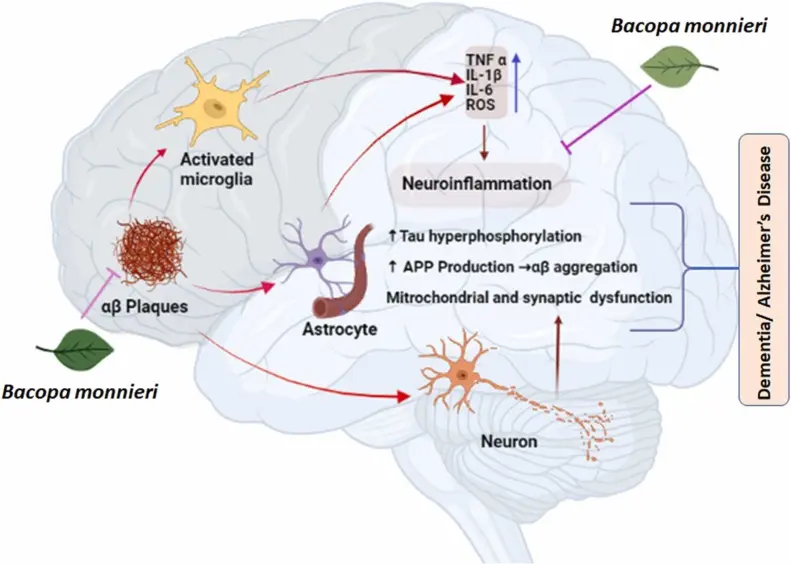
- Kumar N., et al. (2022). Neuroprotective Mechanisms In opposition to Aβ Plaques. J Alzheimer’s Dis.
- Dutta A., et al. (2024). Lengthy-term Security Profile. Regulatory Toxicology & Pharmacology.
- Roodenrys S., et al. (2023). Dose-Response Relationship. Nutraceuticals Analysis.
For optimum outcomes: Pair with Mediterranean weight loss program + cardio train to amplify BDNF results.