Introduction: Why Eurycoma Longifolia Matters in the Global Ingredients Market
Eurycoma longifolia Jack, widely known as Tongkat Ali, is one of Southeast Asia’s most researched botanical raw materials. Traditionally used in Malaysia and Indonesia, it has evolved into a globally traded functional ingredient used in dietary supplements, sports nutrition, functional beverages, and emerging wellness formulations.
Today, Eurycoma longifolia extract is no longer just a “traditional herb.” For professional buyers, it represents a standardized botanical ingredient with defined active markers, traceable sourcing, and clear regulatory positioning.
This guide is written for:
- Ingredient buyers and formulators
- Brand owners and OEM/ODM partners
- Importers, distributors, and contract manufacturers
The focus is raw material science, application logic, and sourcing decisions—not consumer marketing or medical claims.
What Is Eurycoma Longifolia Extract?
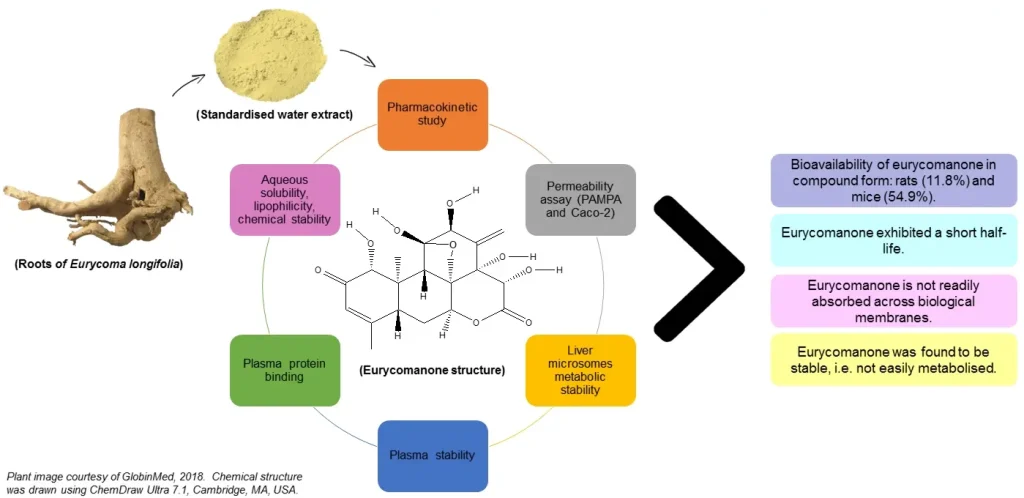
Eurycoma longifolia extract is derived primarily from the root of the Eurycoma longifolia Jack plant. Modern extraction processes concentrate specific quassinoids, with eurycomanone recognized as a key reference compound for quality standardization.
Key Characteristics
- Botanical name: Eurycoma longifolia Jack
- Plant part used: Root
- Extraction method: Water or hydro-ethanolic extraction
- Standardization markers: Eurycomanone, total quassinoids
Unlike whole root powder, standardized extracts offer:
- Batch-to-batch consistency
- Clear analytical specifications
- Better suitability for industrial formulation
Active Compounds & Scientific Context (Non-Therapeutic)
Research has identified multiple quassinoids in Eurycoma longifolia, including:
- Eurycomanone
- Eurycomanol
- Eurycomanol-2-O-β-D-glucopyranoside
Scientific literature focuses on:
- Botanical chemistry profiling
- Hormonal pathway interaction (mechanistic, not clinical claims)
- Adaptogenic and stress-response models
These studies help define ingredient functionality, not medical outcomes.
Key research sources:
- PubMed botanical chemistry reviews
- NIH dietary supplement monographs
- Malaysian herbal pharmacopoeia references
From a regulatory perspective, Eurycoma longifolia extract is positioned as a dietary ingredient, not a pharmaceutical substance.
Global Applications by Industry
1. Dietary Supplements
Common formats:
- Capsules & tablets
- Stick packs
- Combination formulas (with zinc, magnesium, ginseng, maca)
Why brands use it:
- Botanical positioning
- Recognizable Southeast Asian heritage
- Compatibility with male wellness and vitality concepts
2. Sports Nutrition & Active Lifestyle Products
Used in:
- Pre-workout blends
- Recovery formulations
- Performance-support stacks
Formulation advantage:
- Low dosage inclusion
- Heat-stable powder format
- Works well with amino acids and plant extracts
3. Functional Foods & Beverages
Emerging applications:
- Ready-to-drink functional shots
- Herbal beverage concentrates
- Powder blends for instant drinks
Important for buyers:
- Solubility profile
- Taste masking strategy
- Stability in acidic environments
4. OEM / Private Label Opportunities
For OEM clients, Eurycoma longifolia extract is often selected because:
- It allows clear differentiation
- It fits premium positioning
- It supports multi-market labeling strategies
Dosage Logic (Industry Reference, Not Consumer Advice)
From published formulation data and commercial use patterns:
| Application | Typical Inclusion Range |
|---|---|
| Capsules/Tablets | 50–200 mg/day |
| Powder Blends | 0.1–0.5% |
| Functional Beverages | Application-dependent |
Final dosage decisions must comply with local regulations and finished-product requirements.
Safety, Compliance & Regulatory Perspective
Eurycoma longifolia extract has been:
- Reviewed in multiple toxicological assessments
- Included in traditional pharmacopeias
- Subject to safety evaluations for dietary use
Regulatory notes:
- Classified as a dietary ingredient in many regions
- Labeling and claims must follow FDA DSHEA, EFSA, and local authority guidelines
- Not approved as a drug or treatment agent
Key references:
- NIH Office of Dietary Supplements
- FDA Dietary Supplement Guidance
- EFSA botanical safety framework
Quality Standards That Matter to Professional Buyers
For B2B procurement, quality is defined by documentation, not marketing language.
Core Quality Indicators
- Defined eurycomanone specification (e.g., ≥1%, ≥10%)
- Full Certificate of Analysis (COA)
- Heavy metals & pesticide compliance
- Microbiological safety
- Batch traceability
Typical Technical Parameters
| Item | Standard |
|---|---|
| Appearance | Brown-yellow powder |
| Assay | HPLC-verified |
| Heavy Metals | ICP-MS |
| Solvents | USP / EP compliant |
How to Evaluate a Reliable Bulk Supplier
When sourcing Eurycoma longifolia extract in bulk, professional buyers should verify:
- Manufacturing system
- GMP-certified production
- Documented SOPs
- Analytical capability
- In-house or third-party HPLC testing
- Transparent COA sharing
- Supply consistency
- Stable raw material sourcing
- Scalable production capacity
- OEM & customization
- Custom assay levels
- Private labeling support
From Blog to Purchase: Recommended Conversion Path
High-Authority Blog (Education & Trust)
↓
Product Page (Specs, COA, MOQ)
↓
Factory / OEM Capability Page
↓
Inquiry Form (Application-Focused)
This structure aligns with Google’s Helpful Content System and real B2B buying behavior.
Frequently Asked Questions (FAQ)
Is Eurycoma longifolia extract the same as Tongkat Ali powder?
No. Extracts are standardized and concentrated, while powders are ground raw material without defined active content.
What is eurycomanone and why does it matter?
Eurycomanone is a reference compound used for quality standardization and analytical comparison.
Can the extract be customized for OEM projects?
Yes. Assay levels, particle size, and packaging can typically be adjusted for OEM clients.
Is Eurycoma longifolia approved by FDA?
It is regulated as a dietary ingredient, not as a drug. Finished products must comply with DSHEA and labeling rules.
What documents should a supplier provide?
COA, MSDS, specification sheet, allergen statement, and origin traceability.
References & Authoritative Sources
- PubMed – Botanical & Quassinoid Studies
https://pubmed.ncbi.nlm.nih.gov/ - NIH Office of Dietary Supplements
https://ods.od.nih.gov/ - FDA Dietary Supplement Guidance
https://www.fda.gov/food/dietary-supplements - EFSA Botanical Safety Framework
https://www.efsa.europa.eu/