Fermentation-derived Ubidecarenone · CAS 303-98-0 · Reference lot SZFQ260423, assay 99.6% · Request batch COA, bulk quote and technical qualification.
99.6% Reference Batch
Microbial Fermentation
Bulk MOQ / Price on Request
01. Manufacturer-Direct Coenzyme Q10 Procurement Overview
AIHerba® supports global B2B sourcing of fermentation-derived Coenzyme Q10 (Ubidecarenone) for supplement manufacturers, contract manufacturers, formulation laboratories and ingredient procurement teams. Buyers can request product-specific qualification, pricing and logistics review instead of relying on a generic retail product listing.
PROCUREMENT / COMMERCIAL
R&D / QUALITY
02. What Is Coenzyme Q10 (Ubidecarenone)?
Coenzyme Q10, also called Ubiquinone-10 or Ubidecarenone, is a lipophilic quinone with a decaprenyl side chain. It is involved in biological electron transport. As a commercial raw material it requires a defined chemical identity, assay basis and physical grade.
| Identity attribute | Product information |
|---|---|
| Chemical name | Coenzyme Q10 / Ubiquinone-10 / Ubidecarenone |
| CAS Registry Number | 303-98-0 |
| Molecular formula | C59H90O4 |
| Molecular weight | Approximately 863.37 g/mol |
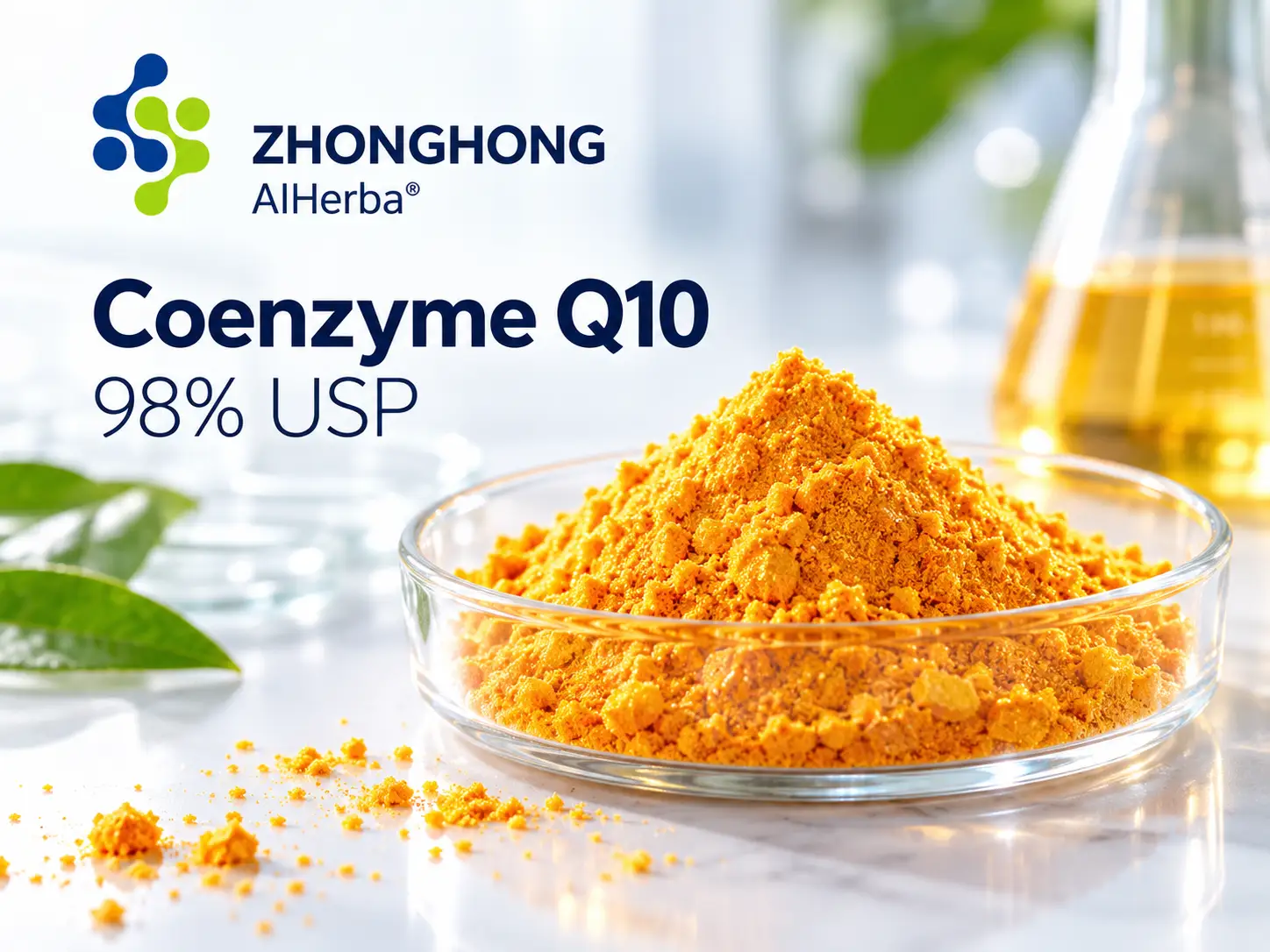
| Material form | Yellow-orange crystalline powder |
| Source declaration | Microbial fermentation, subject to source-document verification |
This product page concerns Coenzyme Q10 raw ingredient powder with a defined chemical identity and material grade.
03. Product Grades & Standardization
The supplied Coenzyme Q10 documentation specifies 98.0–101.0% assay on the anhydrous basis in line with the referenced USP monograph. This range reflects the defined assay specification, not an instruction to use 101% of the material in a formula.
DOCUMENTED: CRYSTALLINE POWDER
CUSTOMIZED FORMATS: BY FEASIBILITY
04. 12-Parameter Technical Specification Dashboard
This dashboard distinguishes target limits from the actual reference batch SZFQ260423, allowing purchasing and QA teams to screen material compatibility efficiently.
| Parameter | Specification / target | Reference lot result or status |
|---|---|---|
| 1. Identity | Coenzyme Q10, CAS 303-98-0 | IR identification: conforms |
| 2. Assay (anhydrous) | 98.0–101.0% | 99.6% |
| 3. Source | Fermentation origin | Declared in COA/TDS |
| 4. Appearance | Yellow-orange crystalline powder | Conforms |
| 5. Melting point | 48–52 °C | Conforms |
| 6. Sieve analysis | 100% pass 80 mesh; ≥90% pass 100 mesh | 100% / 94% |
| 7. Tapped density | 0.40–0.60 g/mL | 0.47 g/mL |
| 8. Water (KF) | ≤0.20% | 0.02% |
| 9. n-Hexane | ≤290 ppm | 1 ppm |
| 10. Methanol | ≤3,000 ppm | 22 ppm |
| 11. Ethanol | ≤5,000 ppm | 102 ppm |
| 12. Total aerobic count | ≤1,000 CFU/g | Below 10 CFU/g |
05. Microbial Source & Lot Traceability
The supplied TDS and COA describe the product as microbial-fermentation-derived Coenzyme Q10. The named origin is a declaration in the supplied technical file, not independent verification of the manufacturing facility. Buyers seeking a non-GMO declaration, fermentation route statement or audit records should review the supporting documents.
For traceability, match the proposed order to its production lot, manufacture date, packaging code, material release specification and country-of-origin declaration. Reference lot SZFQ260423 was recorded as manufactured on April 11, 2026; the COA was dated April 13, 2026.
06. Manufacturing Process & Quality Control
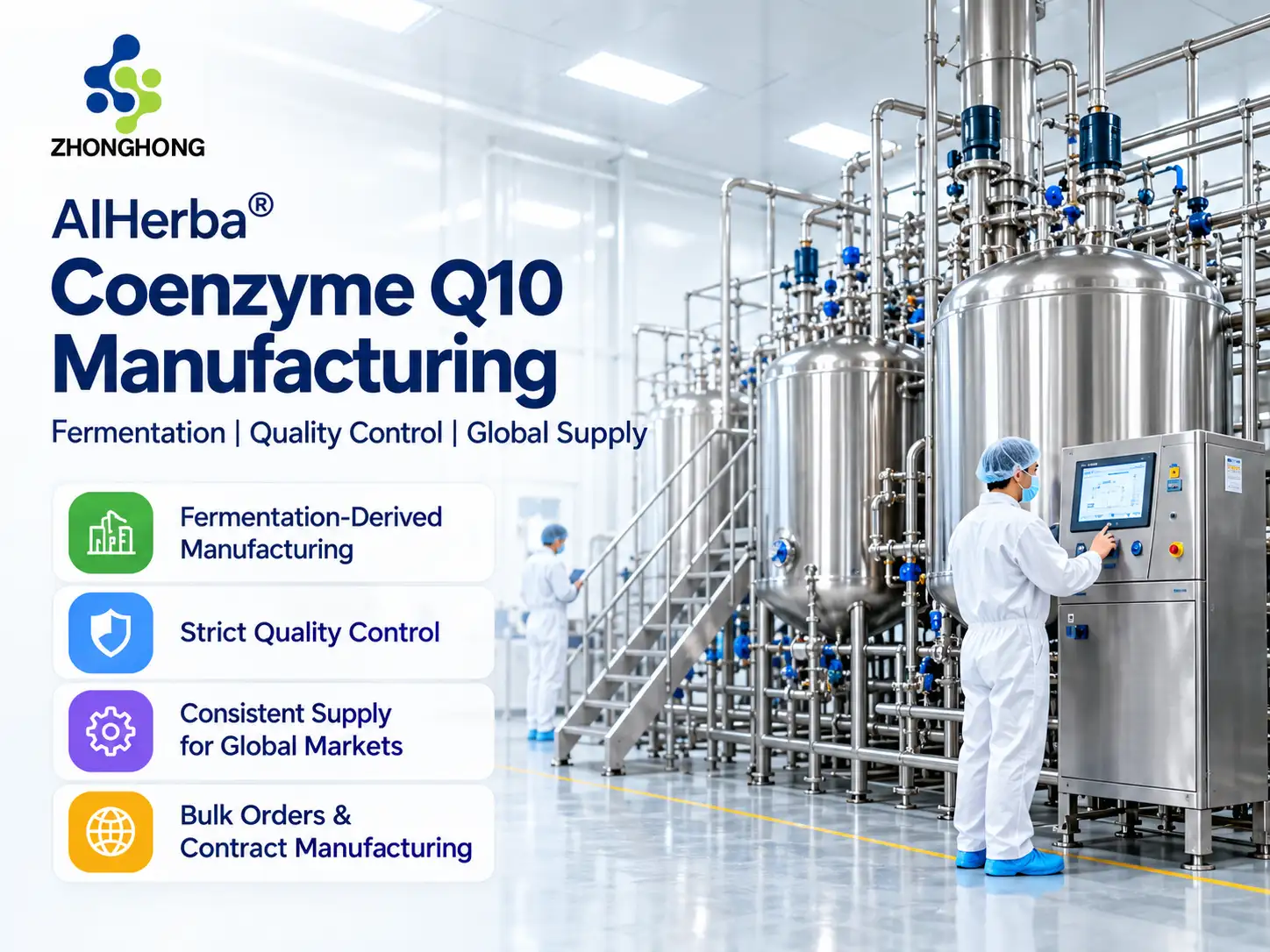
A typical fermentation-derived CoQ10 workflow involves fermentation, biomass/process separation, recovery, purification, crystallization, drying, sizing, analytical testing and protected packaging. The exact sequence, solvents and process validation parameters for this material must be confirmed by the responsible manufacturing QA team.
IN-PROCESS QUALITY
RELEASE QUALITY
07. Assay Method & Analytical Verification
Reference COA SZFQ260423 reports 99.6% assay (anhydrous basis) using a chromatographic method identified as USP <621>. IR identity is reported as conforming to the USP <197K> reference spectrum. In this context, chapter identifiers indicate test-method frameworks; the actual validated procedure and chromatograms should be requested when the customer needs method transfer or independent confirmation.
The supplied COA’s assay result must not be relabeled as an HPLC area-normalization purity percentage without reviewing the underlying procedure. Likewise, chemical isomer identification should not be claimed without appropriate source-specific evidence.
08. Chromatographic Fingerprint & Identity Evidence
Identity checks for Coenzyme Q10 differ from botanical fingerprint analysis. For this chemically defined active, buyers normally focus on retention matching, assay specificity, relevant isomer/related-substance control and orthogonal identification such as IR.
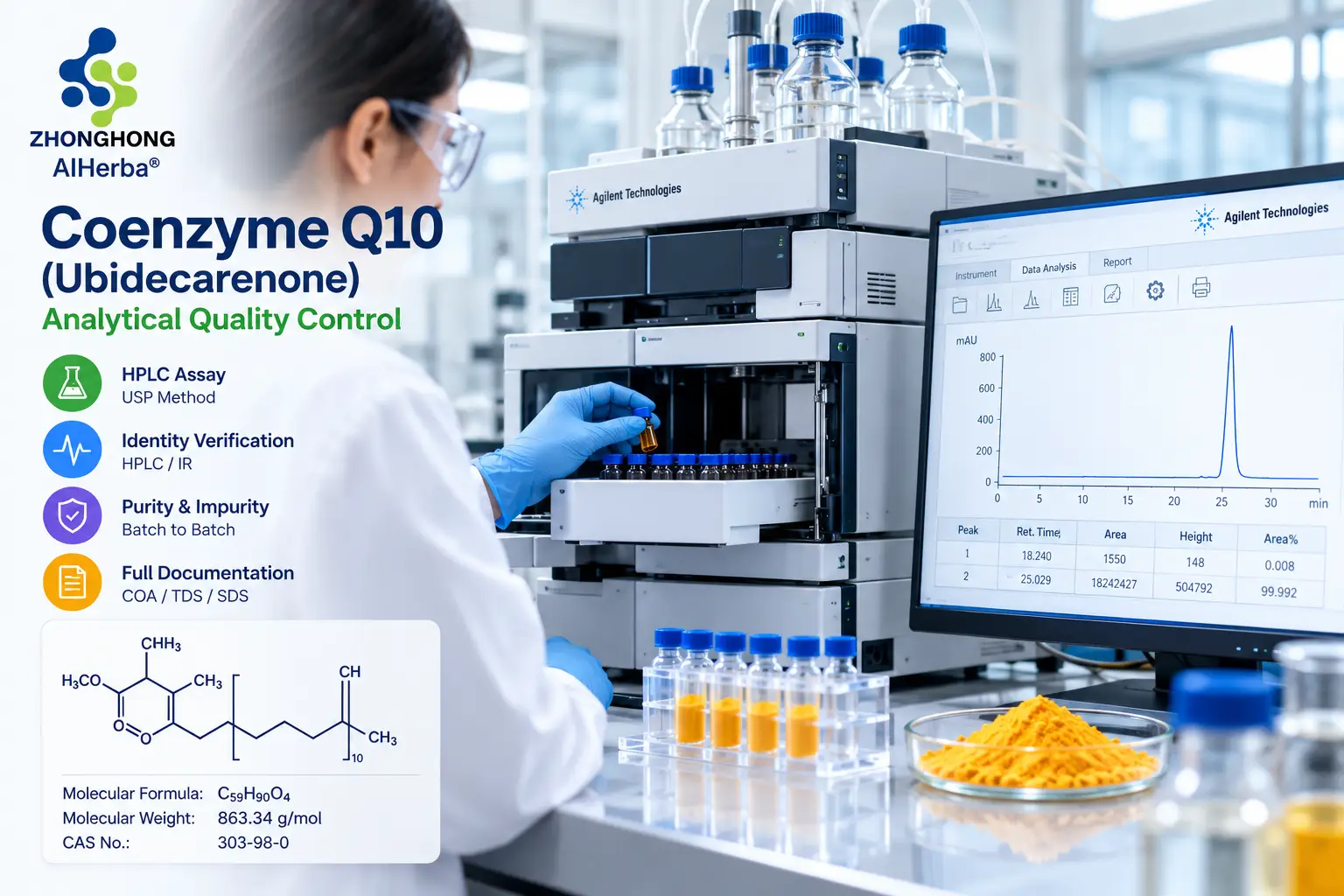
| Evidence type | What it supports | Commercial qualification status |
|---|---|---|
| IR reference-spectrum matching | Chemical identity confirmation | Reference COA reports Conforms |
| Chromatographic assay | Quantitative content determination | Reference COA reports 99.6% |
| 2Z-isomer / related substances | Isomer profile and analytical selectivity | Request signed method-specific report; not confirmed in the COA values supplied |
| Raw chromatogram / method details | Review of separation, integration and batch consistency | Available only after confirmation with QA |
09. Batch COA & Specification Matrix
The reference batch documentation supports a procurement qualification discussion, but the final shipment should be approved against a current lot COA and agreed specification rather than this historical example alone.
| COA checkpoint | Specification | Lot SZFQ260423 |
|---|---|---|
| Assay, anhydrous | 98.0–101.0% | 99.6% |
| IR identity | Matches USP reference | Conforms |
| Water (Karl Fischer) | ≤0.20% | 0.02% |
| Residue on ignition | ≤0.10% | 0.06% |
| Sieve analysis | 100% 80 mesh / ≥90% 100 mesh | 100% / 94% |
| Microbiological count | TAMC ≤1,000 CFU/g | Below 10 CFU/g |
| E. coli | Absent in 10 g | Not detected |
| Salmonella | Absent in 25 g | Not detected |
For buyer approval, request the signed batch COA, technical specification/TDS, applicable SDS, packaging information and additional reports tied to the selected lot.
10. Impurity, Residual Solvents & Safety Controls
Residual solvents and contaminants are important differentiators for pharmaceutical and premium nutraceutical procurement. The supplied COA lists specific limits and actual values for methanol, n-hexane and ethanol in reference lot SZFQ260423.
| Risk / parameter | Reported limit | Reference result |
|---|---|---|
| n-Hexane | ≤290 ppm | 1 ppm |
| Methanol | ≤3,000 ppm | 22 ppm |
| Ethanol | ≤5,000 ppm | 102 ppm |
| Lead (Pb) | ≤0.5 ppm | Below 0.5 ppm |
| Arsenic (As) | ≤1.0 ppm | Below 1.0 ppm |
| Cadmium (Cd) | ≤0.5 ppm | Below 0.5 ppm |
| Mercury (Hg) | ≤0.1 ppm | Below 0.1 ppm |
| Yeast & mold | ≤50 CFU/g | Below 10 CFU/g |
Evaluation should use the customer’s destination-market limits and written testing plan. A very low measured solvent value in one lot is not proof of a universal “zero residual” process.
11. Physical Properties, Particle Size & Solubility
Standard CoQ10 crystalline powder is lipophilic and practically insoluble in water. The reference material is yellow to orange; its reported tapped density is 0.47 g/mL, with 100% passing 80 mesh and 94% passing 100 mesh.
SOLID-DOSE COMPATIBILITY
OIL / EMULSION FORMATS
12. Formulation Applications & R&D Considerations
CoQ10 can be evaluated for supplement capsules, softgels, lipid-based preparations and selected cosmetic systems. Suitability is determined by the intended dose, ingredient concentration, processing temperature, excipients, oxidation/light exposure and product category.
| Finished-product format | Buyer / R&D qualification questions |
|---|---|
| Hard capsules and tablets | Powder flow, blending uniformity, assay during processing, compatibility with other actives |
| Softgels and oil-based formats | Carrier oils, CoQ10 solubility, precipitation at low temperature, oxygen and light exposure |
| Water-dispersible preparations | Type and proportion of carrier, dispersion performance, actual CoQ10 content, stability under intended processing |
| Cosmetic formulations | INCI usage, oil-phase compatibility, color impact, packaging and formula stability |
Formulation assistance is offered as technical evaluation, not as a guarantee of clinical efficacy or a finished-product regulatory claim.
13. Stability, Storage & Shelf Life
The supplied CoQ10 TDS states a 36-month shelf life when stored under the prescribed conditions. The COA recommends well-closed, light-resistant packaging and storage at not more than 25°C, away from heat and sunlight. Batch-specific expiry or retest dates must be checked at order time.
Stability requirements change with dose form and carrier. A solvent-solubilized or emulsified preparation does not automatically inherit the crystalline powder’s shelf life. Buyers should request applicable real-time or accelerated evidence for the proposed grade and finished-product process.
14. Regulatory, Certifications & Market Qualification
The USP Ubidecarenone monograph provides an assay definition of 98.0–101.0% (anhydrous basis). Compliance with a chemical specification is separate from establishment-level GMP certification and from country-specific authorization for dietary supplement, food, cosmetic or pharmaceutical uses.
For supplier qualification, review the applicable manufacturing facility certificates (with validity dates and scope), any required food-safety programs, origin and allergen declarations, non-GMO status evidence, SDS and country-specific import requirements. Do not assume that a generic “USP grade” description independently verifies a site audit.
15. Bulk Manufacturing, MOQ & Packaging
AIHerba® supports commercial CoQ10 procurement inquiries and can review manufacturing schedules, packing options and requested delivery terms. The supplied TDS lists 20 kg and 25 kg fiber drums with protective PE bag liners as packaging options; current supply and minimum order requirements must be reconfirmed.

| Commercial parameter | What procurement can request |
|---|---|
| MOQ | To be confirmed for selected grade / order size |
| Sample quantity | Evaluation sample subject to availability and agreed shipping arrangement |
| Packaging | 20 kg / 25 kg drum options as listed in TDS |
| Bulk capacity | Confirmed against production schedule; historical lot size does not equal stock |
| Lead time | Quoted after stock/production and packing check |
| Trade terms | EXW / FOB / CIF / DAP or other agreed Incoterms as available |
| Wholesale pricing | Quotation for 1 kg / 10 kg / 25 kg / 50 kg or forecast volume; availability by tier |
Please share the annual forecast and first-order quantity for a realistic factory quotation rather than relying on an unverified generic per-kilogram price.
16. Coenzyme Q10 Grade Comparison & Alternatives
| Ingredient format | Primary considerations | Evidence required |
|---|---|---|
| Crystalline CoQ10 powder (documented) | 98.0–101.0% anhydrous assay; defined sieve and residual-solvent controls | Current-lot COA, assay method, particle data |
| Micronized CoQ10 (to evaluate) | Particle-size reduction changes flow, handling and potentially dispersion | D10/D50/D90 and assay/stability after milling |
| Oil-dissolved / softgel premix (to evaluate) | Carrier identity, CoQ10 concentration, crystallization risk | Composition, solubility and stability report |
| Water-dispersible / encapsulated (to evaluate) | Carrier content and performance differ from crystalline powder | Active-content basis, pH/temperature dispersion data, excipient disclosure |
| Ubiquinol (separate molecule / product) | Reduced form with different stability and handling requirements | Separate specification, COA and regulatory review |
17. International Buyer Qualification Checklist
A procurement-ready request should specify the material, analytical acceptance criteria and logistics needed for production qualification. Use the following checklist to reduce unnecessary quotation revisions.
Attach a draft specification or a competitor COA only if you have the right to share it. AIHerba can then assess material matching and document availability.
18. RFQ, Samples & Commercial Quotation
Ready to qualify Coenzyme Q10 for an upcoming formulation or bulk order? Send your target specification and required quantity. The technical team can review an appropriate reference sample and batch documentation, and commercial staff can respond with available quotation terms.
QUALITY / R&D REQUEST
PROCUREMENT / PRICE REQUEST
19. Procurement FAQ — Coenzyme Q10 Manufacturer & Bulk Supplier
Answers to common factory-price, batch-release, formulation and global shipping questions.
Can you provide a current-batch Coenzyme Q10 COA?
Yes, request the proposed lot and specification with your RFQ. A reference COA for SZFQ260423 is available for review, but the shipment must be qualified against its own batch records.
What is the documented assay specification?
98.0–101.0% of Ubidecarenone on the anhydrous basis. Reference lot SZFQ260423 reported 99.6%.
What is the MOQ for CoQ10 bulk powder?
MOQ depends on grade, production availability and packaging. Provide the initial order and annual forecast for confirmation.
Is this grade water-soluble?
The documented crystalline powder is practically insoluble in water. Water-dispersible or encapsulated systems require separate composition and performance validation.
What mesh size is documented?
For reference lot SZFQ260423, the COA lists 100% passing 80 mesh and 94% passing 100 mesh. Finer D90 requirements must be evaluated separately.
Do you offer 1 kg, 10 kg, 25 kg and 50 kg pricing?
You can request all four quotation tiers. The price, availability, pack size and shipping quotation are confirmed case by case.
Can you supply GMP, USP or regulatory documentation?
The product specification follows the referenced USP Ubidecarenone assay definition. Manufacturing certificates, actual site scope and market-entry documents must be supplied and verified separately.
How fast can you ship internationally?
Lead time depends on stock, production, packaging, logistics service and destination import clearance. The quote will distinguish dispatch and transit estimates.
How do residual solvents compare with the specification?
Reference lot SZFQ260423 reports n-hexane 1 ppm, methanol 22 ppm and ethanol 102 ppm, each below the COA-specified limits. Obtain current-lot results before approval.
Can I use the same CoQ10 powder for gummies or beverage applications?
Only after formulation testing. The standard lipophilic powder is not an instant-dissolving beverage grade; gummies and liquids require compatibility and stability assessment.
20. References, Analytical Scope & Technical Disclaimer
This page summarizes the provided AIHerba® Coenzyme Q10 COA (reference lot SZFQ260423), the Coenzyme Q10 TDS dated May 20, 2026, and the official USP Ubidecarenone monograph. Reference data describe the corresponding documented lot or technical target and may not apply to future lots or different ingredient formats.
Factory-Direct Coenzyme Q10 Inquiry
Send product grade, assay and particle-size requirements, sample request, first-order quantity, annual forecast and delivery country. Request an up-to-date COA and quote before placing a purchase order.
Documentation, testing, samples and DDP options depend on the selected grade and destination.